Showing posts sorted by relevance for query bicycle. Sort by date Show all posts

Tuesday, August 14, 2018

Thomas. The Magician.

This throw-out card is about as plain as you can get on the face of it. It doesn’t fool around, it gets right to the point. “Thomas. The Magician.” It does however have several things about it that make it a little extra special.  It says that Thomas is from Canton, PA and it states that “Entertainments Given at Reasonable Rates”. It further states “Illusions Skilled in the Mystic Art”.

What is really interesting is that the ad for Bicycle is different than the usual statement of “When you play with BICYCLE you hold GOOD PLAYING CARDS”. On this particular card it reads, "This is a sample of 'BICYCLE' Playing Cards. It pays to buy 'Bicycles' because they wear best, and are so satisfactory in appearance, finish and dealing and playing qualities. Sold by dealers every-where from Greenland to Australia."


Bicycle Motorcycle No. 2 Back.


On the reverse of the card is the Bicycle Motorcycle No. 2 back. This is the only throw-out card in my collection issued by Bicycle with this variant back. Bicycle issued this back design in 1914, so we know it cannot be earlier than that.


Trying to find out who this Thomas was has been a real interesting adventure! When trying to locate the name Thomas in my usual resources, I came up with too many people. I then tried the city Canton, PA and found just a couple of ads in different magic magazines in which Thomas was selling a few things. An ad in The Sphinx for December of 1910 said this.


  This still did not tell me more of his name, until I found one ad in Mahatma for July of 1901.

Now I had some initials, but nothing more. The magic resources were now at an end. So I went to Find A Grave and looked up D. H. Thomas for Canton, PA. I found a listing for a Delos H. Thomas buried in Canton, but was he our magician? I did find out that Delos Thomas was a veteran of World War I, as there was a marker for this next to his gravestone. Besides his name, there are just the dates 1883-1955.
 
I then thought I would look him up on the resource I have for newspapers for up-state New York. I figured it was worth a shot. As it turns out, Canton, PA is not that far from Elmira, NY and I found 37 references for a Delos H. Thomas in the Elmira newspapers. There was a Canton column that was like a society column relating the latest news of the citizens of Canton. We were able to read that Delos went to a banquet with a friend. Another time he spent a day “fishing for pickerel on Towanda Creek”. In 1916 it was mentioned that Delos and a group of people “were motor visitors to Troy on Sunday”.
Elsewhere, in the 1907 Bradford County Pennsylvania Directory for the Canton Borough, it said that Thomas was working as a clerk. Delos Thomas’s obituary was found in the Elmira NY Star Gazette for March 7, 1955.
 
Well, was Delos Thomas a magician? Was he the subject of this post? At the bottom of the references to Thomas on the database I was looking at, I found this in the Elmira NY Morning Telegram for June 4, 1905.
 
Then on May 8, 1914, this appeared in the Star Gazette in Elmira.
 
Trying Ask Alexander one more time, I was able to find this one entry in Mahatma for March of 1903.
There we have it. It took a lot of sleuthing but I was finally able to confirm that Delos H. Thomas was the one time amateur magician who produced the above throw-out card with the really cool Bicycle back. Maybe more will turn up on Mr. Thomas in the future. Maybe too, there are more Motorcycle No. 2 cards out there! 

Thursday, July 20, 2017

Holding Even More Good Bicycle Cards

Elsewhere, we have written about the United States Playing Card Company's promotional campaign for Bicycle cards, often employing the catch phrase "When You Play with Bicycle, You Hold Good Cards."  The campaign proved a boon for vaudeville-era magicians seeking free or subsidized promotion for their acts, and more indirectly, to modern-day collectors of these pasteboards.  Well, our good friend Jay Hunter, inspired by this historical effort, assembled this stunning array of such cards, representing a broad assembly of Bicycle card backs.

And, another buddy, Lee Asher, offered his considerable knowledge to identify the backs designs. According to Lee, they are as follows:


ROW 1 (Left to Right) - Lotus Back, Racer Back, Cyclist No. 2 Back

ROW 2 (Left to Right) - All Wheel Back, Acorn Back, Cupid Back

ROW 3 (Left to Right) - Sprocket No. 2 Back, Wheel No. 2 Back, New Fan Back.

Additionally, Lee advises, several of the backs are uncommon specimens, in particular the Cyclist No. 2 and the Sprocket No. 2.

Of course, the fronts are equally engaging, if not as colorful, depicting advertisements from nine different magicians, none of which have yet been covered here at Propelled Pasteboards.  You can see the faces below.  While the individual performers may be worthy of further comment (by way of example, I have assembled several other pieces and some information about De Jeu, Max Terhune and Professor Lindhorst), several of these are little-known performers about whom no information may exist other than that depicted on these fine collectibles.

However, these images are worthy of further examination.   The assemblage tells us a little more about the Bicycle promotional campaign, not only by the backs depicted, but also the ad copy on the faces.  Most of them bear some variation of the "hold good cards" theme.  Yet take a look at the detailed description on the Harry Kane card, which is very different than that usually encountered on these pieces.  Moreover, the Bicycle promotional text runs vertically along the side of the Hiestand card, while the normal positioning of this text is usually horizontally along the top of the card.  Finally, the Max Terhune card features a more specific endorsement relating to his use of Steamboat and Bicycle cards, along with the standard text.  Each of these differences are likely clues to the date the cards were printed, and may provide further insights.


Many thanks to Jay for sharing this wonderful assortment with us.

And before leaving the world of Bicycle throwing cards, here's an image of the 1905 Annual Report of the Commissioner of Patents in which USPCC first registered the "hold good cards" slogan, along with some others:


Sunday, March 10, 2019

Jack Burch – A Bicycle Mystery

I really enjoy finding new throw-out cards that utilized the free promotion that was offered to magicians from Bicycle Playing Cards. In exchange for the ad on the front of the card that proclaimed how good Bicycle Cards were, the magicians could get the cards made up for free. This card for Jack Burch caught my eye as the wording was a little different than what I was used to seeing.
 
In place of the phrase “When you play with BICYCLE you hold GOOD PLAYING CARDS”, this card states, “Bicycle” “Playing cards possess peculiar points of merit not found in other makes at the same price. Their playing and wearing qualities are unequaled. Insist on having “Bicycles”. “They are the best”.
The back of this card remains a mystery however. It is gone. It is not that there is scrapbook residue covering the back. The back is just not there. Evidently this card was glued in a scrapbook, and when it was removed, the Bicycle back was left behind. It is a shame too, as I feel this card is a very early example from the Bicycle promotion. The era in which Jack Burch performed leads me to believe this.
From The Sphinx for July of 1902.
Below is a short bio on Burch which appeared in The Sphinx for November of 1902. His name was John G. Burch, but in reality his last name was Burcy. He went by “Jack”. Besides the bio, he was also featured on the cover of the magazine.
In the first ten years of the Twentieth Century, I found several references to Burch, and good reviews, in the magic magazines and newspapers of that era. An odd item I found in The Sphinx for June of 1904 was a notice that Burch had declared bankruptcy. I thought that this was an unusual thing to print in a magic magazine. This is where I found his real last name.
Occasionally Burch ran ads in The Sphinx for items that he had for sale. In September of 1906, he was offering Harry Kellar’s “Blue Room” Illusion for sale. If he really did have Kellar’s original apparatus as he said he did, you would think he would have avoided misspelling his name as Keller. Twice!
Kellar ad from the Boston Globe for May 18, 1897 and The Sphinx for September, 1906.
After 1910, references to Jack Burch seemed to stop. The only thing I did find was an item from The Sphinx in February of 1917, in which W. J. Hilliar was quoted as saying, “Do you remember – When Jack Burch was a magician?” Like the backside of his throw-out card, Jack Burch just vanished…
From the Louisville Courier-Journal for January 6, 1901.

Friday, December 16, 2016

"When you play with Bicycle, You hold Good Cards"


The rise of color lithography during the golden age of magic proved a happy accident for collectors of fine, classic magic posters.   For throwing card enthusiasts, the rise of vaudeville stage magic during an explosion in playing card production around the turn of the 20th Century created a similar synergy. 

By the late 1800s, new printing technologies and methods brought about great improvements in the quality of playing cards.  The formation of the United States Playing Card Company in 1894, which soon acquired several other major manufacturers, created a worldwide industry leader. Beginning in approximately 1900, the Company embarked on a number of aggressive marketing campaigns, registered numerous trademarks for its new designs and slogans, offered free window displays to retailers, and invested heavily in national print advertising.

As part of US Playing Card Co.'s promotion of its products, the company hit upon an unusual idea: it offered free, custom-printed advertising cards to stage magicians.  Each card featured one of the Company's prized back designs, plus a slogan promoting Bicycle cards on the face.  The balance of the face was devoted for space featuring images and text about the magician.

"For a number of years, in the early part of this century, the United States Playing Card Company, and other manufacturers of playing cards would print a quantity of cards gratis for any magician requesting them." John Mulholland wrote in The Sphinx in June 1944.  "The playing card companies’ generosity to magicians to distribute cards bearing advertising of their products on one side of the cards."

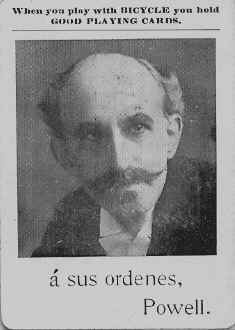
It proved a brilliant means of cross-promotion.  Some magicians scaled the cards into the audience, ensuring that the Company's samples would be caught -- and often kept -- by eager audience members.   The results is that dozens of magicians, including some top names in the field, such as T. Nelson Downs and Frederick Powell, had Bicycle brand throwing cards printed.  (On another magic site, collector Jay Hunter put together a collage of nine different back designs that appear on Powell's cards.)  Bicycle cards also feature relative unknowns, such as ventriloquist/magician Ned Frailey.


US Playing Card Co. Ad from Life, February 1901

Each of the Bicycle cards are imprinted with the slogan "When you play with Bicycle, You Hold Good Cards," or some slight variant of this slogan.  The use of this slogan helps date these cards quite specifically.  Searching through various databases, it appears that U.S. Playing Card registered this slogan in various trademarks and used it in print advertising from 1900-1905, like the ad seen here.   This suggests that any throwouts bearing this slogan date from this around period.

It's worth noting that several other playing card companies employed a similar strategy, including Golf Playing Cards and the Canadian Playing Card Company.  In fact, one promotional card touting "National" and "U.S." playing cards as the best could well be considered the scarcest throwing card of all: its face features a young and not-yet-successful Harry Houdini as a magician offering instruction in sleight of hand.   (A very small image of this card can be seen in Ricky Jay's book Cards as Weapons, which is also a scarce collectible).

 "Throw-out cards should have great publicity possibilities," Mulholland concluded, "but in the past
most of the cards have either been poorly printed or carried designs which were inartistic and were printed from cheap cuts. Except for Thurston, and one or two others, the printing was never in colors. With the proper layout and pictures, good printing, and in colors, one good stock, throw-out cards might once again regain their usefulness as good advertising for magicians, and souvenirs the public would cherish."

Mulholland's critique has particular application to the playing card company promotional cards: designed primarily to sell decks, not magic, these pasteboards feature luscious back designs, but the fronts generally offer grainy photos and splotchy printing.   Nevertheless, they are highly collectible and interesting souvenirs of a bygone era.

To learn more about the importance of back designs in the study of throwing cards, check our Back Story page


 Readers interested in lithographic posters can find lots of great information and images at Ken Trombly's magicposters.com and Charles Greene's site, magicpostergallery.com.

Tuesday, February 6, 2018

Lindhorst - Two Magicians, One Name

This is about two magicians, Will Lindhorst and his cousin Charles Lindhorst.  Both men were from Saint Louis, Missouri and both left their mark on magic.

The Bicycle backs from left to right are:  Cupid back, Cyclist No. 2 back, and New Fan back.

William L. Lindhorst was born on April 22, 1890 and became interested in magic by the age of eight. During 1911-1912, Will worked as an assistant to Howard Thurston who taught him much about stagecraft and showmanship. Thurston evidently thought so highly of Will that there was talk at one time of Lindhorst heading one of Thurston’s road companies. He entertained the troops during World War I, and was a charter member of the St. Louis S.A.M. Assembly in 1921. He was also a long time member of the I.B.M. ring in that city.

From "The Linking Ring" for April 1929
Lindhorst was known as a magician, illusionist, author, inventor, and manufacturer. For many years he operated a magic shop at various locations around St. Louis. He also was known as “Chandu the Magician” when it was popular as an early radio program. Another title for Lindhorst was as “The Magic Piano Salesman” selling pianos for the Baldwin Piano Company and utilizing magic as part of his selling of the pianos.
The Bicycle backs from left to right are:  Wheel No. 2 back, New Fan back, and Rider back.


Will Lindhorst incorporated his various endeavors such as Chandu, piano salesman, box office man, and his magic shop into producing many throw-out cards with the different vintage backs that Bicycle had to offer.
Will Lindhorst was well known and a well-respected member of the magic community for decades. Will passed away on March 7, 1954 at the age of 63 in his native St. Louis.

Will Lindhorst’s cousin Charles W. Lindhorst also had a long involvement in magic though maybe not quite as well-known as Will.  While I found several references to him over the years in the magic journals, there is very little about him of a personal nature. I could only find one Charles W. Lindhorst on “Find-A-Grave”. As it was for a man in St. Louis, it may be him. It said that he was born on June 23, 1893 and died on April 12, 1971 in St. Louis. This does differ however from his brief “Magicpedia” entry. It was this entry by the way that says the two Lindhorsts were cousins.
Charles was a long time member of the S.A.M and is best remembered as a manufacturer and craftsman of magic apparatus.  To those in magic who are familiar with the late Danny Dew and his abilities as a producer of fine magic apparatus, it should be noted that Charles Lindhorst not only tutored Dew in the performance of magic, but taught him the skills needed to become the renowned manufacturer that he became.

The Bicycle backs from left to right are:  Automobile No. 2 back, Expert back, and Rider back.
 
I have three throw-out cards for Charles Lindhorst and as with Will they have some early Bicycle backs. After acquiring all of these different Lindhorst cards, it took me a little while to figure out who was who, and to separate these two men.
One thing I know for sure. They both had some fantastic throw-out cards!

Thursday, March 16, 2017

It's T. Nelson Downs's Birthday!


The Bicycle "Expert" Back (1895)
 While working as a railroad telegrapher in Marshalltown, Iowa, T. Nelson Downs (1869-1938) passed the long, lonely hours teaching himself sleight of hand using coins. The time was well spent -- Downs mastered the art, becoming one of the greatest manipulators of all time. He developed an act in which dozens of coins seemingly materialized at the performer's fingertips. Down's act, dubbed "The Miser's Dream," was the first major advance in coin magic in nearly a century, and is still used by many magicians.

Tuesday, August 21, 2018

Dana Walden – On Pins and Raisins

About a year ago, Judge Brown had a post entitled “Holding Even More Good Bicycle Cards”. Included in the post was an assortment of Bicycle cards of nine different magicians. This post is about one of them, Dana Walden. The two examples in my collection have slightly different wording on the face of the cards in reference to holding Bicycle Playing Cards.
The reverse of these two cards show a couple of early Bicycle backs. The card on the left is the Wheel No. 2 back first released in 1907. The card on the right is a Sprocket No. 2 which came out in 1905.
According to an interview Lorenzo Dana Walden gave to The Sphinx in May of 1915, he said that he was born on October 16, 1885 in Syracuse, New York. Walden was able to do something that many of us that are interested in magic wish we could have done. He got to witness a performance by Alexander Herrmann, “Herrmann the Great”, when young Walden was seven years old. He was so impressed, that he decided that becoming a magician was in his future.
The Sphinx for September, 1906
When the Lyceum and Chautauqua magician Edward Maro passed away in 1908, Walden stated, “I filled the remainder of his season at Alkahest (Lyceum), Georgia”. A bio I found on Maro however, claims Eugene Laurant took Maro’s place on the circuit.  Further research leads me to believe it was two different entertainment bureaus in which these two magicians acted as replacements. Walden however, did go on from there to become a well-known and admired magician himself on the Lyceum and Chautauqua circuits.
Walden was mentioned in the magic magazines of his time for many years. In February, 1910, Walden wrote that “he has cut his show from a dozen trunks to two only, and is giving a better show”…”and greater satisfaction to his Lyceum audiences than ever before”. In 1922, T.W. McGrath writing in The Sphinx stated, “We never tire of Dana Walden, and his act is an inspiration, and no one we have ever seen has as much real magic at his finger ends as our Walden on the stage”.
From The Sphinx for August, 1915
Walden also marketed some of his magic effects, including a version of Houdini’s Needle Trick, in which a number of sewing needles, together with some thread is swallowed and then, the needles are pulled from one’s mouth strung on the thread. Walden called his trick, “Supper of Pins”.
Ad in The Sphinx for March 15, 1920.
One really interesting story about Walden is that for a period of time from between 1916 and 1918, he gave up magic in order to buy a ranch in California to grow grapes… to be made into raisins! By July of 1918 however, the ranch was sold, and The Sphinx reported that Walden and his wife “will return to the stage”. Dana Walden went on to live until sometime in the 1930’s. I have not been able to find his exact date of death.
“Herrmann the Great” inspired a lot of magicians in the early part of the twentieth century, and many went on to uphold his standards when it came to pleasing their audiences. It sounds like Dana Walden was one of those magicians. Here is a final comment from The Lyceumite and Talent magazine from 1912.
 

Monday, July 3, 2017

De Weird –The Great Mystifying Wizard


James Thomas Riley Weir was born on October 19,1885, in Martin’s Ferry, Ohio. His father, James and mother Elizabeth, and the family moved to a home on Carey Alley in Pittsburgh. Three years later, James’ father passed away. A year later, young James’ twin brother Sylvester passed away. By the age of fourteen, James, along with his older brother and sister, took on the chores around the house. When James was fourteen, he got a job as an elevator boy in town. He had been performing small magic for the school he went to as well as other small shows.

The back of this card is Bicycle's Chainless #18 design.

            In 1906, he played a week in Altoona at a local venue featuring his skills as a magician and escape artist under the name of Professor James De Weird. He married Elizabeth Miller in 1907. James worked in a pet shop as a salesman while practicing his magic for customers. By 1914, he was a member of the Pittsburgh Association of Magicians where he was elected to the office of Vice President. His fellow performers enjoyed his skill and James was always trying ideas out on the members to hone his abilities. His forte and expertise was in escapes from handcuffs.

The back of this card is Bicycle's Mobile #2 design.

This is James Weir's WWI draft card.

The back of this card is Bicycle's Latern #2 design.


Some of the other members included George Wanner, Silent Mora, Copenhagen Paul, Charles "Baffles" Brush, Jack Gwynne, and Harry Rouclere. By 1918, James was nearly thirty-three when he registered for the draft. He was working as a salesman for a local pet shop on Smithsfield Street in Pittsburgh. James continued to perform at ladies clubs and local fraternity organizations for many years. In 1940, James claimed to be employed as a salesman at a Bird Seed Store. One of the last reports found was in 1942, where James was employed to entertain at a senior woman’s club in Pittsburgh. 

The back of this card is Bicycle's League #35 design.

This is James Weir's WWII draft card.


His last non-magic-related employment was as a night watchman. I received an email from a relative of James, or as she remembered him as "Uncle Jim." Evelyn mentioned, "...that he entertained all of us kids at family gatherings; he was the delight of our lives." James Weir passed away on August 17, 1951, and is buried Saint Michael's Cemetery in Allegheny County, Pittsburgh, Pennsylvania.


Thursday, March 30, 2017

Bamberg, the Elusive Mr. Heir and the Triple-Promotion Throwout Card


Some time ago, when Tom published this terrific post about Theo Bamberg a/k/a "Okito", I wondered about the odd layout and language on the card reproduced here.  Why the empty space between the Bicycle Playing Cards banner and the "Free Trick" text below that?  At first I thought perhaps it was part of a trick that the card would be used for, but that didn't feel right.   And when it says "I can recommend The Bamberg Magic & Novelty Company," who is this mysterious "I"?

We have, of course, written elsewhere about the Bicycle Playing Card promotion offering free throwout cards to magicians,  In years of research, though, I have never found a specific reference to the arrangement, other than a mention by John Mulholland.   And, certainly, we've covered a throwing card hawking the Tarbell Course, as yet another form of cross-promotion.   But the layout of this Bamberg card proved curious.


Then, fortuitously, I came across an eBay auction for another card, advertising what is presumably a magic show called "Wonderland" starring someone named George (using the quaint, largely obsolete abbreviation "Geo.")  Heir.  The card, which sports a US Playing Card Company 808 back, answers certain questions about Tom's Okito card.   Heir's card features largely similar text about Bamberg Magic and the Bicycle Playing Card marquee, but also has the photo and text for Mr. Heir overprinted within that mysterious space.  So Bamberg must have sold or given cards like the one seen above as "blanks" to performers seeking to pitch their shows, who would overprint the cards with an image or additional text in the empty space.   So this card, from an advertising perspective, is a triple-threat: it simultaneously promotes Heir's show, Bamberg's shop and Bicycle cards.

In fact, this card also provides some evidence of something I've suspected for a while: it may be that US Playing Card distributed the cards printed with their backs and the "Hold Good Cards" banner, and performers were required get the fronts printed elsewhere.  If this theory is correct, it would account for the vast differences in the quality of printing between the beautiful backs of these cards and the often abysmal imaging on their faces.

Even assuming that this card provides a clue to this production mystery, it raises a new question. Who in the world was George Heir?  So far, my research has turned up an absolute blank on him.  So like Stincel, he may remain a man of mystery. . . .


Oh, and before we bid farewell to Mr. Bamberg, Gary Frank brought this piece to my attention.  It's a sticker, playing card sized, that he could use to convert a blank (or presumably even a printed) card into an advertising piece.  And Gary raises a very interesting question: do you think Bamberg got a discount on these given that they misspelled his name?

Tuesday, December 13, 2016

Professor Agoston – The Swiss Enigma


This particular card is for Professor Ernst G.A. Agoston (Ernst G.A. Schifferdecker), a wonder worker born in Berne, Switzerland October 11, 1872, who immigrated to America and became a very popular card and platform magician in the late 19th and early 20th centuries.


According to a personal write-up in February 1920 issue of The Magic World, Agoston began performing magic at age 12 appearing before the Swiss public as a “Boy Wonder.” He was reportedly following in the footsteps of his uncle, the famous Chevalier Agoston, who toured the continent extensively from 1860 to 1885.


Agoston indicated he himself toured most of the principal cities in Europe and toured South America from 1888 to 1891 with the Rodriquez Brothers Circus. In 1891, he came to the U.S. on a four-masted schooner landing in Florida and later became a citizen. On September 11, 1893, he married Maybel C. Wilson in New Castle, Delaware and they had two daughters, Matilda (June 2, 1900) and Virginia (April 22, 1905). In August 1920, Maybel passed away.

With the outbreak of the Spanish American War, Agoston enlisted August 12, 1898, and joined as a Private in the Second Pennsylvania Infantry. He served only until October 25, 1898, when he was discharged for medical reasons. The injuries he suffered during his four-month enlistment plagued him for the rest of his life.

He operated his own Vaudeville agency and entertainment bureau in Philadelphia from 1904-05, and then returned to playing professional engagements exclusively in drawing rooms, private clubs and the homes of the wealthy. He relocated to Chicago and throughout the 1920s entertained the city’s top family like the Wrigleys, Armours, and others. On December 11, 1921, he married again, this time wedding Rose Dennison of Chicago.

He was best known for his original blindfolded Demonstration of Mental Telepathy. When he wasn’t performing he worked at the Chicago magic firm of B.L. Gilbert, 11135 South Irving Avenue doing general office work, demonstrating magic and illustrations. He was apparently a talented pen and brush artist and reportedly helped Gilbert publish a book “Card Effects Without Apparatus” which featured some of his original card effects. He also performed Kellar’s Growth of Flowers as shown in the accompanying photo which is inscribed to Dr. A.M. Wilson, editor of The Sphinx.


Agoston was an early member of the I.B.M. being #21. At the time he joined he lived at 1814 Howe Street, Chicago. He was also a member of the National Conjurors Association as reported in the February 1923 Sphinx.  

Beginning in the late 1920s and early 1930s, Agoston’s war injuries ended him up in various military hospitals for years at a time including the U.S. Veteran’s Hospital in Dwight, Illinois. He apparently suffered from lung-related issues. The Billboard for October 4, 1930, reported that he was hospitalized with an abscess on his left lung which had placed him in the hospital since 1927. By December 1930, he was back working clubs in Chicago doing card tricks while blindfolded.

Eventually, his ill health or age caught up with him and he died October 15, 1932, at age 60. He is buried at the Sunset Cemetery in Quincy, Illinois. His two daughters lived to old age, Matilda passing away in 1985, and Virginia in 1983.


Bicycle Automobile No.2 back (c. 1913)


The scaling card (above) that Agoston left behind promoted him as “The Wizard With The Cards” and offered his Mental Telepathy act. For ten cents in silver interested parties could obtain his Magic Book and “Phantom Trick Cards.” The card also promoted Bicycle cards with the slogan, “When you play with BICYCLE, you hold GOOD PLAYING CARDS.”