Showing posts sorted by date for query Jay Hunter. Sort by relevance Show all posts

Saturday, December 24, 2022

SIX YEARS OF FLYING CARDS!


Analyzing 150,000+ Hits on Propelled Pasteboards' 6th Anniversary

Our own promotional throwout card  
out of print and now a collectible!


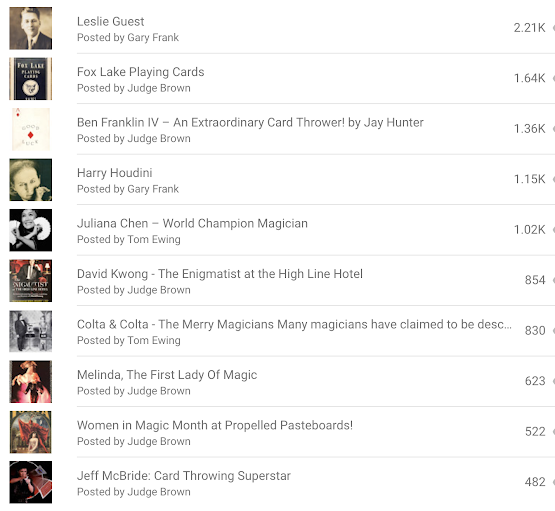
This month, Propelled Pasteboards marked its six year anniversary, having racked up more than 150,000 visits in that time.  So, it's time for our version of the "People's Choice Awards," finding out which posts attracted the most interest.  Some magicians who made our "Top Ten" list prove quite predictable, while others might just surprise you.  And you'll never guess who ranked #1.


The four writers who regularly contribute to Propelled Pasteboards - Tom Ewing, Gary Frank, Jay Hunter and me - have offered an astonishingly broad array of posts - 250 listings which encompass some of history's best known magicians to performers so obscure that they nearly defy our investigative research efforts.  And these listing have drawn well over 150,000 hits (some of our early data was lost to a conversion from http:// to https://).  In this post, I'll be examining those posts that have attracted the most hits.


Perhaps most predictably, Gary Frank's feature on Harry Houdini made the top ten list, with well over 1,000 visits.  Shockingly, however, Houdini did not place first!  More on that in a moment.  Other superstars closely connected with card throwing - like Jeff McBride & Juliana Chen - predictably placed on our top ten list.  (Ricky Jay did not make the cut, though several posts dedicated to him made the top 20 list.)  David Kwong, also placed high on the list, perhaps we used the opportunity to highlight his then-popular show, The Enigmatist.  Our salute to women in magic also proved quite popular, with both the "Women in Magic Month" post and articles on Melinda and Ms. Chen taking three of the spots.  Visitors also showed interest in the production of throwout cards, with posts spotlighting Fox Lake Playing Cards also making the cut, while a post about DeLand made the top twenty.  (Relatedly, we have two static pages on throwing cards and throwing card backs that racked up similar numbers, but don't get ranked on the top ten list as they're not "posts.")

Other posts that proved popular are more puzzling, as they feature lesser known magicians.  Jay Hunter's feature on Ben Franklin IV ranked third (with more visitors than Houdini), while Tom Ewing's terrific feature on Colta & Colta came in seventh.   But perhaps the biggest surprise is our top contender.  The number one, most visited Propelled Pasteboards blog post, indeed, the only post with more than 2,000 visits is . . .  [drum roll] . . . Leslie Guest!  This unanticipated placement remains unchanged from our analysis of hits when the site marked 100,000 hits.  Please don't misunderstand, at Propelled Pasteboards we pride ourselves on featuring magicians of all kinds, often celebrating obscure, mysterious and even unsuccessful performers that you won't find anywhere else.  Furthermore, Gary Frank's feature on Mr. Guest is thorough and interesting.   But that Guest would best Houdini, Thurston, Kellar and some of the other historic greats we've featured is something no mentalist could have predicted!  

But for the record, at this writing, this is . . .

Propelled Pasteboard's Most Popular Posts

The Top Ten List with Official Hit Counts


When you have time, check out these posts and some of our less popular pieces.  You won't be disappointed.

Wednesday, April 14, 2021

Jean De Jeu, the Wizard a/k/a Jean De Jen


Regular readers have already seen a card featuring De Jeu the Wizard, as part of Jay Hunter's assembly of Bicycle Promotional cards.  The custom card here features some additional details about this performer, who was clearly influenced by the unparalled success of Alexander the Man Who Knows.  In fact, when I picked this card up from Ray Goulet's collection in early 2017, I initially thought that De Jeu could be yet another stage name for Claude Alexander Colin, who performed under a number of names (including Astro the Seer) because of, among other things, many scrapes with the law.


But that initial impression was quickly dispelled through a bit of research.  Turns out Jean De Jeu (b. 1896) was a noted Lyceum performer and a formidible businessman.   Based on the styling and approach used on this card, he was clearly influenced by Alexander the Man Who Knows, who was, after all, quite the magic superstar.   According to Grdina, De Jeu changed his name to De Jen in or around 1921, due to concerns about anti-semetism.   And, indeed, the historical record bears this out -- by the 1920s, all references to this performer use the name Jean (and sometimes John) De Jen.

He worked as a stage magician throughout the 1920s, taking on the sideline of booking other acts. Several ads in periodicals reflect the fact the he bought and then sold entire magic acts and pieces, including Karl Germain's black art act.

While we often focus on the charming details of the performers featured here, not everyone adored De Jeu.  Here's what Stuart Cramer had to say about De Jeu, according to a piece reprinted in Magic magazine in 2003:


"I admired him as a magician, but intensely disliked him as a person. It probably harks back to the time I assisted him as a high school kid, at the 1930 IBM Convention in Fort Wayne, Indiana. I was surprised when I went to his apartment in Cleveland Heights to learn there would be no rehearsal, just a typewritten sheet of instructions. The act didn't come off well, and it earned me a blistering and embarrassing bawling out after the show. I hadn't even known how the Asrah worked until I was pushing the table offstage with Mrs. De Jen inside. I later overheard De Jen blaming some of his own flubs on "that fool of a new assistant." I was so incensed that I took the bus home." 

By 1930, in the height of the Great Depression, De Jen accepted a sales position with General Electric, ending his stage magic career.  After retiring from GE, he founded his own visual presentation company, Oravision, which marketed easels, podia and similar devices for public speakers.  In The Perennial  Mystics No. 2, James Hagy presents a detailed biography of De Jen's life and career.

Saturday, September 12, 2020

Propelled Pasteboards Surpasses the 100,000 Mark!

Blogger reports that after nearly four years, and more than 200 high-quality posts with beautiful illustrations, Propelled Pasteboards has garnered more than 100,000 views.   Pretty amazing for our little corner of the web.   Thanks to all of our readers for stopping by so often.   Please let your friends know to stop by and look around sometime.

Below are our dozen most popular posts at this time, along with the number of hits on that page, in descending order.  It's a wonderfully eclectic mix -- there is no accounting for taste.  Who would have thought, for example, that Leslie Guest would come in at number one, garnering more than twice the number of hits as Harry Houdini?  But each is special in its own way, and all are worth a second look.  

You can click on any of them to view the posting.  And please remember there are hundreds of other pages on the site, so make sure to look around a little!

Posted by Gary Frank
1.95K

Posted by Gary Frank
986

Posted by Judge Brown
742

438

Posted by Judge Brown
359

310

Posted by Tom Ewing
306

263

Perhaps I'll challenge my colleagues to do an "Author's Favorite" posting.  In the meantime, enjoy, and thanks for stopping by.


Judge Brown

Tuesday, February 12, 2019

Gene Keeney - "The Keen Genie"

My colleague Jay Hunter's posting on Jack W. Thomas, who appeared as the Frost Sugar Magician brought back pleasant memories of a friend and fellow magician, Gene Keeney - "The Keen Genie." I devoted quite a bit of space to him in my 1999 book, "Conjurors and Cornfields: Magic on the Indianapolis Stage." It chronicles all of the magicians and related artists who lived in Indianapolis, appeared there, or had some connection to the city. This is certainly true of Gene.

Gene was the first live magician I saw. He was performing at a local club, The Atheneum, and he did some great magic. He performed the thumb tie, stretched a glass of milk from a regular size to one two feet tall, did the egg bag, and much more. I was about 14 or 15 and he really sank the hook into me for my interest in magic.

His scaling card is cute and creative. It shows a bunny rabbit as the central image where the rabbit's ears form the "M" in magician and the "G.K" of his name the nose and hind quarters of the bunny. He used the tag line, "Don't Fool Yourself - That's My Business." The reverse side is a blue Foxlake back.


William Eugene Keeney was born August 6, 1915 in Indianapolis. A performer since boyhood, Keeney played state and county fairs around the Midwest, appeared in USO shows during World War II, and sold advertising in programs during the Dance-a-thon and Walk-a-thon crazes of the 1930s. He also printed the programs and made pretty good money.

When that craze faded he tried to interest the automobile stunt driver Earl "Lucky" Teeter into letting him sell advertising in the programs Teeter sold at his state fair appearances but Teeter was not interested. Instead, he wanted Keeney to join his organization and do a stunt involving driving a speeding car headlong into a brick wall. The stunt used two people, the driver and Gene. As the car hurdled toward the wall, the driver would jump out. Gene's job was to keep the car heading toward the brick wall and at the last moment, jump over the front seat and hunker down among some mattresses placed there. Upon collision, the engine would absorb most of the impact but would still come crashing into the front seat area. It worked pretty well in practice. Teeter's big act was shooting up a ramp and jumping his car over parked cars or a full-size bus lengthwise.

The weekend after Keeney's successful dry run of the brick wall crash, Teeter was killed when his engine misfired as it went up the ramp and instead of landing on the opposing ramp, his car crashed headlong into the ramp killing him. Gene took this as an omen and left the company for less dangerous work.

Gene was not done with stunt driving though as he performed blindfold drives around the state. Perhaps his most famous was at the Indianapolis 500 Racetrack in 1950 when he drove around the track blindfolded with track owner Tony Hulman and racing legend Wilbur Shaw in the back seat.

At one time he performed magic as part of a nationwide tour of the Amos n' Andy show. It was during this tour that he met Ed Sullivan at a nightclub and did some magic, picked his pocket, lifted his watch and greatly entertained Sullivan. Sullivan invited him to appear that next Sunday on his TV show but Keeney had to stay on tour.

Bottle and Glass tubes sported Kahn' labels
and used wieners and ketchup bottles instead. 

Keeney was best known as a representative for the Kahn's Meat Company. He traveled the country in a 35-foot trailer pitching Kahn meats using a magic-themed show that incorporated many of their products. He used the well-known boomerang optical illusion to stretch a Kahn's wiener longer than competing brands. He produced strings of wieners from an empty top hat. His finale was a P&L rosebush which first grew wieners and then real roses. The rosebush trick promoted the company's Red Rose line of meats. As each real flower was handed out to audience members, Gene affixed a Kahn's sticker to each stem. For many years throughout Indiana and the Midwest, the magic word for kids was not "Abracadabra" but rather "KAHN'S!!!"  I saw him perform many times at local supermarkets and he not only performed a great product-themed magic show, he also sold a LOT of Kahn products. 


At one time Gene also performed a ghost show when those theatrical production were popular. He did it with his son Robert. For seven or eight years he worked in sales promotion for Philip Morris in a magic show called, "Wonderful World of Fantasy." He put over 176,000 miles on his trailer and car during the tour.

Gene was very involved in the I.B.M. and was one of the founding members of Ring 10 (the first magic club I ever joined), and eventually the club was named in his honor. Traveling the country, as he did, allowed Gene to track down many magic collections and amass a gigantic hoard of interesting memorabilia. He called Bud Tracy's "Directory of Magicians" his "Bible," and used it to find magicians from whom he acquired great collectibles. He was a longtime member of the Magic Collectors' Association and sold magic from the trunk of his car outside of Magic Inc.

He was very kind to me and sold me many interesting items over the years. He was of greatest help by providing me access to his large collection of photos, letters, and other memorabilia relating to James "Harto" Harte and his wife Catherine. It allowed me to write the manuscript, "Two Harte's That Beat as One." He was a good friend, kind to magicians, a real salesman of the first order, and one of magic's biggest boosters.

(Note: If anyone would like a copy of Conjurors and Cornfields, I have a few left. It's 186 pages long with at least as many photographs and represents several lifetimes of collecting information on famous, near-famous and infamous magicians, circus performers, collectors, and others from Indianapolis and surrounding areas. The price is $15 and includes shipping.).  


Monday, January 28, 2019

The S.A.M. Match

Apologies for my recent absence from the blog but thanks to Jay Hunter and others for keeping the site fresh. I'm back with an interesting posting that falls in the general category of scaling cards although I'm certain that anyone who obtained a set of these cards would not scale them away into the audience. I speak of a special packet trick issued as a gift from Dal Sanders and his wife during his 2014 S.A.M. presidency. The set is shown below.
Shown are extremely well crafted playing cards featuring some of the more famous leaders of the S.A.M. as well as some well-known magicians. Featured are: Harry Kellar, Harry Houdini, Harlan Tarbell, Howard Thurston, Jay Marshall, and David Copperfield. The recipient gets a set in red and matching set in blue. The reverse side features the S.A.M. logo in the middle.


The packets allow the owner to do a trick based on Larry Becker's "Will The Cards Match?" from the award wining book Stunners Plus first published in 1992. Two spectators are given the packets of cards (one red - one blue) and then they will move cards from the top of their stack to the bottom, one for each letter in the sentence, "Great magicians Are in SAM." The order of that movement will be at the pleasure of audience members.

The effect starts with the performer going through the face up cards mentioning who each person is and their association with the SAM. On the membership cards that year (above) was the sentence "Great magicians are in SAM." Audience members are asked to decide which color card (or cards) will be moved from the top to the bottom of the stack, They can decide one red, one blue, two reds, one blue, or whatever alternating colors they wish. After the act of moving the cards is completed the top face down cards of each pile are turned over and they match. The next in line don't, nor do the bottom cards.

Once again the sentence is spelled and cards moved in any order. Again the top cards match. This continues until the last cards match. The effect involves a stack and is self-working. While clearly not scaling cards per se, I like them anyway and I've added them to the collection.

Wednesday, November 28, 2018

Jeff McBride: Card Throwing Superstar

Decades ago, in a Genii review of one of Jeff McBride's early Mystery School stage performances, I observed that "McBride can do more with a single playing card than most magicians can with a ton of equipment. Of course, McBride doesn't produce a single playing card. He produces a thousand. Or so it would seem."  In crafting this observation, I unwittingly stumbled upon one of McBride's fundamental magic philosophies.  The magician, long one of magic's most creative forces, a disciple of magic giant Eugene Burger and a venerable teacher of the art, entreats his students to "do the most with the least" during magic performances, offering a stage act using equipment that fits in a satchel or even an eyeglass case.  And those diminutive items are imbued with outsized emotion and power: in this master magician's hands, a tissue paper heart becomes a moving symbol of heartbreak, and its beautiful, transformative restoration an effective remedy for hopelessness.

Card throwing has long been a central part of his compelling stage performances.  Those performances blend a variety of body movement styles -- kabuki, martial arts, dance, mime and puppetry -- with impeccable sleights.  McBride is pure magic, a kaleidoscope of color, movement and energy that imbues each effect with wonder. The result is beautiful, funny, fascinating, and frightening.  McBride doesn't simply perform, he entertains, holding the audience rapt in each new movement.

His adherence to a pack-small, play big philosophy helps explain McBride's fondness for card throwing.    Using handfuls of cards, he creates an explosive onstage display showcasing a series of flourishes and using card scaling as a dramatic finale.  Here's a sample:


As you can see, he doesn't throw cards so much as "shoot" them, using one hand to both hold the deck and propel the cards with his thumb, in rapid-fire fashion.   As featured in the title of his video on the subject, the cards "Zoom, Bounce and Fly" all around the theater.   Indeed, among his many honors, Jeff was awarded a Guinness book record for the most playing cards thrown in one minute - scaling 106 pasteboards more than 12 feet in 60 seconds.

The magic doesn't end with the onstage display: those lucky enough to catch one of these cards (in fact, your correspondent caught two of the cards pictured here) are afforded an opportunity for even more magic.


 "The Many Faces of Magic" card is the one currently used by Jeff in his exhibitions.   The "McBride Magic" card was used by Jeff in  2001.   Both cards use the Internet to bring the art of card throwing to a new level: the web addresses on these cards guide lucky recipients to an interactive web interface revealing their fortune.   These keepsakes are, therefore, packed with more entertainment than any other throwing card, permitting audience participation to continue long after the show ends.


In preparing this entry, however, I recalled a masked throwout card from Jeff's early days which I had seen in Kardwell International ads appearing in old magic magazines, like those seen here.


This card is extremely rare -- indeed, I had never seen an original version of the card.    Jeff recommended that I ask Tobias Beckwith, an accomplished magician, artist, director, consultant and producer,  who had created the original design.  Tobias, whom I have known for many years and has always been a supportive fellow, searched through storage boxes for me to come up with a deck of these cards.  The results of this mission can be seen in the images below, which I present with thanks to Jeff and Tobias.


McBride has also become a legendary magic teacher, operating the McBride Magic & Mystery School which provides world-class training and seminars in legerdemain.  Having recently attended the Magic & Meaning conference, I can attest to the inspiring vitality and sophistication of the school's offerings.  More to the point, he has shared many of his card throwing secrets by offering items to performers interested in pursuing the art of card scaling.   In particular, his video, "Zoom, Fly and Bounce" DVD, along with a certain secret something that can also prove of assistance, are available here.  He even offers these cautions regarding card throwing safety as a public service:


And as Jay Hunter recently recalled in this post on throwing card trivia, the great Howard Thurston could have benefitted from McBride's sage advice, having been sued for injuring an audience member struck in the eye with a flying pasteboard.

Your correspondent with Jeff McBride, IBM National Convention, Grand Rapids MI, July 2018

A few other facts about Jeff McBride that I can provide through personal observation: his enthusiasm for our art knows virtually no bounds, as he gets as exuberant about a good story line or pocket effect as for a groundbreaking stage illusion.  He also happens to be a really nice guy.   It therefore gives me great pleasure to salute this grand master of the throwing card tradition, who has proven to be a great teacher and friend.

Judge Brown


Saturday, September 8, 2018

George McAthy – “Mandroop the Magician”

How many times have you heard the phrase, “It’s a small world”? Well, it really is true. Recently my wife was walking with her friend Kay, and Kay was talking about a lunch with some longtime friends of hers. She related that she had just found out for the first time that the husband’s father had been a magician and ventriloquist. There are so many magicians, that the chances of my having ever heard of him were very slim. However, the fact he was also a ventriloquist told me he was much more than just a dabbler in the hobby as a ventriloquial figure is an expensive investment. I asked my wife to find out his name. When I read the email and saw the name “McAthy”, I thought to myself, “Mandroop”!
George "Mandroop" McAthy's Throw-Out Card
From the time I got involved in magic at the age of twelve, I had seen the name George McAthy mentioned in the magic magazines and in magic shop catalogs. I told Kay that he was very well known during his years in magic. How well known? Well, when I typed in the name McAthy on the Ask Alexander search engine, I got 1,119 matches in 521 documents! That’s well known.
George “Mandroop” McAthy was born on May 24, 1910 in Oswego, New York. His interest in magic started after witnessing a magic show of Howard Thurston, America’s most famous magician. Edgar Bergen was the inspiration for his interest in ventriloquism. McAthy lived in several towns growing up in New York, and had several mentors such as Gene Gordon, and Elmer Eckam who helped him and encouraged his interest in the art.
His first big break was working as an assistant on the show of Cliff Lesta. Lesta let McAthy have a spot in the show doing a ventriloquist act. George relocated to Pennsylvania and while attending an I.B.M. convention in Beaver Falls, he met a girl whose parents had an interest in magic, Harry and Zola Pavey. Her name was Mary Lou, and a short time later, Mary Lou became Mrs. George McAthy. After a few years, the McAthy’s moved to California. George and Mary Lou had two sons, Gary and Greg.
While George McAthy worked outside of magic for a time, he went on to become very active as a magician and ventriloquist in many different aspects of those arts; he wrote numerous books on magic and ventriloquism, as well as developing many magic effects. George also constructed, refurbished, and repaired ventriloquial figures. His main figure that he used was named “Corny”. Corny went on to some measure of fame as a movie star according to this article from The Linking Ring for September 1957.
George also worked for several magic shops in California including Thayer’s Studio, Abbott’s in Hollywood, and Merv Taylor’s store. This ad ran in The Linking Ring for December of 1945.
McAthy formed a partnership with Tommy Windsor in the 1940’s. Tommy marketed the tricks, tips, and ideas that George came up with. George had great ideas for doing comedy magic. (Did I also mention he performed as Hokey the Clown?) The great TV comedy and gag-writer Robert Orben said “It was McAthy’s early books on magic patter that persuaded him to take up a writing career”. George McAthy was the founder of “The Deceptive Order of Prestidigitatorial Entertainers Society", or "The D.O.P.E.S.". George and Tommy published a magazine called the Dope Sheet.
McAthy as "Hokey the Clown" and an issue of the Dope Sheet.
George McAthy was considered by his peers as one of the nicest people in magic. While everyone who met him expected to meet a man full of jokes and wise-cracks, on the contrary, George was a quiet and retiring individual. The late Eric Lewis, in writing about McAthy said, “My original mental image had been of a man who might be difficult to make friends with; the truth was a man who it was impossible NOT to be friendly with”. The Linking Ring for September 1947 had great things to say about George.
When I sent Kay some images and information that I had on George McAthy, she sent them on to her friend, George’s son Gary. He was really interested and amazed that anyone would remember his father. George McAthy had passed away on September 7, 1971. It had been a long time. Gary and Kay made arrangements for him and his wife Sally to come to my home to see my collection and to talk more about his father.
Ventriloquists including George McAthy and his son Gary from The Linking Ring for October, 1949.
We spent several enjoyable hours going over the items I had on his dad, and he talked about his memories of his father.  We talked about his dad’s connection with Tommy Windsor, and I showed him my magic collection devoted to Tommy, as I had seen him perform when I was a kid.

From the left: Sally and Gary McAthy, Jay Hunter, and Kay Chave.

One final thing I would like to mention. Kay had said Gary looked a lot like his father after she had seen pictures of George that I had shown her.  Boy, was that an understatement!
George McAthy in the left photo, and his son Gary McAthy standing next to the guy in the Hawaiian shirt.
My wife Susan and I would like to thank Gary and Sally McAthy for coming to our home and making it such a memorable day. Also, a REALLY big thank you to our friend and neighbor Kay Chave for making that day possible.

Friday, April 27, 2018

Harry Kellar - The Real Wizard of Oz?


 Students of magic history are probably familiar with Harry Keller (b. Heinrich "Henry" Keller 1849-1922), one of the great American illusionists.  While his fame has since been eclipsed by that of Harry Houdini (with whom he was close), and his chosen successor, Howard Thurston, in his day, Kellar was the best known illusionist in the world.  His fame was such that his advertising media, like the poster seen below, bore only his name "Kellar" -- there was no need to note that he was a magician or illusionist, as everyone knew.   Kellar's lithographic posters, produced by Strobridge litho, are among the most beautiful and highly sought after magic collectibles.

Sunday, February 11, 2018

The Eng Sung Enigma: Resolving a Riddle for the Chinese New Year!


 Last year, in celebration of the Chinese New Year, we were proud and pleased to bring you a post about Chen Ting Soo, showcasing a vintage throwing card and featuring a genuine Chinese-American magician.  This year, with the same holiday approaching, I turned to a card recently added to my collection featuring "Eng Sung - Chinese Magician."  The piece is a keepsake, featuring a handsome portrait of the performer and an absolutely wonderful graphic of a levitation illusion.  I started to wonder -- Who was Eng Sung?  Little did I know that my curiosity would ignite a fast and furious debate among significant members of the throwing card blogosphere, that quickly and conclusively resolved a mystery.

Deploying the powerful "Ask Alexander" tool, I could only find three articles containing a reference  to Eng Sung, all three of which described the very same performance at a 1934 convention of the Keystone State Federation of IBM Rings. So, whomever Eng Sung was, he didn't perform for very long.  Or, I posited, at least it was an assumed name that some magician only used for a short time.   The reporting contained little detail about his performance, other than to place him on a bill with a number of better-known performers, including Burling Hull, Max Holden and LuBrent.  And then there was the emcee....more on him in a moment.

Could this be the same fellow pictured
on the Eng Sung card?
In studying the card, I noticed was that "Eng Sung" did not appear to be Asian, but, more likely, was part of the then-popular, insensitive tradition of a Western magician playing the role of a Chinese magician.  (On these pages, you'll find references to several such performers, including Chung Ling Soo, Chang,and  Okito.)  This led to the suspicion that he likely performed under one or more other names.

Because the card provides no other information about him -- other than the photograph -- there wasn't much to work with.  But that picture, it seemed to me, was familiar.  It reminded me of a photo of another performer on a card for Namreh the magician, seen here.  Namreh was one stage name for Herman Weber (1900-1953).  "Namreh" is Herman spelled backwards.  And then I looked back at the performance reports .... Herman Weber was the emcee for the only show at which Eng Sung had been recorded as appearing.
"Rice, Rice, Rice" -just one of many Asian-themed
effects that Herman Weber published.  

Could the two be one and the same?  I was quickly able to convince myself of the viability of this theory.  Weber had written quite a bit about performing "Oriental" magic, and included some in certain of his programs.

He had assumed other characters -- like Namreh -- who performed in devils robes.   And the more I looked at the pictures of Namreh and Eng Sung, the more I grew convinced that they looked the same.

So I did what I often do when I need more material for magic research: I turned to our friend Jay Hunter.  I was hoping, most of all, that Jay could come up with another throw-out card featuring the same "Levitation" back, which, if it was for Herman Weber, could close the deal.


Jay dug into his extensive collection, producing a remarkable quantity of material in a very short period of time.   The materials he gathered about Herman included the wizard offering "Oriental Mysteries" and performing in different characters and costumes.


The levitation graphic in a book
authored by Herman Weber.

And then Jay found what I thought would be the silver bullet: he found the "Levitation" graphic, not on a throwout card, but in a booklet published by Weber!  And, Jay added, he had seen this graphic nowhere else.  While he expressed interest in my theory, he had his doubts as to whether the two men appeared to be one and the same, and raised some concerns about the ages of the performers pictured compared to certain biographical facts.

So we called in the rest of the Propelled Pasteboards team.  Tom Ewing -- our resident expert on Pennsylvania-based magicians -- advised that, unbeknownst to us,  he's currently working on a book about Herman Weber, having come across a trove of materials on the Allentown native.   While he had not come across anything about Eng Sung, Tom confirmed that Weber was an exponent of Chinese-themed magic, devoting half of his stage show to that style of performance.  Tom liked the theory, but thought we needed to do more work on the question.  He supplied a vintage ad for the sale of Namreh's show, reproduced here, which makes it clear that a large portion of the show was devoted to  "Oriental" magic.

Enter Gary Frank.  Using nothing but his keen powers of observation (which could perhaps characterized as superpowers) Gary provided a point by point facial analysis of the Namreh and Eng Sung cards -- too long to reproduce here -- that included details such as the "flow of contour" of facial characteristics, "cupids bows," hairline shape, etc.   Suffice it to say that Mr. Frank concluded they were different fellows.  An Internet based facial recognition program into which I fed the two photos reached the same conclusion.  Everyone was sold that my theory was wrong ... even though I continued to hope.

Based on the evidence we had assembled, Mr. Frank theorized that they were pals and knew each other, and he focused on a critical clue: the initial reports of Eng Sung's performance noted that one of his assistants was someone named "Miss Snyder."   Using this clue, I was able to formulate more Ask Alexander searches.  And this time, I hit pay dirt.  Herman Weber did indeed have a pal named Edgar Snyder, who had acted as Weber's assistant at one time.   Reports also noted that Edgar Snyder's wife was an accomplished magician's assistant.

Armed with this new fact, I found our man: Eng Sung was Edgar Snyder (d. 1970), who also hailed from Allentown.  He was specifically identified as such in several magic magazines, but never spelled correctly: writers listed him as "En Sing," "En Sung" and even "Yen Sen."  These misspellings explain why initial searches didn't turn up his identity.   Having completed the record, it turns out that Snyder has a fairly long career in magic, performing a s "Eng Sung" during the 1930s, and later moving to Florida and becoming an officer and important organizing force in the S.A.M.

Here's one description of his performance as "Eng Sung" from the Linking Ring in 1933:

"Then came Edgar Snyder (En Sing) of Allentown, doing Oriental Magic, using large Chinese Blocks, and a production silk act from large tube, finish- ing with a 30 foot silk banner. He also used a new idea in Chinese rice bowl. Mr. Snyder's apparatus has been decorated by a real expert in Chinese art."

Oh, and just as "Namreh" is Herman spelled backwards, Snyder left us a similar clue: Eng Sung and Ed Snyder both have the initials "E.S."