Showing posts sorted by relevance for query Jay Hunter. Sort by date Show all posts

Sunday, December 24, 2017

A Merry Christmas Throw-Out Card from Jay Hunter and Charles Arbuthnot III

[Having read my recent post about Al Munroe which decries the scarcity of holiday throwing cards, our friend Jay Hunter picked up the throwing card gauntlet, dove into his copious collection and came out with this wonderful item.  So here it is, just in time for Christmas and the Magical New Year!  Thanks, Jay]


A Merry Christmas Throw-Out Card

by Jay Hunter

This throw-out card from Charles Arbuthnot III wishes everyone “A Merry Christmas” and “A Magical New Year." Arbuthnot, who went by “Arb” was born on September 1, 1888 in Pittsburgh, PA. He was a past president of the Pittsburgh S.A.M. assembly and contributed to several magic magazines. Something he had in common with Judge Brown of this particular website is that they were both Yale University alumni, with Arbuthnot graduating in 1912.

Arbuthnot worked as the vice-president of a floor covering business, and was dubbed by The Linking Ring in 1942 as "the exemplification of a gentleman,"  who "has injected a higher intellectual level into our art."  Arbuthnot, who became interested in magic in 1939,  contributed effects to most of the periodicals of his day and assembled a large, valuable magic library.  His contributions were highly desired by magic editors of the time.

Cartoon from Linking Ring
article re: Arb's purloined book
One of the interesting stories about Arbuthnot derives from his interest in magic literature.  Arbuthnot always carried a leather bag with a copy of Greater Magic, a then recently-published tome containing effects penned by numerous prominent magicians of the day.  Whenever he met one of them, Arbuthnot would procure the autograph of the particular contributor on the page where his effect appeared.  In February 1942, at a magic event in Tampa Florida, the book - by that time laden with signatures and quite valuable -- reportedly disappeared.  Arbuthnot offered a hefty reward for its return, purportedly to no avail.  In April of that year at a Pittsburgh magic event, an Indianapolis-based mindreader identified only as Sir Edward (real name: Ramon La Rue) offered readings of sealed questions.  The Linking Ring reports as follows:

"Among those present was Charles Arbuthnot III, whose valuable auto­graph book vanished February 17 during an affair held by Tampa Ring 13, International Brotherhood of Magicians, at the Roosevelt. On his card he had written a question that even his offer of a liberal reward had failed to answer, "Who stole my book?"
Mr. Arbuthnot can't explain it— and as far as this skeptic is con­cerned, you can write your own answer—but when the sealed ques­tion was held to the blindfolded
mentalist's ear, he said, "Your book will be returned to you at 10:30 to­night." At 10:35 a Western Union boy walked in and handed Mr. Arbuthnot his autographed "Greater Magic" book."
Arbuthnot died on January 2, 1951. 

The image on the face of his card is a small photo of himself that has been pasted on. The back of the card is a blue Fox Lake design.

Tuesday, June 20, 2017

McEvoy “The Society Necromancer” by Jay Hunter


Regular readers have already gotten to know our friend Jay Hunter, who is one of our "go-to" sources on obscure throwing cards.  Well, right after the release of "Karl or Carl," his first guest post, Jay kindly sent me this fascinating contribution, featuring a beautiful and unusual throwing card. - Judge Brown  

I acquired this throw-out card several years ago at a magic collectors’ convention. I saw the back of the card in an album of memorabilia and got very excited.  I thought it was a throw-out card for Howard Thurston who used the same Miller Tires back and similar front design, early in his career on one of his throw-out cards.  Imagine my surprise when I flipped it over and saw a magician named McEvoy!

Harry K. McEvoy was born

Saturday, December 24, 2022

SIX YEARS OF FLYING CARDS!


Analyzing 150,000+ Hits on Propelled Pasteboards' 6th Anniversary

Our own promotional throwout card  
out of print and now a collectible!


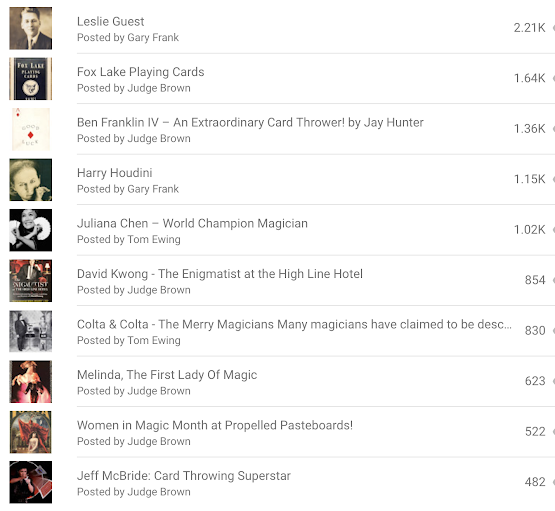
This month, Propelled Pasteboards marked its six year anniversary, having racked up more than 150,000 visits in that time.  So, it's time for our version of the "People's Choice Awards," finding out which posts attracted the most interest.  Some magicians who made our "Top Ten" list prove quite predictable, while others might just surprise you.  And you'll never guess who ranked #1.


The four writers who regularly contribute to Propelled Pasteboards - Tom Ewing, Gary Frank, Jay Hunter and me - have offered an astonishingly broad array of posts - 250 listings which encompass some of history's best known magicians to performers so obscure that they nearly defy our investigative research efforts.  And these listing have drawn well over 150,000 hits (some of our early data was lost to a conversion from http:// to https://).  In this post, I'll be examining those posts that have attracted the most hits.


Perhaps most predictably, Gary Frank's feature on Harry Houdini made the top ten list, with well over 1,000 visits.  Shockingly, however, Houdini did not place first!  More on that in a moment.  Other superstars closely connected with card throwing - like Jeff McBride & Juliana Chen - predictably placed on our top ten list.  (Ricky Jay did not make the cut, though several posts dedicated to him made the top 20 list.)  David Kwong, also placed high on the list, perhaps we used the opportunity to highlight his then-popular show, The Enigmatist.  Our salute to women in magic also proved quite popular, with both the "Women in Magic Month" post and articles on Melinda and Ms. Chen taking three of the spots.  Visitors also showed interest in the production of throwout cards, with posts spotlighting Fox Lake Playing Cards also making the cut, while a post about DeLand made the top twenty.  (Relatedly, we have two static pages on throwing cards and throwing card backs that racked up similar numbers, but don't get ranked on the top ten list as they're not "posts.")

Other posts that proved popular are more puzzling, as they feature lesser known magicians.  Jay Hunter's feature on Ben Franklin IV ranked third (with more visitors than Houdini), while Tom Ewing's terrific feature on Colta & Colta came in seventh.   But perhaps the biggest surprise is our top contender.  The number one, most visited Propelled Pasteboards blog post, indeed, the only post with more than 2,000 visits is . . .  [drum roll] . . . Leslie Guest!  This unanticipated placement remains unchanged from our analysis of hits when the site marked 100,000 hits.  Please don't misunderstand, at Propelled Pasteboards we pride ourselves on featuring magicians of all kinds, often celebrating obscure, mysterious and even unsuccessful performers that you won't find anywhere else.  Furthermore, Gary Frank's feature on Mr. Guest is thorough and interesting.   But that Guest would best Houdini, Thurston, Kellar and some of the other historic greats we've featured is something no mentalist could have predicted!  

But for the record, at this writing, this is . . .

Propelled Pasteboard's Most Popular Posts

The Top Ten List with Official Hit Counts


When you have time, check out these posts and some of our less popular pieces.  You won't be disappointed.

Tuesday, August 15, 2017

Ben Franklin IV – An Extraordinary Card Thrower! by Jay Hunter


[Jay Hunter, whose generosity knows no bounds, has drafted this wonderful post for us, along with some additional specimens from his collection.  Thanks, Jay! -Judge Brown]


Benjamin  Franklin IV was a high school principal in Point Pleasant,  West Virginia.  He was born on December 27, 1913 in Point Pleasant.  Besides his day job, for many years he was active as a semi-professional  magician. I found many references to him on the “Ask Alexander” search engine.  Many of these references alluded to the claim the he indeed was a descendant of “THE” Ben Franklin, one of the founding fathers of the United States.

Friday, April 21, 2017

Karl or Carl? A Guest Post by Jay Hunter

Introductory Note: We're very happy to bring you this guest post authored by Jay Hunter, whose scholarly contributions were recognized on the Roterberg Stock Card post.  Jay is a noted magic collector who has invested a great deal of time and energy into assembling and curating an amazing collection.  His thoughtful contribution follows. - Judge Brown


This post features two throw-out cards for magician Howard Karl. Both cards took advantage of what appears to be a way to get your card made and to have someone else pay for it!  One card is on an early Bicycle red Cupid back and is part of the U.S. Playing Card Company promotion discussed elsewhere on this site.  The other card is an ad for Pluto Water, and the Bamberg Magic and Novelty Co. which Judge Brown has written about in his Triple-Promotion post.


Sunday, October 29, 2017

The Mahatma Mystery Solved!


Advertisement appearing in Mahatma in 1895.
From 1895 through 1906, Mahatma, the first U.S. newspaper catering to magicians, was published at Martinka's magic shop in New York City.  Another thing Mahatma published, as indicated in the print ad seen here, were "Playing Cards With Your Advertisement Printed on Them," at a rate of $1.50 per thousand or $6.00 for 5,000.   These ads appeared from time to time in the periodical's decade-long run, but alas, without ever including any images of the cards.


Ad from 1905
The first reference I encountered about cards printed by Mahatma was the June 1944 article by John Mulholland, which is excerpted on our Back Story page.  "Scores of magicians had cards made with a back design, 'The Mahatma' magazine had
drawn," Mulholland wrote. "This design pictures a number of different pieces of magical apparatus." Mulholland did not provide an image of this unique back design created by the folks at Mahatma.   I began thinking about the dozens of cards we had posted here on Propelled Pasteboards, but it was difficult to think of any that fit Mulholland's description . . . except for maybe one.

Indeed, my leading suspect was the back that I've referred to as the Roterberg Stock Card  as they were sold by dealer August Roterberg.  Examination of the back, as reproduced here, proves consistent with Mulholland's description: a custom-drawn back picturing various magical apparatus (including fans, birdcages, funnels, wands, hats, etc.)   And given that the ad for these cards appears in Roterberg's catalog circa 1915, the timeline seemed to fit.

But that was just a suspicion.  Before I acted on it, I decided to consult our friend, Jay Hunter.  In what seemed like minutes, Jay responded with an email containing images of throwing cards featuring the Mahatma backs in two colors.


How can be be sure that Jay is right?   Well, just look closely at the design -- there's a signature: it says "Mahatma,"  As for the faces of these cards, they bear advertisements for magicians named "George Heller" and "M. Roberts."  Their stories will await another day.

But a third Mahatma card from Jay's collection sheds just a bit of light on another mystery.  Regular readers may recall the elusive Geo. Heir from our discussion of Bamberg Throw-Out Cards.  If you'll recall, Heir was one of our dedicated Men of Mystery, about whom we have been unable to locate any data even with the help of Ask Alexander.   Well, Jay found another Mahatma card, this one featuring Mr. Heir:


So, with that card, we add another data point to Mr. Heir's profile: he hailed from Jersey City, N.J.  That may lead to more....

Of course, only after Jay cracked the case, I found an ad for Mahatma cards with an entirely different "Mahatma" card back.   See below:


But before we leave the issue of magic magazines printing throwing cards, there's one more thing I'd like to cover.  In researching this piece, I happened across another ad -- this one in an old copy of The Sphinx from 1902, featuring nearly the exact same ad, this time attributed to The Sphinx rather than Mahatma:


Apparently, Mahatma wasn't the only magic magazine moonlighting in the throwing card business.  And if you'd like to see one of these backs on a card, check out the Leon Herrmann posting!


---------------------------------------------------
Postscript: After reading this post, my co-contributor Gary Frank dove into his wonderful collection and turned up three more of these wonderful cards.  The story of these performers will await another day... but meanwhile, now appearing on Propelled Pasteboards are the magical styles of M. Roberts (whose back design appears above), Marvill and Burton the Magician.


Wednesday, April 26, 2017

Magical Copycats on World Intellectual Property Day

Today is World Intellectual Property Day, an annual commemoration instituted by the World Intellectual Property Organization, known as "WIPO," (a branch of the UN which coincidentally employs my best friend).  According to WIPO:

"Every April 26, we celebrate World Intellectual Property Day to learn about the role that intellectual property rights (patents, trademarks, industrial designs, copyright) play in encouraging innovation and creativity."

Perhaps unsurprisingly, among magicians, intellectual property rights have often been disrespected, much to the chagrin of magical inventors, innovators and manufacturers.  I will not explore that serious problem here.  In commemoration of this day, however, I thought I would highlight a few of the throwing cards which, though they may not technically violate intellectual property rights, certainly constitute bold imitations of the work of others.


Sunday, February 11, 2018

The Eng Sung Enigma: Resolving a Riddle for the Chinese New Year!


 Last year, in celebration of the Chinese New Year, we were proud and pleased to bring you a post about Chen Ting Soo, showcasing a vintage throwing card and featuring a genuine Chinese-American magician.  This year, with the same holiday approaching, I turned to a card recently added to my collection featuring "Eng Sung - Chinese Magician."  The piece is a keepsake, featuring a handsome portrait of the performer and an absolutely wonderful graphic of a levitation illusion.  I started to wonder -- Who was Eng Sung?  Little did I know that my curiosity would ignite a fast and furious debate among significant members of the throwing card blogosphere, that quickly and conclusively resolved a mystery.

Deploying the powerful "Ask Alexander" tool, I could only find three articles containing a reference  to Eng Sung, all three of which described the very same performance at a 1934 convention of the Keystone State Federation of IBM Rings. So, whomever Eng Sung was, he didn't perform for very long.  Or, I posited, at least it was an assumed name that some magician only used for a short time.   The reporting contained little detail about his performance, other than to place him on a bill with a number of better-known performers, including Burling Hull, Max Holden and LuBrent.  And then there was the emcee....more on him in a moment.

Could this be the same fellow pictured
on the Eng Sung card?
In studying the card, I noticed was that "Eng Sung" did not appear to be Asian, but, more likely, was part of the then-popular, insensitive tradition of a Western magician playing the role of a Chinese magician.  (On these pages, you'll find references to several such performers, including Chung Ling Soo, Chang,and  Okito.)  This led to the suspicion that he likely performed under one or more other names.

Because the card provides no other information about him -- other than the photograph -- there wasn't much to work with.  But that picture, it seemed to me, was familiar.  It reminded me of a photo of another performer on a card for Namreh the magician, seen here.  Namreh was one stage name for Herman Weber (1900-1953).  "Namreh" is Herman spelled backwards.  And then I looked back at the performance reports .... Herman Weber was the emcee for the only show at which Eng Sung had been recorded as appearing.
"Rice, Rice, Rice" -just one of many Asian-themed
effects that Herman Weber published.  

Could the two be one and the same?  I was quickly able to convince myself of the viability of this theory.  Weber had written quite a bit about performing "Oriental" magic, and included some in certain of his programs.

He had assumed other characters -- like Namreh -- who performed in devils robes.   And the more I looked at the pictures of Namreh and Eng Sung, the more I grew convinced that they looked the same.

So I did what I often do when I need more material for magic research: I turned to our friend Jay Hunter.  I was hoping, most of all, that Jay could come up with another throw-out card featuring the same "Levitation" back, which, if it was for Herman Weber, could close the deal.


Jay dug into his extensive collection, producing a remarkable quantity of material in a very short period of time.   The materials he gathered about Herman included the wizard offering "Oriental Mysteries" and performing in different characters and costumes.


The levitation graphic in a book
authored by Herman Weber.

And then Jay found what I thought would be the silver bullet: he found the "Levitation" graphic, not on a throwout card, but in a booklet published by Weber!  And, Jay added, he had seen this graphic nowhere else.  While he expressed interest in my theory, he had his doubts as to whether the two men appeared to be one and the same, and raised some concerns about the ages of the performers pictured compared to certain biographical facts.

So we called in the rest of the Propelled Pasteboards team.  Tom Ewing -- our resident expert on Pennsylvania-based magicians -- advised that, unbeknownst to us,  he's currently working on a book about Herman Weber, having come across a trove of materials on the Allentown native.   While he had not come across anything about Eng Sung, Tom confirmed that Weber was an exponent of Chinese-themed magic, devoting half of his stage show to that style of performance.  Tom liked the theory, but thought we needed to do more work on the question.  He supplied a vintage ad for the sale of Namreh's show, reproduced here, which makes it clear that a large portion of the show was devoted to  "Oriental" magic.

Enter Gary Frank.  Using nothing but his keen powers of observation (which could perhaps characterized as superpowers) Gary provided a point by point facial analysis of the Namreh and Eng Sung cards -- too long to reproduce here -- that included details such as the "flow of contour" of facial characteristics, "cupids bows," hairline shape, etc.   Suffice it to say that Mr. Frank concluded they were different fellows.  An Internet based facial recognition program into which I fed the two photos reached the same conclusion.  Everyone was sold that my theory was wrong ... even though I continued to hope.

Based on the evidence we had assembled, Mr. Frank theorized that they were pals and knew each other, and he focused on a critical clue: the initial reports of Eng Sung's performance noted that one of his assistants was someone named "Miss Snyder."   Using this clue, I was able to formulate more Ask Alexander searches.  And this time, I hit pay dirt.  Herman Weber did indeed have a pal named Edgar Snyder, who had acted as Weber's assistant at one time.   Reports also noted that Edgar Snyder's wife was an accomplished magician's assistant.

Armed with this new fact, I found our man: Eng Sung was Edgar Snyder (d. 1970), who also hailed from Allentown.  He was specifically identified as such in several magic magazines, but never spelled correctly: writers listed him as "En Sing," "En Sung" and even "Yen Sen."  These misspellings explain why initial searches didn't turn up his identity.   Having completed the record, it turns out that Snyder has a fairly long career in magic, performing a s "Eng Sung" during the 1930s, and later moving to Florida and becoming an officer and important organizing force in the S.A.M.

Here's one description of his performance as "Eng Sung" from the Linking Ring in 1933:

"Then came Edgar Snyder (En Sing) of Allentown, doing Oriental Magic, using large Chinese Blocks, and a production silk act from large tube, finish- ing with a 30 foot silk banner. He also used a new idea in Chinese rice bowl. Mr. Snyder's apparatus has been decorated by a real expert in Chinese art."

Oh, and just as "Namreh" is Herman spelled backwards, Snyder left us a similar clue: Eng Sung and Ed Snyder both have the initials "E.S." 

Monday, December 12, 2016

The Roterberg Stock Card

As the curator of the now-defunct throwingcard.com website, it was a privilege to further the study of throwout cards through the aggregation of information from a number of generous and knowledgeable magic collectors and historians.  Through an iterative process, we were able to assemble an interesting history of the Roterberg stock throwing card, which began with curiosity over a beautiful card back.  I wanted to share that here:


Ken Klosterman sent me this charming, elegant piece, circa 1927, featuring Clarence Rothschild, a little-known, California-based performer and dealer.   The face is mostly text with a small period graphic.  More interesting is the back, pictured below, showcasing a plethora of magical images, including skulls and renderings of vintage magic equipment.  


The very same day I received the Rothschild card, Scott Morley asked me about a blank throwing card he had in his collection, bearing this same back.  Scott has been able to trace his blank card to a listing in a August Roterberg magic catalog, as seen below:


It thus appears that Rothschild used a stock throwing card, available from Roterberg, overprinted with information about him and his act.   We even know the cost of the stock -- $2.50 per 1,000.   This was the first use of a stock throwing card that I'd been able to identify.

Enter Jay Hunter, throwing card collector extraordinaire, who has assembled a collection of hundreds of throwing cards.   Jay scoured his collection in search for other examples of the Roterberg stock card.  Amazingly, in addition to Rothschild, he found ten:

1. Millo the Mystic

2. Adolphe Blind

3. Earl A. Lockman

4. Eddie Bass

5. Phil Dalee

6. Troseth.

7. Alvin Gentil

8. Loring Campbell

9. Patricola

10. Oran Dent


Having uncovered all of these examples of Roterberg stock throwing cards, Jay provided another remarkable service for magic history.    At the 2007 Magi-Fest in Columbus, Ohio, he sought out Ohio magician Oran Dent, and put him in contact with us.   Oran kindly provided a copy of his Roterberg card, pictured above, and related the following history of its manufacture:


"I think my use of this back design dates to the early 1970's, when I lived in Cincinnati. I think I simply copied the design from a blank face stock card that I had on hand, and which I found today, still in my accumulation of interesting bits and pieces. The back is very striking, I thought at the time, and very magical, and I still agree with these observations! Ron Maifeld, who was active in magic circles in Cincinnati at that time, worked for the Post Office and had a small printing business on the side that he ran from his basement. He handled the printing for me, but I don't know whether he did it himself or farmed out the job. As far as I know, Ron is still in Cincinnati, but I haven't seen him in quite a while. I don't remember how many were printed or what they cost, but now I just have a few remaining and I'm sure that Ron charged me a very reasonable amount for the work. I know I didn't give out all that I had--they were discarded along the way. At the time of printing, I had developed a club act using all jumbo cards and was trying to market it locally. I did some targeted direct mailing, and I even had a nice mention in one of the popular columns in a Cincinnati newspaper. Would you believe, not a single booking emerged from this! After a while, I went on to other approaches in my magic, although I'm still partial to jumbo cards, even after all these years."

Many thanks to Ken, Scott, Jay and Oran for their help with documenting this interesting bit of magic history.

Thursday, March 2, 2017

Harry Houdini

Harry Houdini (Erik Weisz and later Ehrich Weis) born March 24, 1874 – October 31, 1926) was a Hungarian-American illusionist, stunt performer, and noted for his sensational escape acts. So much has been written about Houdini’s life from articles to books. The life he lived and the secrets he took with him over ninety years ago are still being researched and found today. There still seems to be an endless source of material around the world.

Over the past handful of years alone, anything from scrapbooks, posters, and letters seem to appear, and it doesn’t seem there will be any end in sight. The name Houdini will continue to live on as a goal setter. Whether it was his method of publicity, his public recognition, or just good timing; the name Harry Houdini has been the bar to reach for in magic.

Harry scaled playing cards with accuracy and he could cut a card in mid-air with a pair of scissors. Thanks to Jay Hunter for solving one part of the Houdini throw out card mystery. Jay found the following in "The Sphinx" for June, 1936. Included in John Mulholland's "Editor's Page", he included the following from Harry's brother, Theo Hardeen.  "...Hardeen wrote the following interesting letter to me: 'The very beautiful story about the card throwing of Herrmann and Thurston in the May issue interested me very much. However I think that it is a little incomplete in not mentioning the name of Houdini. In 1894, when Houdini and I were performing as the Houdini Brothers, Houdini threw out steamboat cards with his picture on the front. These were the regular cards, no thicker. Then when Houdini joined the Welsh Brothers tent show, after his marriage, and worked the act under the name of Harry and Bessie Houdini, Jim Bard of the famous Bard Brothers (Jim and Eddy) taught him how to do a back somersault. After that Houdini would scale out the cards and the last card, he would throw out, turn a back somersault and catch as it returned to the ring." 
        If it wasn't for one particular publication by someone who has surpassed Houdini in his prowess of handling cards, we wouldn't be able to enjoy the image below what appears to be the Houdini throw out card. Here is an image of the front of the card published in the 1977 book by Ricky Jay titled, Cards as Weapons. I want to make an open request, please. If you own this throw out card, it would really be nice to know what is on the back. What is the actual size and would you be so kind as to allow us to post a perfect image? One wonders, what happened to all of these cards? 

             To honor the man whose name continues to be brought up almost daily around the world, here is another image in the form of advertisement that nearly coincides with our site.

This 7.62cm x 11.43cm card was used to promote soap.

            It should be mentioned, the facts on the back of the card are not all correct (well, they got his name right). Possibly those were the facts they received at the time of the publication. This is one cards advertising Orocrema Almond Soap that was created in the early 1920’s. Each card measured three inches by four and a half inches (7.62cm x 11.43cm).

Loosely translated the card reads:
“A single film has been enough to make this fantastic artist universally known. Son of a wealthy merchant was born in Chicago, in 1887, where he studied the career of an engineer. Since childhood, he has always shown an engaging and decadent character that led him to the realization of his daring plans. He built an armored armor that was the main reason for his only film titled "Houdini and the human tank" that gave him popularity. He is of a nervous temperament, and his numerous prowess has made the stairway of the facade of a "skyscraper" with the sun helping his feet and hands. He is currently retired from cinematography.”
              Houdini's skills were somewhat legendary, as discussed on the sites Wild About Harry and The Great Harry Houdini. According to many sources, he would scale steamboat cards with his autograph on the face. Images of such cards can been seen on Pinterest and here on this site Propelled Pasteboards.

This three sheet poster is currently on display at the famed Winchester House in San Jose, California (Yes, that's me).

              As seen above, there was always one item that really would have made a perfect throw out card, but alas, it was only created as a poster.

Friday, December 16, 2016

"When you play with Bicycle, You hold Good Cards"


The rise of color lithography during the golden age of magic proved a happy accident for collectors of fine, classic magic posters.   For throwing card enthusiasts, the rise of vaudeville stage magic during an explosion in playing card production around the turn of the 20th Century created a similar synergy. 

By the late 1800s, new printing technologies and methods brought about great improvements in the quality of playing cards.  The formation of the United States Playing Card Company in 1894, which soon acquired several other major manufacturers, created a worldwide industry leader. Beginning in approximately 1900, the Company embarked on a number of aggressive marketing campaigns, registered numerous trademarks for its new designs and slogans, offered free window displays to retailers, and invested heavily in national print advertising.

As part of US Playing Card Co.'s promotion of its products, the company hit upon an unusual idea: it offered free, custom-printed advertising cards to stage magicians.  Each card featured one of the Company's prized back designs, plus a slogan promoting Bicycle cards on the face.  The balance of the face was devoted for space featuring images and text about the magician.

"For a number of years, in the early part of this century, the United States Playing Card Company, and other manufacturers of playing cards would print a quantity of cards gratis for any magician requesting them." John Mulholland wrote in The Sphinx in June 1944.  "The playing card companies’ generosity to magicians to distribute cards bearing advertising of their products on one side of the cards."

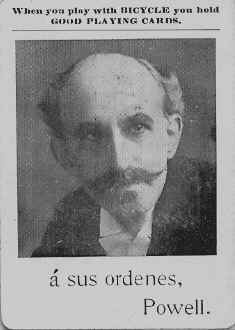
It proved a brilliant means of cross-promotion.  Some magicians scaled the cards into the audience, ensuring that the Company's samples would be caught -- and often kept -- by eager audience members.   The results is that dozens of magicians, including some top names in the field, such as T. Nelson Downs and Frederick Powell, had Bicycle brand throwing cards printed.  (On another magic site, collector Jay Hunter put together a collage of nine different back designs that appear on Powell's cards.)  Bicycle cards also feature relative unknowns, such as ventriloquist/magician Ned Frailey.


US Playing Card Co. Ad from Life, February 1901

Each of the Bicycle cards are imprinted with the slogan "When you play with Bicycle, You Hold Good Cards," or some slight variant of this slogan.  The use of this slogan helps date these cards quite specifically.  Searching through various databases, it appears that U.S. Playing Card registered this slogan in various trademarks and used it in print advertising from 1900-1905, like the ad seen here.   This suggests that any throwouts bearing this slogan date from this around period.

It's worth noting that several other playing card companies employed a similar strategy, including Golf Playing Cards and the Canadian Playing Card Company.  In fact, one promotional card touting "National" and "U.S." playing cards as the best could well be considered the scarcest throwing card of all: its face features a young and not-yet-successful Harry Houdini as a magician offering instruction in sleight of hand.   (A very small image of this card can be seen in Ricky Jay's book Cards as Weapons, which is also a scarce collectible).

 "Throw-out cards should have great publicity possibilities," Mulholland concluded, "but in the past
most of the cards have either been poorly printed or carried designs which were inartistic and were printed from cheap cuts. Except for Thurston, and one or two others, the printing was never in colors. With the proper layout and pictures, good printing, and in colors, one good stock, throw-out cards might once again regain their usefulness as good advertising for magicians, and souvenirs the public would cherish."

Mulholland's critique has particular application to the playing card company promotional cards: designed primarily to sell decks, not magic, these pasteboards feature luscious back designs, but the fronts generally offer grainy photos and splotchy printing.   Nevertheless, they are highly collectible and interesting souvenirs of a bygone era.

To learn more about the importance of back designs in the study of throwing cards, check our Back Story page


 Readers interested in lithographic posters can find lots of great information and images at Ken Trombly's magicposters.com and Charles Greene's site, magicpostergallery.com.

Wednesday, November 15, 2017

Theodore DeLand's Got Your Back!

Deland's "Watch the Dice, 6 or 7," on the backs of throwout for J.W. Wilson, Puzzling Pierson and Lightner


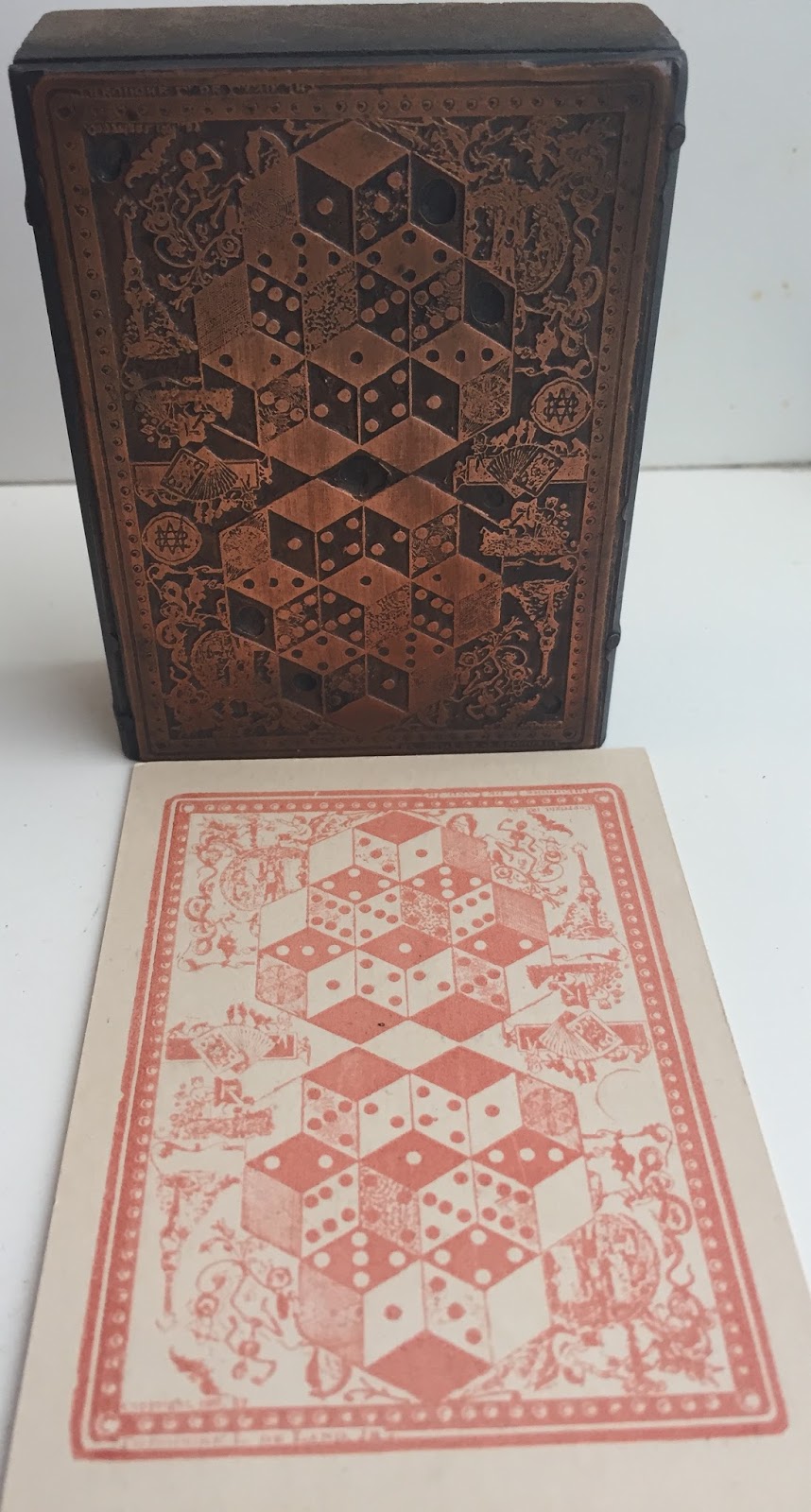
As part of our continuing study of throwing cards, we have often stressed the importance of examining a card's back to provide added insight as to it provenance, manufacture, and approximate age. And if you look a enough magicians' cards, it will not be long before you notice one or more with this intriguing design, produced by Theodore DeLand, an eclectic, prolific magic card manufacturer in 1907. It's called "Watch the Dice, 6 or 7," and it's a terrific negative space illusion: Rotate the card 180 degrees and the number of dice in the stack appears to change.


Another unusual aspect of these cards is the manner in which they were created.  Unlike the various cards we've discussed which were sold as blanks, such as the Roterberg Stock Card and the Bamberg Magic Card, or cards that were professionally printed on both sides, to create these backs, DeLand sold printing blocks to allow magicians to create them on their own. I was fortunate enough to be able to add one of these rare printings blocks for the "6 or 7" back to my collection.   That block, seen here with a Puzzling Pierson card back, is in beautiful condition, and I suspect it was never really used.  It bears the emblem of the S.A.M. embedded in the design.


Gary Frank was able to provide me with one of the ad cards that DeLand used to sell these printing blocks.  The "Advertise Yourself" copy was printed on the face of playing cards with printed images of the three backs for which they were available.  Price: three printing blocks for $1!  (I paid much, much more for mine, even when adjusted for inflation.)  One of those three designs, obviously, was the "6 or 7" back.  In addition, I believe a second one was the "Dollar Deck" back, seen below as well as on the reverse of the promotional card used by McDonald Birch.  The third may have been the Daisy Deck back, though we have been unable to locate a throwing card with that particular design.


Jay Hunter was able to turn up something else: The M. Lewis Company, the work of which will be discussed in another post, advertised the DeLand "6 or 7" printing plate in the Sphinx in 1907.  Interestingly, as seen in the ad reproduced here, Lewis sold them for $1 each, offered with or without the S.A.M. emblem engraved in the circles in the design.  Lewis suggests having the corners rounded like a playing card, or square like a business card, and notes that it had a "large supply on hand."

Jay also kindly prepared an array of cards sporting the "6 or 7" back, printed in four different colors, both with and without the S.A.M. emblem as well as with rounded and square corners:


So who was Deland?  Well, according to Magicpedia, "Theodore DeLand (1873-1931) created the phenomenon of packet tricks between 1906 and 1915, during which time he marketed almost 100 tricks using gimmicked cards and decks, many of his own unique creation. DeLand was a clerk at the U.S. Mint in Philadelphia and died in an insane asylum in Norristown, Pennsylvania."   That snippet hardly captures DeLand's unusual story; for many years, Richard Kaufman has been working on a biography, DeLand: Mystery and Madness, which is expected to be released soon.

And while DeLand did not have a throwing card, many of his decks and effects included signature aces, which are quite interesting.   Several are seen below, which Mr. Kaufman helped me identify.


Ace of Spades from original Deland Dollar Deck
(later printed by S.S. Adams)


Ace of Spades from Deland's "Twister" trick

Ace/Three from a DeLand effect called "Pickitout"