Showing posts sorted by relevance for query deland. Sort by date Show all posts

Wednesday, November 15, 2017

Theodore DeLand's Got Your Back!

Deland's "Watch the Dice, 6 or 7," on the backs of throwout for J.W. Wilson, Puzzling Pierson and Lightner


As part of our continuing study of throwing cards, we have often stressed the importance of examining a card's back to provide added insight as to it provenance, manufacture, and approximate age. And if you look a enough magicians' cards, it will not be long before you notice one or more with this intriguing design, produced by Theodore DeLand, an eclectic, prolific magic card manufacturer in 1907. It's called "Watch the Dice, 6 or 7," and it's a terrific negative space illusion: Rotate the card 180 degrees and the number of dice in the stack appears to change.

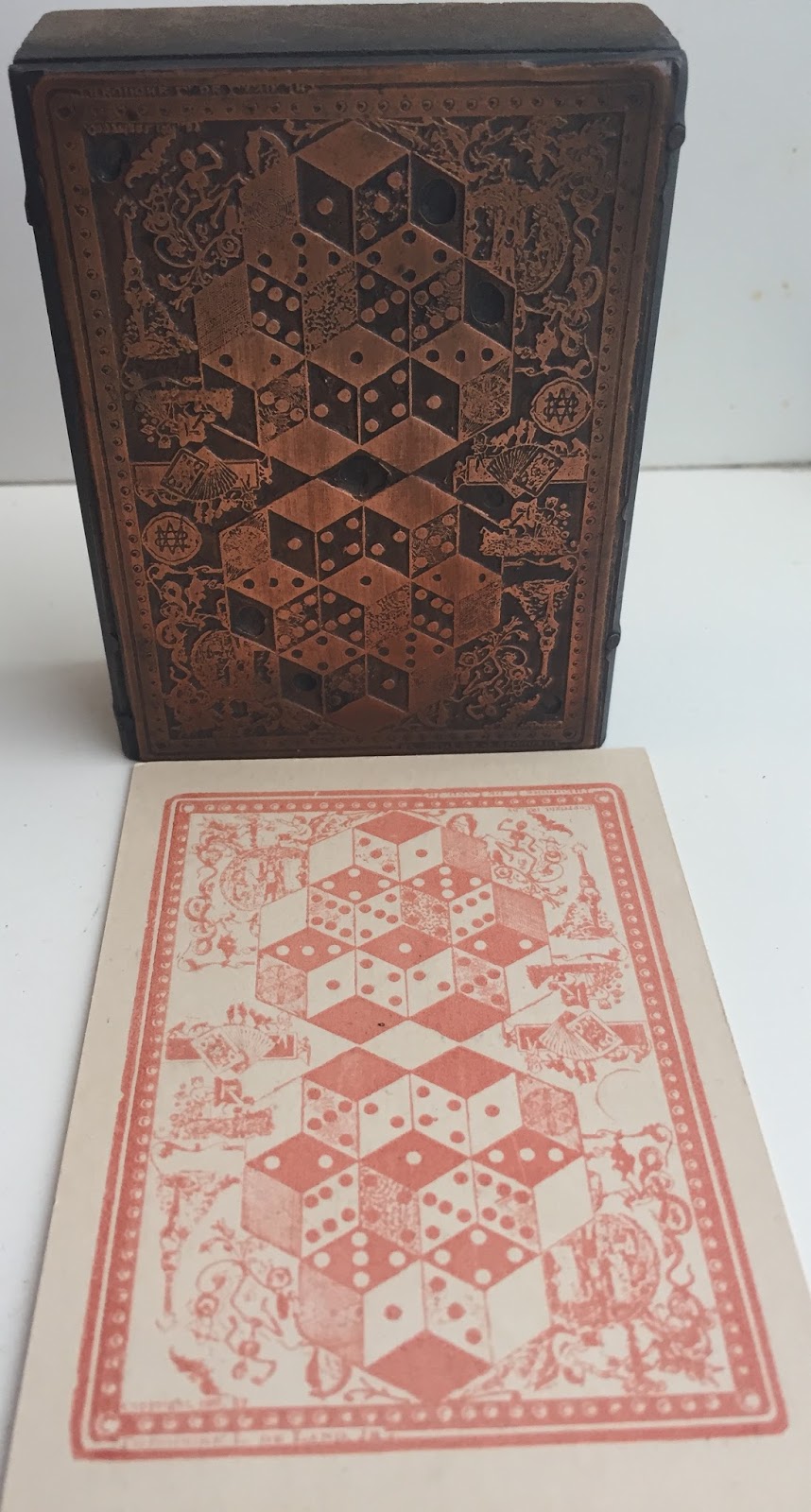


Another unusual aspect of these cards is the manner in which they were created.  Unlike the various cards we've discussed which were sold as blanks, such as the Roterberg Stock Card and the Bamberg Magic Card, or cards that were professionally printed on both sides, to create these backs, DeLand sold printing blocks to allow magicians to create them on their own. I was fortunate enough to be able to add one of these rare printings blocks for the "6 or 7" back to my collection.   That block, seen here with a Puzzling Pierson card back, is in beautiful condition, and I suspect it was never really used.  It bears the emblem of the S.A.M. embedded in the design.


Gary Frank was able to provide me with one of the ad cards that DeLand used to sell these printing blocks.  The "Advertise Yourself" copy was printed on the face of playing cards with printed images of the three backs for which they were available.  Price: three printing blocks for $1!  (I paid much, much more for mine, even when adjusted for inflation.)  One of those three designs, obviously, was the "6 or 7" back.  In addition, I believe a second one was the "Dollar Deck" back, seen below as well as on the reverse of the promotional card used by McDonald Birch.  The third may have been the Daisy Deck back, though we have been unable to locate a throwing card with that particular design.


Jay Hunter was able to turn up something else: The M. Lewis Company, the work of which will be discussed in another post, advertised the DeLand "6 or 7" printing plate in the Sphinx in 1907.  Interestingly, as seen in the ad reproduced here, Lewis sold them for $1 each, offered with or without the S.A.M. emblem engraved in the circles in the design.  Lewis suggests having the corners rounded like a playing card, or square like a business card, and notes that it had a "large supply on hand."

Jay also kindly prepared an array of cards sporting the "6 or 7" back, printed in four different colors, both with and without the S.A.M. emblem as well as with rounded and square corners:


So who was Deland?  Well, according to Magicpedia, "Theodore DeLand (1873-1931) created the phenomenon of packet tricks between 1906 and 1915, during which time he marketed almost 100 tricks using gimmicked cards and decks, many of his own unique creation. DeLand was a clerk at the U.S. Mint in Philadelphia and died in an insane asylum in Norristown, Pennsylvania."   That snippet hardly captures DeLand's unusual story; for many years, Richard Kaufman has been working on a biography, DeLand: Mystery and Madness, which is expected to be released soon.

And while DeLand did not have a throwing card, many of his decks and effects included signature aces, which are quite interesting.   Several are seen below, which Mr. Kaufman helped me identify.


Ace of Spades from original Deland Dollar Deck
(later printed by S.S. Adams)


Ace of Spades from Deland's "Twister" trick

Ace/Three from a DeLand effect called "Pickitout"


Tuesday, October 15, 2019

Senator Lightner, the Wizard


This throwout card for Senator Joe Lightner (1884-1946) has everything a person could want in a throwing card. First, behold the intriguing stage moniker -- Lightner, reminiscent of lightning, conjuring up powerful supernatural images. Then, look to the bold, unsupportable claim to the title "America's leading magician," an excellent piece of showmanship. Next, consider the dramatic portrait -- the conjurer's profile, with a top hat perched at a jaunty angle, simply exudes mystery. Finally, the card contains some real magic -- the face of the card entreats the holder to count the dice on its back. (A standard Deland back design makes this a puzzling endeavor.)
Several Deland backs.  Lightner's is on the right.

Lightner first performed as "Lightner the Wizard" in 1906. performing in Chautauqua.  He was close friends with Dr. A.M. Wilson, and after the good doctor's death, he joined a group of investors who bought The Sphinx magazine, becoming a shareholder and member of the Board of Directors.

While I was running the throwingcard.com web site, Tom Ewing kindly supplied the following report about Lightner from the October 1943 issue of The Sphinx:

___________________________________________________________________________


The Hon. Jos. G. Lightner, a member of the Missouri Senate, and leading citizen of his home town of Odessa, Missouri, is as proud of once having been a magician as he is of any of the various high elective public offices he has held.

Joe Lightner had his own show of magic for a number of years and as he was a good magician, it was a good show. It was during this period of his life that he first became a close friend of the late Dr. Wilson. During the latter years of the Doctor's editorship of The Sphinx, Joe aided him in innumerable ways. His devotion to Dr. Wilson and The Sphinx prompted him to become one of the first stockholders of the present corporation. At one period, Joe was also associated   with the Seven Circles magazine.

An early member of the S.A.M., Lightner regularly came to New York for the annual banquets. He has also attended many conventions of magicians. Joe likes magic to be fast, colorful and it must be entertaining. Although he has little time for his own magic today, he always seems to be able1 to make time to go to see the performance of some other magician. His love of watching magic is so great that he will travel great distances to see a performance.

 Joe Lightner in his quiet way is awfully good company and knows magic and magicians of today and yesterday. 

  __________________________________________________________________________


He had a storied career in and out of magic, becoming president of a group called the International Magic Circle and regularly reporting on the Seven Circles Conclave.  His wife- named Marvel - also performed in vaudeville with comedian Gallagher Shean.   Collectors might be interested to learn that he inherited many artifacts from Doc Wilson, including the very first pack of Deland's Dollar Deck, autographed by Deland for Wilson.


Lightner died of a heart attack in 1946 at age 62.  Upon his death, The Sphinx described him as "a brilliant man of noble tendencies."


Sunday, December 18, 2016

Thayer Magic - The Wand of the West

Anyone even remotely interested in the history of conjuring knows the name Floyd Thayer, a magician and craftsman who established The Thayer Magic Company in California. Thayer was born in 1877 and at first made magic wands and for non-magicians, tourist trinkets and souvenirs of out orangewood which he turned on his lathes. Those lathes later turned out some of the most remarkable magic effects, especially his multiplying billiard balls which came in many sizes and colors.

Thursday, January 19, 2017

Alpigini – Wizard of the East

I never knew Harry Alpigini, but like so many of the magicians I write about in columns and posts, I wish I had. My particular interest is multifaceted. First, he was an early member and supporter of magic in Philadelphia and then later had significant influence on the Baltimore magic scene. He was colorful, highly talented, a real insider, and finally…perhaps best of all…he was a collector!

Alpigini, his actual family name for a change, was born in Philadelphia May 22, 1879. His parents came from Italy, as did his older sister. He first became interested in magic at age 5 and gave his first performance at 7 years of age. While he was well-known in magic circles, and even more so as he grew older, his primary profession was as an engraver, and apparently he was quite skilled.
According to The Sphinx, Alpigini applied for membership in the S.A.M. in Dec. 1922 and was endorsed by the entire Philadelphia assembly. Then S.A.M. President Harry Houdini accepted his application.  

In his very early performing years, Alpigini created and performed an act he called "Artographs," in which he dressed up in typical artist costume and created beautiful works of art from scraps of rags. It was the well-known and then, very popular, rag picture act. In my collection is a small three-fold brochure he used to promote himself. Shown below are the front and inside of the brochure. 

Wednesday, December 18, 2019

J.W. Wilson

I've long had a particular fondness for this card featuring J.W. Wilson, perhaps drawn by the incredibly cheesy devil-costume clad assistant whispering in this performer's ear.  This particular piece of ephemera dates to an era when artists like Thurston and Kellar distributed promotional pieces adorned with gorgeous lithography sporting imps, devils, owls and other familiars imparting secrets to the performer. Wilson went decidedly low-tech and low-rent on this piece, offering a friend in a devil get-up in this black-and-white photo. The Deland back suggests that Wilson may have hand-printed these himself.  

A group of Deland backs.  Wilson's is on the left.

So who was J.W. Wilson?   That Wilson is a common surname, and he insisted (generally) on only using the initials J.W.. made him somewhat difficult to track down.   (Consider the fact that these pages also feature a contemporary named John Darrell Wilson).  Scattered references reveal that together with the famed A.M. Wilson (ed. of the Sphinx), he was admitted to the Society of Buffalo (New York) Magicians in 1921. Later that year, the Sphinx reported that J.W. performed something intriguingly entitled his "Black Box Mystery" but left tantalizingly undescribed. (Additional research suggests it was a put-together production box).    In 1922, the Sphinx reported that Wilson was performing magic and Punch and Judy shows for American Legion halls.  By 1928, he hosted a group of Buffalo magicians, now using the name "John W. Wilson" and performed a spirit seance, and by 1933, this group elected him "stage manager."

The other textual clue on the card was the reference to The New York Clipper.  This periodical, it turns out, was a theater newspaper published in New York City through 1924, when its coverage was assumed by Billboard.  This helps date the card, and suggests that Wilson was playing the theater circuit.

Fortuitously, I came across this image of a 1918 issue of The Magic World on an Internet antique dealer's site, and Tom Ewing was able to secure a copy of the article for me.   It adds a few details: Wilson was born September 29, 1876 in Buffalo.  He developed a magic program and eventually added some large stage illusions, leading to a contract with United Booking Offices.  The illusions included Black Art and The Haunted House.  The Magic World found him working in Delaware and developing a new, Asian-themed act.  


 Despite my derisive comments about the production values of Wilson's throwing card, it turns out the image he used was a magazine cover portrait, which makes it a pretty cool collectible.

Finally, there is a coin move called the "JW Wilson Grip."  For a time, I assumed it was attributable to this performer.   However, continued searching led me to a September 2010 article in M-U-M by inventive magician Nathan Kranzo.  Fascinated by the JW Wilson move, he dug into the question, and came to believe that it had been developed by a Jimmy (sometimes spelled "Jimmie") Wilson, Jr. whose father, J.W. Wilson Sr. was also an accomplished magician.  Yet Richard Kaufman credits "Jimmy Wilson, Sr." for developing a coin grip in 1946 (see Genii, June 2003).  And the Conjurer's Magazine for May 1946 does contain  an effect called the "Five Coin Vanish" by one Jimmy Wilson.

The J.W.'s -  father and son - have left us with a few mysteries.


Monday, January 15, 2018

Puzzling Pierson, the Wisdom of Petronius and the Yale Divinity School

Having long ago acquired one of Puzzling Pierson's throwout cards, pictured here, I featured it on ThrowingCard.com, without much information of value.  However, access to increasingly more powerful research tools, as well as some old-fashioned shoe leather, permits me to tell you a great deal more about this charming piece, an unglazed card with square corners and an optical illusion Deland back.  The back bears a copyright date of 1907, making this a century old piece of magicana.  The face bears a Latin phrase, attributed to Petronius, "Mundus Vult Decipi Decipiatur," meaning "The world wants to be deceived, so let it be deceived" and also graces Martinka magic tokens of this era.   The face design really packs it in: the unique imp-devil character, hand with wand, linking rings, appearing bird cage and fabulous font make for an exquisite example of throwing card art.  (Another variant of this card -- which I've seen but do not own -- features a steamboat back.)

Well before his first appearance in magical literature,  George Pierson, a/k/a Guy H. "Puzzling" Pierson (b. circa 1879) is mentioned in the quarterly journal of the Yale University Divinity School, which describes him as a prestidigitator who entertained students on St. Patrick's Day, 1911.  It is in the same publication that we learn of his day job -- for the previous ten years, he had served as assistant superintendent of the Divinity School's buildings.  Less than a week later, the Yale Divinity News reports, a Professor Macintosh offered a sleight of hand demonstration “in imitation of Pierson” as part of a “Faculty Stunt Night.”  By 1917, Pierson began reporting New Haven's magical happenings in the Sphinx with an occasional feature called "Pierson's Paragraph."  In 1923, he helped organize this effort by forming a magic society headquartered at the famed Petrie Lewis company.

In 1947, The Sphinx ran a wonderful autobiographical piece about this performer.   In it, Pierson describes his early influences in magic, including a seminal trip to Martinka's, a friendship with its proprietor, and his acquisition of a copy of Professor Hoffmann's Modern Magic. "In my day we could not buy or hear anything about magic, especially in small towns," he reflected.   "We started with a chair round with a brass tack stuck in the end for a wand and a deck of cards,a few tin cups made by the local plumber and a home-made table with music rack legs. But suddenly the Great Mysto Company sprang up in New Haven and we began to get some good magic."  In 1949, he wrote a reminiscence about traveling medicine shows and the opportunities they offered magicians for The Sphinx, which elicited published comments by Augustus Rapp a few months later, and in 1950, he did a similar reflection on early travelling magic shows.   The last reference I can find about him was a performance mentioned in M*U*M in 1958.


Not satisfied that I had unearthed everything I could about Puzzling Pierson, I packed one of his cards with me on an early 2017 trip to Ray Goulet's Magic Art Studio, figuring that, on a well-attended Saturday, one of the assembled experts on New England's magic history could tell me something more about him. Well, I didn't find a subject matter expert, but among the many treasures there, I found something equally interesting,  Perched near a Spirit Clock, I spotted a cabinet-style card with a photo of Pierson.   In the photo, he's posing next to a small tripod magic table covered with vintage magic equipment, including a large ghostly chronometer. The Clock in the picture appears to be a different one than the one in the shop, unless, as one of the wags present noted, Pierson made the numbers change to Roman numerals from beyond the grave!


A second Pierson variant from Gary Frank's collection.
For anyone who might be interested, I have a duplicate Puzzling Pierson card in my collection which I'd be happy to trade for something of similar vintage.

Saturday, September 12, 2020

Propelled Pasteboards Surpasses the 100,000 Mark!

Blogger reports that after nearly four years, and more than 200 high-quality posts with beautiful illustrations, Propelled Pasteboards has garnered more than 100,000 views.   Pretty amazing for our little corner of the web.   Thanks to all of our readers for stopping by so often.   Please let your friends know to stop by and look around sometime.

Below are our dozen most popular posts at this time, along with the number of hits on that page, in descending order.  It's a wonderfully eclectic mix -- there is no accounting for taste.  Who would have thought, for example, that Leslie Guest would come in at number one, garnering more than twice the number of hits as Harry Houdini?  But each is special in its own way, and all are worth a second look.  

You can click on any of them to view the posting.  And please remember there are hundreds of other pages on the site, so make sure to look around a little!

Posted by Gary Frank
1.95K

Posted by Gary Frank
986

Posted by Judge Brown
742

438

Posted by Judge Brown
359

310

Posted by Tom Ewing
306

263

Perhaps I'll challenge my colleagues to do an "Author's Favorite" posting.  In the meantime, enjoy, and thanks for stopping by.


Judge Brown

Friday, March 27, 2020

Schulte: Penman of Performers Patter

The subject of this post is one George Frederick Schulte, a magician and author who created more humorous patter and one-liners than anyone of his time. This was long before Robert Orbin started turning out patter books. Schulte was born May 22, 1887 in Athens, Wisconsin. He lived there until 1899 when he moved to Chicago, which became his permanent home.

So popular a performer in the Windy City, Schulte was billed as, "Chicago's Most Popular Magician." His first appearance in the city came in 1900. Our subject had a very nice scaling card featuring his photo on the front, his name printed in red at an angle with "The Magician" printed beneath. It had the Deland back in blue.


In 1912, Schulte was presenting a Vaudeville magic act called "Magic As You Like It." I learned this when searching through my photo files and I came upon what I assumed was a postcard of the performer. Turning it over, however, I discovered it was actually part of an image from a larger photo that someone cut down. You can just see the edge of a table in the lower right and one must wonder what he was gesturing at. This was Schulte in his prime. 


He was best known for his series of soft cover booklets of humorous patter and one-liners. He published "Talks for Tricks" (1916); "Magical Monologues," (1919); "Patter Paragraphs," (1921); and "Words for Wizards," (1924). These booklets are prized by collectors. According to Magicpedia, his favorite trick was the Conradi Coffee and Milk effect which was published in Dorny's book Trix and Chatter.  

An auctioned "Words for Wizards" autographed by Schulte

Speaking of collecting, Schulte gathered an impressive amount of material including letters and scrapbooks and photos, many of which were stamped, "Schulte Collection." A number of these items went up for auction in recent years including on Haversat & Ewing Galleries, Potter & Potter, Swann Galleries, and the Christian Fechner auction. One auction included a letter from Houdini to Schulte thanking him for sending his most recent publication. 

Another letter came from Harlan Tarbell who provided Schulte with a complimentary copy of his Tarbell Course with the admonition not to let anyone know he'd done so or he would be overwhelmed with requests. 

Schulte also sold collectible magic at a time when magic collecting was barely in its infancy. He ran an ad in the May 1928 Linking Ring adverting "Old Programs" for sale. The dozen he offered included Thurston, Houdini, Blackstone, The Great Leon, Dunninger, Thorn and others. A buyer that month could have bought them all for $3.75. Sold today, these programs would be worth thousands of dollars. He even offered copies of old time magic dealer catalogs very cheaply. 

Sphinx ad from 1928. 
Noted historian Henry Ridgely Evans once wrote to Schulte complaining about the lack of interest in magic history. His letter noted that he (Evans) should probably just publish all of the articles that he contributed to The Sphinx in the form of a book, which he did some years later. 

He contributed funny lines and quirky patter to The Sphinx for decades, always under amusing titles like, "Funology ala Magic," "Patter from Merryland," "Magicalities," and many others. These short columns featured insightful philosphies on magic and theater as well as self-effacing comments on magic enthusiasts, many who billed themselves as "Great" but rarely were. 

In the fall of 1926, he was featured on the cover of The Linking Ring, and earlier in June 1917, on the cover of The Magic World, published in Philadelphia. He also appeared on the cover of The Osirian in June 1925. 


In 1910 in Chicago, The World's Master Magicians was formed and met in the showrooms of Halton, Janson & LeRoy. The club had about 25 members at best but most were very famous magicians. Members included: Laurant, Roterberg, Christianer, Ralph Read, Lockman, Gilbert, Tarbell and others. The onslaught of World War I caused the club to disband around 1915. It eventually became The Chicago Magician's Club. 

During World War I, Schulte performed with the famous touring entertainment troupe, the U.S. Navy "Jacks of All Trades." He also performed for troupes during World War II as well. Schulte died March 15, 1967, age 79 and was buried in Port Hudson Cemetery in East Baton Rouge Parish, Louisiana. 

Tuesday, August 7, 2018

Oakland Magic Circle

So right off the bat, I’ll admit that this current pasteboard was likely not propelled but rather given away as a souvenir of the Seventh Annual Dinner Dance of the Oakland Magic Circle. The affair occurred at the Hotel Alameda on September 10, 1932.


The front of the card features the logo of the Circle and lists past presidents beginning in 1925-26 when Professor El-Tab held the post. The reverse is the Theodore Deland back copyrighted 1913.

Over 100 magicians attended the event including a number from the Golden Gate Assembly #2 of the Society of American Magicians in San Francisco. The master of ceremonies was founding member and past President Lloyd Jones (1930-31). Jones was proprietor of Magic Limited in Oakland, California from around 1941 until his death. He published several in-house magazines including: The Bat, Bat, Jr., S.O.B., Jr. and finally Bat Droppings. He also wrote book reviews for Genii Magazine under a column titled "Light From the Lamp" for many years and later in Tops. He also served as a national president of the Society of American Magicians.

The show that evening was presented by local members including:

· Colonel Grant – Radio Artist on station KFI

· Robert S. Bailey – Londonderry Wizard

· K. Kelly

· Barkann Rosinoff

· Dr. Loren J. Ennis

· L. Caro Miller

The effects ranged from Sun and Moon, Spider Illusion, Phantom Tube Productions, billiard ball manipulations and concluded with a vibroharp selection. Outgoing President W.D. Allstrand was presented with the Circle’s Past President Jewel and the affair ended at 1 A.M.

The previous month, the Circle had celebrated “Zamloch Night,” in honor of Professor Anton F. Zamloch then in his 84th year. He was already an honorary member of the Circle for his record of trouping his magic show over fifty years in the U.S. Mexico, the Hawaiian Islands, and elsewhere. He started out in magic in 1869 and was one of the early “gift show” magicians. After retiring from long distance tours he confined his presentations to vaudeville. A magic show was presented in his honor and it was noted that in Burlingame’s 1891 book, “Leaves from Conjurors’ Scrap Books,” Zamloch was described as, “The leading conjuror of the Pacific Coast.

A month after the Seventh Annual Dinner and Dance, Zamloch passed away October 29th after suffering a heart attack. He was in excellent health at the time although advanced in years.

The photo above shows Zamloch with two of his stage effects, a table which raps in response to questions from the audience and a drum which does likewise. Not only were they worked on stage, they were also taken into the audience and placed in the aisles yet the replies came just the same.

The Oakland Magic Circle remains an active club to this day and meets at Bjornson Hall, 2258 MacArthur Blvd., Oakland, California on the first Tuesday of every month, except July. Their website was last updated in 2016. The list of past presidents below features some very talented full-time magicians and amateurs. From noted book collector, dealer, author and magic historian Byron Walker (current Secretary and Past President of the Circle), I learned that the president in 2017 was Nathaniel Segal. The president in 2018 is Doug Eakin.

OMC Past Presidents
1. Prof. El-Tab 1925
2. Arthur F. Bull 1926
3. Alfred Lamb 1927
4. Lewis Miller 1928
5. Claude Burke 1929
6. Lloyd E. Jones 1930
7. William D. Alstrand 1931
8. W. C. McCulloch 1932
9. Dr. L. J. Ennis 1933
10. R. S. Bailey 1934
11. James H. Muir 1935
12. Caro A. Miller 1936
13. Bert F. Hansen 1937
14. Clarence Cain 1938
15. R. S. Glover 1939
16. Robert J. Stull 1940
17. Lloyd E. Jones 1941
18. Ben R. Olsen 1942
19. Murray Rosenthal 1943
20. Jimmy Eyster 1944
21. Fred Braue 1945
22. Lawrence Hunter 1946
23. Almow A. Thompson 1947
24. John B. Lewis 1948
25. Larry C. Keller 1949
26. Larry C. Keller 1950
27. William Fleming 1951
28. Earl F. Wheeler 1952
29. William Fleming 1953
30. Bert F. Pratt 1954
31. Charles M. Chambers 1955
32. Charles C. Conrad 1956
33. Charles C. Conrad 1957
34. Marvin N. Burger 1958
35. Jimmy Embree 1959
36. Larry Oliveira 1960
37. Victor Merga 1961
38. Ralph M. Larion 1962
39. Price Burlingame 1963
40. Ralph J. Brown 1964
41. Lloyd E. Jones 1965
42. Kenneth B. Bull 1966
43. Kenneth B. Bull 1967
44. Roger Mycroft 1968
45. Peter A. Biro 1970
46. Peter A. Biro 1971
47. John P. Mac Namara 1972
48. Peter A. Biro 1973
49. Kenneth B. Bull 1974
50. Hal Dipboye 1975
51. Hal Dipboye/B. Huston 1976
52. Owen Barber 1977
53. Rene Castillo 1978
54. Richard Fleming 1979
55. Richard Fleming 1980
56. Lloyd E. Jones 1981
57. Mel Wittich 1982
58. Mike Palmer 1983
59. Cas Boxley/M. Palmer 1984
60. James Hamilton 1985
61. Larry Nelson 1986
62. Jeff Vines 1987
63. Dave Berry 1988
64. Dave Berry 1989
65. Fred Casto 1990
66. Fred Casto 1991
67. Tom Cutts 1992
68. Tom Cutts 1993
69. Tom Cutts 1994
70. Tom Cutts 1995
71. Dave Berry 1996
72. Dave Berry/Joe Green 1997
73. Tom Cutts 1998
74. Rich Stewman 1999
75. James Hamilton 2000
76. Dale Chung 2001
77. Dale Chung 2002
78. Dale Chung 2003
79. Peter Winch 2004
80. Bill Austen 2005
81. James Hamilton 2006
83. David F. Fry 2007
84. Scott Alcalay 2008
85. Scott Alcalay 2009
86. Scott Alcalay 2010
87. Michael Della Penna 2011
88.Scott Alcalay 2012
89. Scott Alcalay 2013
90. Byron Walker 2014
91. Michael Della Penna 2015
92. Mark Tarses 2016

Saturday, December 24, 2022

SIX YEARS OF FLYING CARDS!


Analyzing 150,000+ Hits on Propelled Pasteboards' 6th Anniversary

Our own promotional throwout card  
out of print and now a collectible!


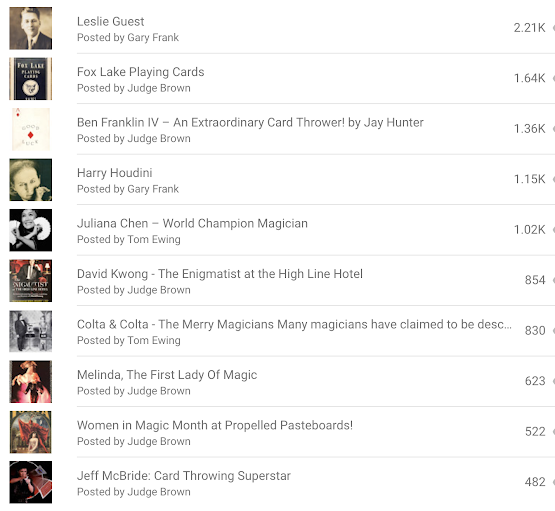
This month, Propelled Pasteboards marked its six year anniversary, having racked up more than 150,000 visits in that time.  So, it's time for our version of the "People's Choice Awards," finding out which posts attracted the most interest.  Some magicians who made our "Top Ten" list prove quite predictable, while others might just surprise you.  And you'll never guess who ranked #1.


The four writers who regularly contribute to Propelled Pasteboards - Tom Ewing, Gary Frank, Jay Hunter and me - have offered an astonishingly broad array of posts - 250 listings which encompass some of history's best known magicians to performers so obscure that they nearly defy our investigative research efforts.  And these listing have drawn well over 150,000 hits (some of our early data was lost to a conversion from http:// to https://).  In this post, I'll be examining those posts that have attracted the most hits.


Perhaps most predictably, Gary Frank's feature on Harry Houdini made the top ten list, with well over 1,000 visits.  Shockingly, however, Houdini did not place first!  More on that in a moment.  Other superstars closely connected with card throwing - like Jeff McBride & Juliana Chen - predictably placed on our top ten list.  (Ricky Jay did not make the cut, though several posts dedicated to him made the top 20 list.)  David Kwong, also placed high on the list, perhaps we used the opportunity to highlight his then-popular show, The Enigmatist.  Our salute to women in magic also proved quite popular, with both the "Women in Magic Month" post and articles on Melinda and Ms. Chen taking three of the spots.  Visitors also showed interest in the production of throwout cards, with posts spotlighting Fox Lake Playing Cards also making the cut, while a post about DeLand made the top twenty.  (Relatedly, we have two static pages on throwing cards and throwing card backs that racked up similar numbers, but don't get ranked on the top ten list as they're not "posts.")

Other posts that proved popular are more puzzling, as they feature lesser known magicians.  Jay Hunter's feature on Ben Franklin IV ranked third (with more visitors than Houdini), while Tom Ewing's terrific feature on Colta & Colta came in seventh.   But perhaps the biggest surprise is our top contender.  The number one, most visited Propelled Pasteboards blog post, indeed, the only post with more than 2,000 visits is . . .  [drum roll] . . . Leslie Guest!  This unanticipated placement remains unchanged from our analysis of hits when the site marked 100,000 hits.  Please don't misunderstand, at Propelled Pasteboards we pride ourselves on featuring magicians of all kinds, often celebrating obscure, mysterious and even unsuccessful performers that you won't find anywhere else.  Furthermore, Gary Frank's feature on Mr. Guest is thorough and interesting.   But that Guest would best Houdini, Thurston, Kellar and some of the other historic greats we've featured is something no mentalist could have predicted!  

But for the record, at this writing, this is . . .

Propelled Pasteboard's Most Popular Posts

The Top Ten List with Official Hit Counts


When you have time, check out these posts and some of our less popular pieces.  You won't be disappointed.