Showing posts with label Dante. Show all posts

Sunday, February 25, 2018

Foye´ “The Magician Deluxe”

The internet can work wonders when it comes to doing research on the history of magic and magicians.  I found this throw-out card some time back on eBay.  I was able to get not only the card, but the original printing plate that was used to make it.  It was for a magician who called himself Foye´, “The Magician Deluxe”. 


Many months into the future, I was attending a book and paper/ephemera show.   A dealer told me that he had just bought a box of magic memorabilia that morning from another dealer before the show opened.  The dealer told me he would have it at another antique show the next month if I wanted to see the stuff.
Handwritten advertisement assumed to be written by Foye´ Pearson
 
When the next month arrived, imagine my surprise when I discovered that the box of memorabilia belonged to a magician whose name was  Foye´ E. “Al” Pearson.   In the lot were several professional photos of Foye´  and his wife Marie (It looks like Al and Marie were in show business together), along with a few magic props, some blueprints for illusions, and even his wallet with an old Ohio Driver’s License.  I bought everything that related to Al and his personal history.  Then the research began.

I have not been able to learn a great deal about Foye´ , but I did find a few things.  Foye´   Emerson Pearson was born on May 4, 1908 in Delaware County, Ohio.   As a young man he lived in Mt. Gilead, Ohio.  By the time he was around eighteen, he was a member of The International Brotherhood of Magicians, holding member # 702.  The only reference I could find on him and his magic career, was that he attended the first ever magicians’ convention held in 1926 by the I.B.M. in Kenton, Ohio.

Dante's use of "The Magician Deluxe"
 
I also found in the “Linking Ring” in 1926 an ad for Harry Jansen as Dante “The Magician Deluxe” in which he sends his “Season’s Greetings”. Now, I wonder, who called themselves “The Magician Deluxe” first?  It could be that the young Al Pearson liked  the way it sounded, after seeing the Dante ad. But maybe, Dante came across one of Foye’s throw-out cards and appropriated the name for himself.  We will never know for sure.
While his interest in magic was strong enough to have had a throw-out card and photos made, magic did not become his lifelong vocation.  According to his obituary which I found online, Foye´ was a retired Master Sergeant in the U.S. Army.   I am guessing that he probably went into the service during World War II as I found some documentation pertaining to his involvement in campaigns in the Pacific.  I also discovered that he ended his career as an Army recruiter in central Ohio.  Foye´ passed away on April 23, 1981 at the age of 72. His wife of many years preceded him in death by 3 months.
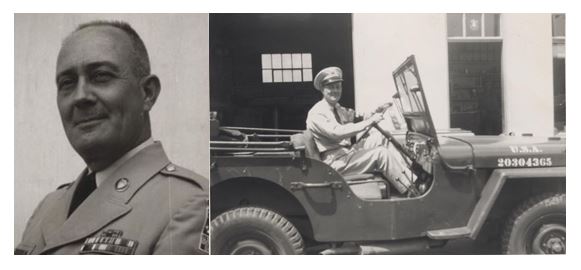
Al Pearson during his Army career
 
In March of 2015, 34 years after his death, there was an estate sale of the belongings of Mary K. Pearson Wolfinger in Mt. Gilead, Ohio.  In the auction listing there were two theatrical trunks of magicians’ effects once owned by her late brother Al, also known at one time in the distant past as Foye´  “The Magician Deluxe”.

Thursday, January 18, 2018

Newmann’s European Novelties and Sensational Features!


C.A. Newmann (1880-1952), was one of America’s greatest hypnotists and mentalists. He humbly appeared as “Newmann the Great.” Here for the first, and probably last time, we feature a throwing card bearing his advertising.
 

Newmann first started performing hypnotism and mind-reading at age 13 billing himself as a “Boy Wonder.” He confined his work primarily to the mid- and upper-Midwest. Although he presented primarily mind-reading and related arts, he was not above offering magic illusions in his show. To publicize his show he frequently performed blindfold drives through the town where he was appearing. These were the days of horse and carriage, of course, and it must have been an amazing sight to see him racing through town while blindfolded.

As magic historians know, Newmann amassed a wonderful collection of magic and an extensive library. He boasted that it was the largest in America but the problem was that because of his touring and itinerant lifestyle, Newmann did not have anywhere to permanently display his entire library.

However he did once secure an empty store and for one brief period, had shelves built, and then filled them with books and rare manuscripts and adorned the walls and columns of the room with posters and broadsides. I have seen photographs of that temporary library and they are impressive.

His friend Howard Thurston acclaimed him one of the greatest of all mentalists. Magician, author, and magic columnist John Northern Hilliard was also amazed at Newmann's incredible feats, declaring him a true artist.

He even eventually ended up teaching classes in psychology at colleges in Minnesota and North Dakota. According to Magicpedia, as late as 1950, Newmann was still appearing in the major auditoriums in Montana and adjacent states. By that time he had been performing continuously before the public for over a half century.

Prior to his death, as well as afterward, Newmann’s library was scattered about. Some 1,000 volumes were given to the library at the University of Minnesota. Collector David Price acquired Newmann’s posters for his Egyptian Hall museum and several of Newmann's scrapbooks are in the Carl W. Jones collection at Princeton University. 

My friend, the late Frank Dailey and I spent considerable time looking over the two scrapbooks at Princeton’s Firestone Library and I was able to photograph a great number of pages. In fact, I lectured on the scrapbooks at a Magic Collectors’ Association weekend back in the 1980s. Newmann died in Minneapolis and his funeral services were conducted by Carl Waring Jones.

And so, why is this Newmann scaling card so rare? Is it one-of-a-kind? Well, yes – sort of. The card was acquired in a larger collection of scaling cards and the previous owner occasionally created scaling cards by pasting some image or advertising on a regular playing card. Such is the case with this card. Running a fingernail across the face of the card, it is clear that he glued on a piece of Newmann promotional material.

Still, it’s a fun card and image and I’ll not be tossing it out. So, fellow enthusiasts, did Newmann have a real throwing card? If so, post it on our site. Here are a sample of some images from Newmann’s scrapbooks at Princeton. You will see that for most performers Newmann wrote up a short item of interest. Every description was flattering to the performer. One scrapbook was devoted to magicians, the other to mentalists. Enjoy!

Tom Ewing 


--  Postscript by Judge Brown --


Tom, I too have a "sort of" Newmann throwing card.  Like you, I got this from an avid throwing card collector.  It's an odd piece -- about the size of a playing card, with two rounded corners and two square corners.  And it does seem to have been cut from something else-- and not too carefully.    But the typescript "With Compliments...." and address have clearly been added with a typewriter, to turn it into an effective business card.  So my presumption is that this piece was created by Newmann himself.


I had always assumed that the improvised nature of this piece showed Newmann -- who was once a major star -- having hit hard times.  He was, after all, hand typing his cards!  But at the last NEMCA conference in 2016, I met a collector-historian who specializes in studying Newmann.  He assured me, with a laugh, that I was wrong.   The card I own, he advised, does not show economic desperation.  Rather, he told me that the piece was typical for Newmann, whom he described as extraordinarily eccentric and parsimonious.

Tuesday, October 24, 2017

Loring Campbell


Alexander Loring Campbell was born on March 19, 1905 in Sapulpa, Oklahoma where in just a few short years, the senior A.L. Campbell and his wife Byrd closed the drug store, packed up their belongings, and had their son comfortably set up in the back seat of the family car for the long trip to Southern California. Loring’s first exposure to magic was watching a group of Japanese performers known as the Ten’ichi Troupe of magicians. It wasn’t long after that Loring tapped by the “Goddess of Magic” and she didn’t let go.

    
  Whether it was entertaining classmates, or working a summer performance in full make-up in a polka dotted suit being billed as “Cambello the Clown”; Loring was fulfilling his destiny to become a full-fledged, professional magician.
After his schooling, Loring captured the attention of the managers of the Redpath-Horner Chautauqua circuit. He was contracted to work a twenty-five week tour. The only condition he had to agree to was being billed as magician Jack Gwynne. Gwynne wasn’t able to complete his contract and it was too late for the management company to alter the advertisements that were in the hands of every place Loring was to perform. So, taking everything in the old adage “the show must go on”, Loring Campbell was “Jack Gwynne”.


 A little known fact in magic history was when in 1929, Howard Thurston was searching for “one more traveling company” to take another one of his sponsored shows out along with his own show, and the Dante and Tampa show; Loring was also in the running. He readily declined, just as McDonald Birch, Werner "Dorny" F. Dornfeld, George Marquis and  Jack Gwynne. This time, Thurston has decided the name for the magician under the Thurston banner would be "Faust the Magician". All declined for the similar reasons; they wanted to keep their name and they their own performance style. When the International Brotherhood of Magicians was founded, Loring joined and was member number twenty-two. He did all that he could to find more members to join this newly established society of magicians wherever he traveled. Loring wasn’t alone in this life adventure, his wife Kathryn was at his side working in the show, on the show, and keeping the show going for many years. Kathryn kept the bookkeeping details kept the rabbits fed, and made sure Loring was on top of his game wherever they performed.

    
They toured throughout the United States dozens of times. Audiences and managers alike praised their magic shows. Loring included numerous effects from sleight of hand, to a presentation of the guillotine, and he would also include escapes. Their two-hour show would change every year and Loring would keep in touch with magic dealers and include whatever the latest effects were popular. He would also update his brochures and posters making sure he would keep the attention on the idea of fun for the entire family. 

          
How could you pass up
seeing this show?


       Whether Loring was performing his noted ventriloquist act with his sidekick, Johnny Applewood, or he stepped up to the artist’s easel and created wonderful rag pictures for all to enjoy; Loring had found his life’s dream and it did come true. He was a member of Los Magicos of Hollywood, Society of American Magicians, and he was a member of the Hollywood Comedy Club. 

           Loring wrote a column for the Tops Magazine titled “The Campbell Caravan” that was enjoyed by all its subscribers. He was elected into the Society of American Magicians Hall of Fame. Loring wrote two books This is Magic in 1945 and Magic That Is Magic in 1946. He retired from the stage in 1955. Kathryn passed away in 1958. Loring continued his interest in magic always there helping other performers and keeping in touch with magic friends he had met for the many years he was on the road. Loring passed away on January 11, 1979.