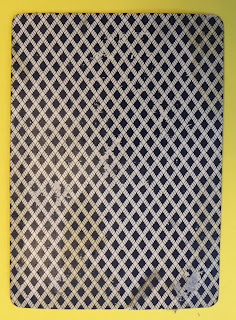
Showing posts with label T. Nelson Downs. Show all posts

Monday, August 29, 2022

The Tall Tales of Eddie "Tex" McGuire


When researching magicians, it's always hard to know what to believe, But the subject of this post - Eddie "Tex" McGuire -- is in a league of his own when it comes to tall tales.


Here's what I can assemble from a number of magic publications:
He was born in or around 1891, and by 1910, persuaded his father to use money that had been saved for college to study magic, eventually performing under the names The Great Gilland, Don Cortex and Tex McGuire. His favorite trick consisted of driving a Cadillac, with seven passengers, on stage and making the car and its occupants disappear. By age 19, he began traveling with a show headed by Mrs. Tom Thumb. He served in WWI, wounded and subject to gas attacks. In the 1920s, he returned to Europe. And here's where the legends begin.


According to various sources -- principally McGuire -- he created a "mathematical system" whichpermitted him to "break the bank" at Monte Carlo on three occasions. While that's an exciting thing to say, it's more interesting once one knows what it means. According to Wikipedia:
The expression "breaking the bank" is used when a gambler wins more money than the reserve held at that particular table in the casino. At the start of each day, every table was funded with a cash reserve of 100,000 francs – known as "the bank". If this reserve was insufficient to pay the winnings, play at that table was suspended while extra funds were brought out from the casino's vaults.


The list of bank breakers -- though admittedly incomplete, does not include McGuire's name. Another myth swirling around McGuire was whether he (like so many others) was the author of The Phantom of the Card Table. That McGuire might be Erdnase is further undermined by a second rumor associating him with Walter Scott, an individual who is claimed by some to be that elusive writer.


Fuel was poured on the tall tale fire by the release of a five dollar book about McGuire authored by Edward S. Cannon and produced by Lee Jacobs in 1953. The ad copy consisted of a series of provocative questions about McGuire, including whether he broke the bank, was actually Erdnase, was the subject of superlative quotes by Houdini and Thurston, and was a star of the Roy Rogers Rodeo. The ad copy concludes that "Tex McGuire was all of these and much, much more." So maybe it wasn't the most accurate historical portrait....


One of McGuire's most important contributions to magic occurred, in a sense, posthumously. Beginning in 1922, he entered into a long, detailed correspondence with the famed T. Nelson Downs. The two men wrote a series of letter that were meticulously cataloged over several years, exchanging trick ideas, moves, handlings and stories. In 1971, John Braun compiled these ideas into a special Linking Ring parade which is quite interesting.


I originally picked up this oversized, two-color, single-sided business card because I knew of McGuire as Max Malini's manager (and I have a copy of what seemed to be McGuire's manager card). After researching this subject, though, I no longer know what to believe.


Sunday, February 17, 2019

Pierce-ing the Mysteries of Scrapbook Damage


Recently, I was admiring this marvelous keepsake -- assembled in 1928 by some long-forgotten fan of  Howard Thurston's -- that was up for auction on eBay.   It was a kind of collage with a throwing card at its heart -- the card and two show ticket stubs had been glued to the face of a newsprint theater program.  While I made a half-hearted attempt to bid on the piece, I was somewhat relieved not to win it. After all, its owner faces a conundrum -- does one keep this unique assemblage together -- possibly the best curatorial thing to do -- or give in to the temptation to try to remove the card from its ancient and likely acidic bonds?   Without doing so, one might not even be able to tell which Thurston card is showcased here -- is it a Perfect Sleep card or the Spirits Return variant?  (You can see both varieties, which share a common face, on the Howard Thurston page).

Considering approaches to this problem brought to mind another difficulty faced by nearly every throwing card collector: how to handle a scrapbook-damaged card.   Because of the 20th Century fascination with slathering glue on collectables, including postcards, playing cards and photographs, and sticking them into scrapbooks and albums, hence making them a "collection," if you collect enough cards you will eventually encounter this issue.  Many of the best pieces in my collection came to me from an auction held by George Hawley (1920-2000), a kind and generous collector and performer who privately sold off his collection in the late 1990s, and from whom I was able to obtain scores of incredibly rare cards.  Unfortunately, many of them had been pulled roughly from a scrapbook at some point in time, probably before George got them. The result is a variety of injuries, ranging from spots and clumps of paper, cardboard and glue on the reverse to, in some cases, tears affecting the images themselves, including irreparable paper loss.  Conservation sources on the Internet suggest that the acidic content of scrapbook remainders could leach into the card itself, destroying the collectible.  Plus, of course, such an accumulation obscures the back of the card.

My card for J.E. "Mysterious" Pierce, seen above, is one example of a badly affected card -- though largely a buildup of cardboard, some of the original card backing had been torn off in places.  Compare this to the pristine red back on the card in Tom's collection reproduced here, as seen on our original Pierce page.


Over the years, I have attempted to remediate damage to some of the cards.  All of my cards are stored in archival sleeves, protecting them from further insult.

In some cases, though, I made more active efforts to remediate the damage. PLEASE NOTE THAT I HAVE HAD A VARIETY OF RESULTS WITH THESE TECHNIQUES, AND HAVE AT TIMES CAUSED DAMAGE TO CARDS.  THEREFORE, I DO NOT ENDORSE TRYING ANYTHING MENTIONED HERE WITH A CARD OF SIGNIFICANT ECONOMIC OR PERSONAL VALUE.   TRY ANY OF THESE IDEAS AT YOUR OWN RISK.

The Bicycle Expert Back
One technique I used was to gently rub the backs of cards with a dampened Q-Tip.  Though slow going, this technique proved effective particularly in cases where the card was glazed or laminated, and the card's surface was largely intact. The red Bicycle Expert back of a T. Nelson Downs card, seen here, was the beneficiary of this treatment.  As can be seen from the photo, I was able to remove accumulated debris and reveal almost all of the back.  While still spotted and faded in places, the result was not bad.


The Pierce card, seen above, was far more problematic. Although most of the back was intact, it has been so thoroughly saturated with glue that the face even bears damage, including brown glue stains. and the upper left corner of the card has been torn off.  As a result, I was hesitant to apply water to the back as it would likely result in water stains.

Trolling around the Internet for a solution took me to a variety of card and photo collecting sites, These sites tout several approaches including chemicals (one that looked promising is called Undu), dental floss, blades, and soaking in water or other solutions.  (Notably, one that I tried, CitraSolv, did not damage the cards but also didn't remove the glue).  Finally, I decided on a fix recommended by a postcard collector, which seemed least risky and most promising: steam.

So I fired up the kettle and gave it a try.  Holding the card back up to the stream of vapor, I steamed small areas at a time.  After a moment, the card curled in my hand, but it was easy to flatten it by blotting on a clean, dry washcloth. Though I tried several tools, including a Q-Tip and a dental flosser, a paring knife proved most valuable, though I mainly used the dull edge of the knife to gently remove the accumulation of cardboard from the card as the steam permeated successive areas.

The white areas turned out
 to be a white glue.

Endeavoring to avoid removing anything other than the dark brown cardboard, I got a bit of a scare when a clump of white came off in my hand -- but that turned out to be a layer of white glue, as can be seen in this close-up.   That glue peeled off easily, revealing the rich blue color and elaborate engraving work of the original card design.


The result?  Overall, not bad. While a few gouges emerged which made the work difficult, the before and after photos below show just how much I was able to improve this card with a bit of work.   It's not perfect, but it allowed me to reveal most of the detail on the back design, and does not appear to have negatively affected the card.  This approach is certainly not suited for every situation, but it helped me restore a touch of grandeur to Pierce the Mysterious.


Before


After: The J.E. Pierce Blue Back


Having gained some confidence and skill with the process, I decided to give it a try with an Ovette "Magic Wand" card -- perhaps the most inappropriate in my collection.  I learned to trust the steam to do more of the work, finding that the glue layer would, properly permeated with heat and moisture, easily peel from the back of the card, leaving it nearly perfect.   Though I again used a knife to help gently scraped the adhered mess from the card back, at times I could even use my finger to gently rub it off.  As you'll see in the before and after pictures below, the result was even better.


Ovette's Back Before
Ovette's Back: After


A quick word on Joseph Ovette (1885-1946), an Italian immigrant, began his career as a medicine show performer, eventually becoming a fixture of vaudeville.  Billed as The Great Ovette in his stage show, he also offered Asian-themed show under the name Lung Chang Yuen and performed mentalism as Mar-Jah.  Ovette wrote several books on magic.

Those who collect posters have professional restorers to whom they can turn, and I have used such services in the past with satisfying results.   If there are professional restoration services available for cards, I am unaware of such.   Perhaps one day, if the value of the card warrants it, that may prove an option.  In the meanwhile, under the right circumstances, I found that using steam was a fairly good method which seemed -- in these cases -- to do little harm to the cards.  Again, though, please use caution -- and prepare yourself for heartbreak -- if you try this on your own.... 

Monday, October 15, 2018

Eddie "E.J." McLaughlin - Magician and Gentleman

Among the hidden gems of the Swedish Magic Archive was this unusual and unexpected piece.  The adjective "unexpected" applies here because, though Christer Nilsson's collection focused largely on European performers, this card features a distinctly American performer with a Bicycle promotional back.   And the back has a particularly distinctive feature: unlike many of the Bicycle-backed throwing cards, this one identifies the back pattern, a Lotus 808, with an indication that the back is available in red or blue, making the card more akin to a salesman's sample.

Turning to the performer featured, Eddie "E.J." McLaughlin was born in Clinton, Iowa in 1897.    According to Frances Ireland, McLaughlin was

"a life-long follower of the art. Although never a full time performer, he was a good semi-pro, and developed into an ardent collector of books and memorabilia. People like Eddie keep magic alive. He thought about magic or did something about it every day of his life. His wide circle of friends included an inner group with which he corresponded or visited at frequent intervals, always with magic as the basis of the friendship. These men were all brilliant followers of magic themselves, men like Charles Maly, Fawcett Ross, the late Tom Bowyer, and Sid Lorraine, and they, together with Eddie, tossed the magic ball back and forth, improving, suggesting, defining, furthering, all of them very sincere in their interest, and none more sincere than Eddie."
McLaughlin became, somewhat famously, a close friend and frequent traveling companion of T. Nelson Downs.  As a result of this friendship, McLaughlin assembled a collection of Downs's correspondence that would later prove important to magic historians.   He was also a friend of Dai Vernon and Max Holden, the latter of whom referred to McLaughlin as "a keen magician and a gentleman of the finest brand."

Eddie McGuire, manager of the famed Max Malini, raved about genuine gold coin routine developed by McLaughlin.  McGuire was so inspired by McLaughlin's routine that he developed a gold coin routine of his own (undescribed in the literature but used the fact that a shell penny fit over a $2 1/2 dollar gold piece), which later became a part of Malini's performances.

McLaughlin held various jobs in business, industry and Government, most notably as an auditor for the Federal Housing Administration.  Magic periodicals document his involvement in the art over a half century, beginning with references in the early part of the 20th Century until his death in 1965.

McLaughlin was a quiet enthusiast who had an oversized role in the progress of the art of magic.  His name was never in lights, and it would be unlikely to find a poster trumpeting his performances.   All of which makes it so very nice to have this throwing card to memorialize his magic career.


Tuesday, October 2, 2018

Thurston – Some Throw-Out Card Trivia

It is amazing how many magicians used a throw-out card, or playing card, or a “Good Luck” card to advertise themselves. Without a doubt, the king of throw-out cards was Howard Thurston. From the time early in his career when he started to throw them out to his audience, until he had to stop performing, he literally sent thousands upon thousands sailing out into the theatres in which he played.  
 
From Adventures in Magic by Henry Ridgely Evans, (1927).

As one can imagine, Howard Thurston has been covered on this blog many, many times. Co-contributor Gary Frank wrote a fine post on Thurston and included many examples of his cards. I thought I would offer up, on this post, some interesting items of trivia that I have found on Thurston related to his throw-out cards, and his card scaling.
One early reference I have found concerning Thurston’s card throwing was found in the Black and White Budget for January 12, 1901 shortly after he had arrived in England. Like Harry Houdini and T. Nelson Downs, Thurston’s career first took off when he went to London. The following is a small sampling from that article.
Thurston’s inclusion of card throwing appears to have been inspired by having seen Alexander Herrmann while a young man. Thurston scaled cards from the start of his career when he billed himself “The World’s Premier Card Manipulator”. On one of his earliest throw-out cards from the beginning of his days as a performer, he had a card produced with an image of him about to throw a card. While I don’t have this particular card in my collection, Harry Houdini had this one shown below in a scrapbook.  This scrapbook now resides, and is through the courtesy of the Harry Ransom Center, The University of Texas at Austin.
Courtesy of Harry Ransom Center, The University of Texas at Austin.
We can get a general idea of the time frame of Thurston’s cards by seeing how he aged on the card over the years. This is not a hard and fast rule, as he would use older cards for long periods to keep himself looking youthful. He was rather vain about his appearance, even to the point of having face lifts.
For me, extra special Thurston cards are those where the audience member who received the card would often write the date of getting the card and sometimes the theatre as well. By searching old newspapers, I was able to find the location and even an ad for Thurston’s  performance  for the throw-out card below.
Acquired at the Crown Theatre in Chicago on January 9, 1913.
Another bit of trivia that I had heard for years, was that Thurston could throw a playing card over an 8 story building. The late John Booth mentioned this in his monthly column in The Linking Ring back in 1999. I was able to nail down the source of this story some years back, when I acquired a vintage newspaper page with the Ripley’s Believe It Or Not cartoon that first stated this fact. It ran in newspapers all over the country on December 23, 1930.
In Hugard’s Magic Monthly, Fred Braue wrote; “What is entertainment? Thurston would throw good-luck cards into the audience for perhaps two minutes – and they loved it!” In the same magazine, but a different issue, the magazine’s namesake Jean Hugard wrote the following; “Thurston would throw these to those at the back of the theatre or in the galleries. These cards were much heavier than ordinary playing cards and were therefore easier to throw to a distance. On one occasion, however, Thurston had the misfortune to have one of these cards strike a spectator in the eye and had to face a suit for damages”. Further research indicates the  member of the audience was awarded $500.00 in damages. So scaling cards out into the audience was not without its perils. (I would like to thank co-contributor Judge Brown for reminding me about this incident.)
There is no doubt that the overwhelming quantities of “Good Luck” throw-out cards that Thurston scaled out to his appreciative audiences was a great marketing tool in terms of advertising. He wanted to make those audiences remember him, and to keep them coming back for repeat performances of “The Wonder Show of the Universe”.

Thursday, March 16, 2017

It's T. Nelson Downs's Birthday!


The Bicycle "Expert" Back (1895)
 While working as a railroad telegrapher in Marshalltown, Iowa, T. Nelson Downs (1869-1938) passed the long, lonely hours teaching himself sleight of hand using coins. The time was well spent -- Downs mastered the art, becoming one of the greatest manipulators of all time. He developed an act in which dozens of coins seemingly materialized at the performer's fingertips. Down's act, dubbed "The Miser's Dream," was the first major advance in coin magic in nearly a century, and is still used by many magicians.

Monday, February 20, 2017

Frank Ducrot


Ducrot's card sports National Playing Card Company's Rambler no. 23 Blue Hindoo Back
Frank Ducrot was born Theodore Francis Fritz on May 7, 1872 in Brooklyn, New York. His interest in magic started as a lad growing up just a ferry ride away from Manhattan where the famed Palace of Magic where Francis J. Martinka’s magic shop was just waiting to entice him. As a performer, he toured the Chautauqua and Vaudeville circuits. His billing as “The Boy Magician” lasted into his 50’s.

Sunday, January 29, 2017

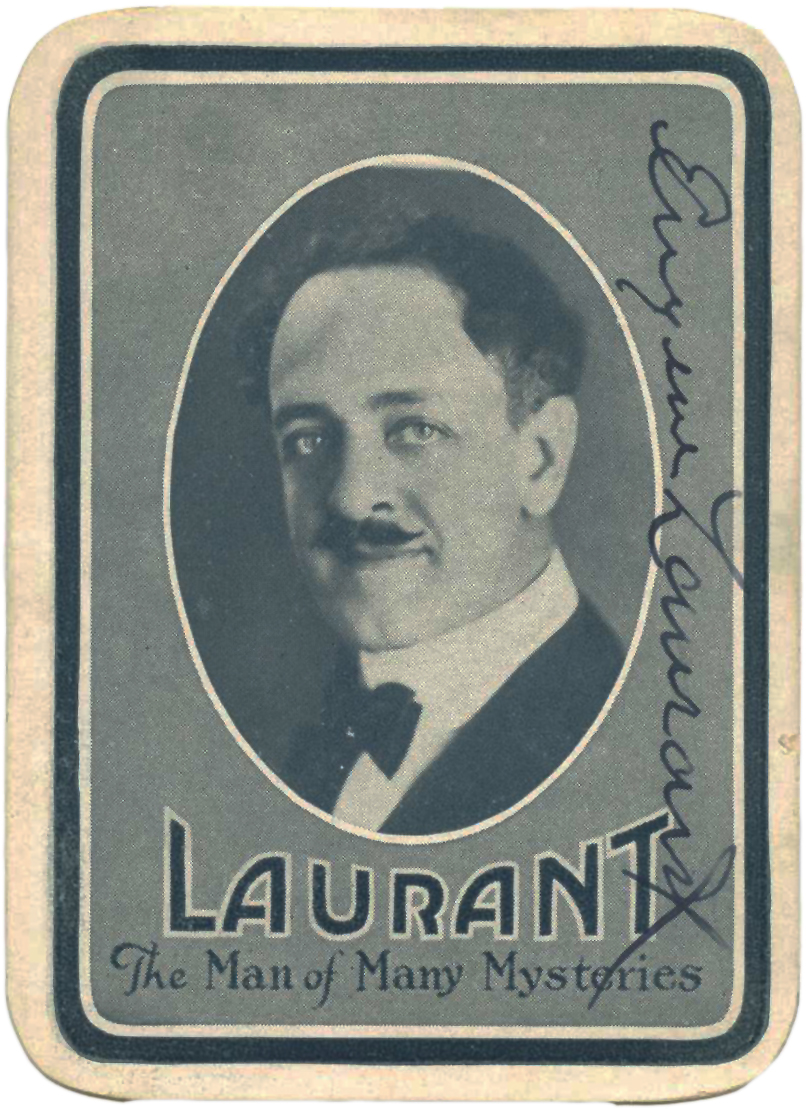
Eugene Laurant


Eugene Laurant was born Eugene Greenleaf August 1875, in Denver, Colorado. He said his interest in magic came all out of a box of tricks in his youth. By fifteen, he billed himself as "Eugene the Boy Magician". He was a part of vaudeville act known as the Carl Nillson's Flying Ballet The Nillson troupe continued to tour and Eugene moved on and joined The Magnascope Company. 

He was one of four acts that performed in between each movie seen. His big break came in 1899 when he was contracted to play at Chutes Park in San Fran­cisco. The park had been opened for four years and their idea was to bring the entertainment to the throngs of attendees. In between taking a ride on the 350-foot Shoot the Chutes, the participants could ride the Scenic Railway roller Coaster, the multi-horse carousel, take aim and try their luck at the shooting gallery, play the games at the penny arcade, or be a part of the show at the park's three thousand seat theater.

Friday, December 16, 2016

"When you play with Bicycle, You hold Good Cards"


The rise of color lithography during the golden age of magic proved a happy accident for collectors of fine, classic magic posters.   For throwing card enthusiasts, the rise of vaudeville stage magic during an explosion in playing card production around the turn of the 20th Century created a similar synergy. 

By the late 1800s, new printing technologies and methods brought about great improvements in the quality of playing cards.  The formation of the United States Playing Card Company in 1894, which soon acquired several other major manufacturers, created a worldwide industry leader. Beginning in approximately 1900, the Company embarked on a number of aggressive marketing campaigns, registered numerous trademarks for its new designs and slogans, offered free window displays to retailers, and invested heavily in national print advertising.

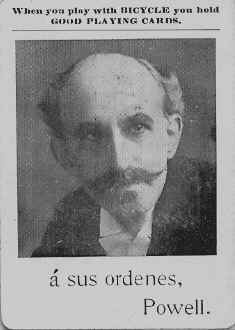
As part of US Playing Card Co.'s promotion of its products, the company hit upon an unusual idea: it offered free, custom-printed advertising cards to stage magicians.  Each card featured one of the Company's prized back designs, plus a slogan promoting Bicycle cards on the face.  The balance of the face was devoted for space featuring images and text about the magician.

"For a number of years, in the early part of this century, the United States Playing Card Company, and other manufacturers of playing cards would print a quantity of cards gratis for any magician requesting them." John Mulholland wrote in The Sphinx in June 1944.  "The playing card companies’ generosity to magicians to distribute cards bearing advertising of their products on one side of the cards."

It proved a brilliant means of cross-promotion.  Some magicians scaled the cards into the audience, ensuring that the Company's samples would be caught -- and often kept -- by eager audience members.   The results is that dozens of magicians, including some top names in the field, such as T. Nelson Downs and Frederick Powell, had Bicycle brand throwing cards printed.  (On another magic site, collector Jay Hunter put together a collage of nine different back designs that appear on Powell's cards.)  Bicycle cards also feature relative unknowns, such as ventriloquist/magician Ned Frailey.


US Playing Card Co. Ad from Life, February 1901

Each of the Bicycle cards are imprinted with the slogan "When you play with Bicycle, You Hold Good Cards," or some slight variant of this slogan.  The use of this slogan helps date these cards quite specifically.  Searching through various databases, it appears that U.S. Playing Card registered this slogan in various trademarks and used it in print advertising from 1900-1905, like the ad seen here.   This suggests that any throwouts bearing this slogan date from this around period.

It's worth noting that several other playing card companies employed a similar strategy, including Golf Playing Cards and the Canadian Playing Card Company.  In fact, one promotional card touting "National" and "U.S." playing cards as the best could well be considered the scarcest throwing card of all: its face features a young and not-yet-successful Harry Houdini as a magician offering instruction in sleight of hand.   (A very small image of this card can be seen in Ricky Jay's book Cards as Weapons, which is also a scarce collectible).

 "Throw-out cards should have great publicity possibilities," Mulholland concluded, "but in the past
most of the cards have either been poorly printed or carried designs which were inartistic and were printed from cheap cuts. Except for Thurston, and one or two others, the printing was never in colors. With the proper layout and pictures, good printing, and in colors, one good stock, throw-out cards might once again regain their usefulness as good advertising for magicians, and souvenirs the public would cherish."

Mulholland's critique has particular application to the playing card company promotional cards: designed primarily to sell decks, not magic, these pasteboards feature luscious back designs, but the fronts generally offer grainy photos and splotchy printing.   Nevertheless, they are highly collectible and interesting souvenirs of a bygone era.

To learn more about the importance of back designs in the study of throwing cards, check our Back Story page


 Readers interested in lithographic posters can find lots of great information and images at Ken Trombly's magicposters.com and Charles Greene's site, magicpostergallery.com.