
Recently, I was admiring this marvelous keepsake -- assembled in 1928 by some long-forgotten fan of Howard Thurston's -- that was up for auction on eBay. It was a kind of collage with a throwing card at its heart -- the card and two show ticket stubs had been glued to the face of a newsprint theater program. While I made a half-hearted attempt to bid on the piece, I was somewhat relieved not to win it. After all, its owner faces a conundrum -- does one keep this unique assemblage together -- possibly the best curatorial thing to do -- or give in to the temptation to try to remove the card from its ancient and likely acidic bonds? Without doing so, one might not even be able to tell which Thurston card is showcased here -- is it a Perfect Sleep card or the Spirits Return variant? (You can see both varieties, which share a common face, on the
Howard Thurston page).

Considering approaches to this problem brought to mind another difficulty faced by nearly every throwing card collector: how to handle a scrapbook-damaged card. Because of the 20th Century fascination with slathering glue on collectables, including postcards, playing cards and photographs, and sticking them into scrapbooks and albums, hence making them a "collection," if you collect enough cards you will eventually encounter this issue. Many of the best pieces in my collection came to me from an auction held by George Hawley (1920-2000), a kind and generous collector and performer who privately sold off his collection in the late 1990s, and from whom I was able to obtain scores of incredibly rare cards. Unfortunately, many of them had been pulled roughly from a scrapbook at some point in time, probably before George got them. The result is a variety of injuries, ranging from spots and clumps of paper, cardboard and glue on the reverse to, in some cases, tears affecting the images themselves, including irreparable paper loss. Conservation sources on the Internet suggest that the acidic content of scrapbook remainders could leach into the card itself, destroying the collectible. Plus, of course, such an accumulation obscures the back of the card.

My card for J.E. "Mysterious" Pierce, seen above, is one example of a badly affected card -- though largely a buildup of cardboard, some of the original card backing had been torn off in places. Compare this to the pristine red back on the card in Tom's collection reproduced here, as seen on our original
Pierce page.
Over the years, I have attempted to remediate damage to some of the cards. All of my cards are stored in archival sleeves, protecting them from further insult.
In some cases, though, I made more active efforts to remediate the damage. PLEASE NOTE THAT I HAVE HAD A VARIETY OF RESULTS WITH THESE TECHNIQUES, AND HAVE AT TIMES CAUSED DAMAGE TO CARDS. THEREFORE, I DO NOT ENDORSE TRYING ANYTHING MENTIONED HERE WITH A CARD OF SIGNIFICANT ECONOMIC OR PERSONAL VALUE. TRY ANY OF THESE IDEAS AT YOUR OWN RISK.
 |
| The Bicycle Expert Back |
One technique I used was to gently rub the backs of cards with a dampened Q-Tip. Though slow going, this technique proved effective particularly in cases where the card was glazed or laminated, and the card's surface was largely intact. The red Bicycle Expert back of a T. Nelson Downs card, seen here, was the beneficiary of this treatment. As can be seen from the photo, I was able to remove accumulated debris and reveal almost all of the back. While still spotted and faded in places, the result was not bad.

The Pierce card, seen above, was far more problematic. Although most of the back was intact, it has been so thoroughly saturated with glue that the face even bears damage, including brown glue stains. and the upper left corner of the card has been torn off. As a result, I was hesitant to apply water to the back as it would likely result in water stains.
Trolling around the Internet for a solution took me to a variety of card and photo collecting sites, These sites tout several approaches including chemicals (one that looked promising is called Undu), dental floss, blades, and soaking in water or other solutions. (Notably, one that I tried, CitraSolv, did not damage the cards but also didn't remove the glue). Finally, I decided on a fix recommended by a postcard collector, which seemed least risky and most promising: steam.
So I fired up the kettle and gave it a try. Holding the card back up to the stream of vapor, I steamed small areas at a time. After a moment, the card curled in my hand, but it was easy to flatten it by blotting on a clean, dry washcloth. Though I tried several tools, including a Q-Tip and a dental flosser, a paring knife proved most valuable, though I mainly used the dull edge of the knife to gently remove the accumulation of cardboard from the card as the steam permeated successive areas.
 |
The white areas turned out
to be a white glue. |
Endeavoring to avoid removing anything other than the dark brown cardboard, I got a bit of a scare when a clump of white came off in my hand -- but that turned out to be a layer of white glue, as can be seen in this close-up. That glue peeled off easily, revealing the rich blue color and elaborate engraving work of the original card design.
The result? Overall, not bad. While a few gouges emerged which made the work difficult, the before and after photos below show just how much I was able to improve this card with a bit of work. It's not perfect, but it allowed me to reveal most of the detail on the back design, and does not appear to have negatively affected the card. This approach is certainly not suited for every situation, but it helped me restore a touch of grandeur to Pierce the Mysterious.
 |
 Before Before
|
 |
| After: The J.E. Pierce Blue Back |
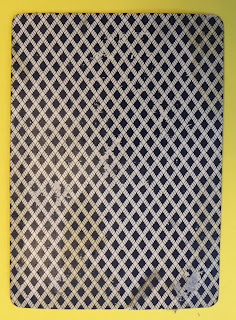
Having gained some confidence and skill with the process, I decided to give it a try with an Ovette "Magic Wand" card -- perhaps the most inappropriate in my collection. I learned to trust the steam to do more of the work, finding that the glue layer would, properly permeated with heat and moisture, easily peel from the back of the card, leaving it nearly perfect. Though I again used a knife to help gently scraped the adhered mess from the card back, at times I could even use my finger to gently rub it off. As you'll see in the before and after pictures below, the result was even better.
 |
| Ovette's Back Before |
 |
Ovette's Back: After
|
A quick word on Joseph Ovette (1885-1946), an Italian immigrant, began his career as a medicine show performer, eventually becoming a fixture of vaudeville. Billed as The Great Ovette in his stage show, he also offered Asian-themed show under the name Lung Chang Yuen and performed mentalism as Mar-Jah. Ovette wrote several books on magic.
Those who collect posters have professional restorers to whom they can turn, and I have used such services in the past with satisfying results. If there are professional restoration services available for cards, I am unaware of such. Perhaps one day, if the value of the card warrants it, that may prove an option. In the meanwhile, under the right circumstances, I found that using steam was a fairly good method which seemed -- in these cases -- to do little harm to the cards. Again, though, please use caution -- and prepare yourself for heartbreak -- if you try this on your own....

 Elsewhere, I mentioned that many of my most prized pieces came from the collection of George Hawley, a long time resident of Batavia, New York. It is unsurprising, then, that one of those pieces was this fine card promoting Billy Russell, perhaps the most famous magical figure to hail from Batavia. During the time I operated throwingcard.com (meaning, before the advent of AskAlexander), information about Mr. Russell was quite hard to come by. Indeed, the sum total of the information uncovered at that time consisted of the following from George Hawley:
 Tantalizingly, in his 1947 profile, Gordon noted that a book that Russell had authored, “Tricks of the Magic Trade, on which he
has been working for years, will be published soon, and all professionals who
have looked over the manuscript pronounce it the 20th century bible of stage
magic.” But no such book followed. In 1964, Dr. Grossman, writing for M*U*M , conducted an extensive search for Tricks of the Magic Trade and proclaimed that the book never saw print. What could have happened to this fine work described by Gordon?
Tantalizingly, in his 1947 profile, Gordon noted that a book that Russell had authored, “Tricks of the Magic Trade, on which he
has been working for years, will be published soon, and all professionals who
have looked over the manuscript pronounce it the 20th century bible of stage
magic.” But no such book followed. In 1964, Dr. Grossman, writing for M*U*M , conducted an extensive search for Tricks of the Magic Trade and proclaimed that the book never saw print. What could have happened to this fine work described by Gordon?


