Showing posts with label Lee Asher. Show all posts

Thursday, December 7, 2017

Phantom Base Ball: "The Finest Magicians' Advertisement Ever Known"

Ad from the Sphinx, 1908
One evening, while searching for something completely different in AskAlexander, I came across this wonderful advertisement from the Sphinx published in 1908.  In that ad, a Philadephia firm called the M. Lewis Company, exhorting magicians to purchase "the finest magicians' advertisement ever known."  Hyperbole aside, M. Lewis was attempting to entice practitioners to acquire, at the cost of $3 per thousand, blank faced playing cards bearing this interesting illusion-back design.  The card offered the possibility of spinning the card to make the "Phantom Base Ball," printed slightly off center, appear to jump to the center of the disc.


Since the "Phantom Base Ball" ad appeared, to my knowledge, only once in a single magazine, and I had never seen such a card, my hopes for finding one (if one ever existed) were slim.  Of course, in discounting these chances, I once again underestimated the remarkable collection curated by, in the aggregate, the contributors to this blog and their many kind friends and associates.   This time it was Gary Frank to the rescue, searching his extensive holdings to produce a gorgeous exemplar:


While M. Field's claim that the illusion back is "the finest ever known" cannot be fairly evaluated, it is certainly a fine, striking back. Like many throwout cards, the vivid, intricate back design is of a far higher quality than the face.  The card promotes Marque, a magician about whom we've been able to uncover nothing, other than to note that like many traveling performers of the period, Marque used The Billboard as a permanent mailing address.


I'm not sure what to make about the manufacturer's concerns about "Bugheads" claiming to have invented this illusion, or the biblical references that follow, other than to conclude that, even in 1908, the illusion was nothing new.  But we certainly can speak to its staying power.

The illusion featured here is one of many "spinning disk" illusions that were and remain popular ways to distort visual perception.  Similar designs can often be found on grafted onto spinning tops or yo-yos.

While there are all kinds of variations of this illusion, a very similar design appeared on the face of several throwing cards, including one for Manfred Scholtyssek as well as another card for the magician Topper Martyn.  Manfred Scholtyssek (1927-2008), publisher of “Zauberkunst”, the magic magazine of the former GDR, which Scholtyssek produced after political change in Germany. The Martyn card, seen here, has an aviator back which may have been produced by Haines House of Cards. The Scholtyssek card came as part of the collection of the Swedish Magic Archive.
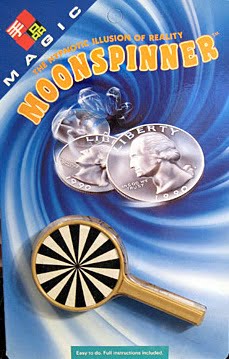
Package for Tenyo Moonspinner Illusion


While discussing this card with enthusiast Lee Asher, he pointed out the similarity of this illusion to that incorporated into Tenyo's Moonspinner paddle illusion.




Thursday, June 8, 2017

Haywood's Back, An Exquisite Enigma

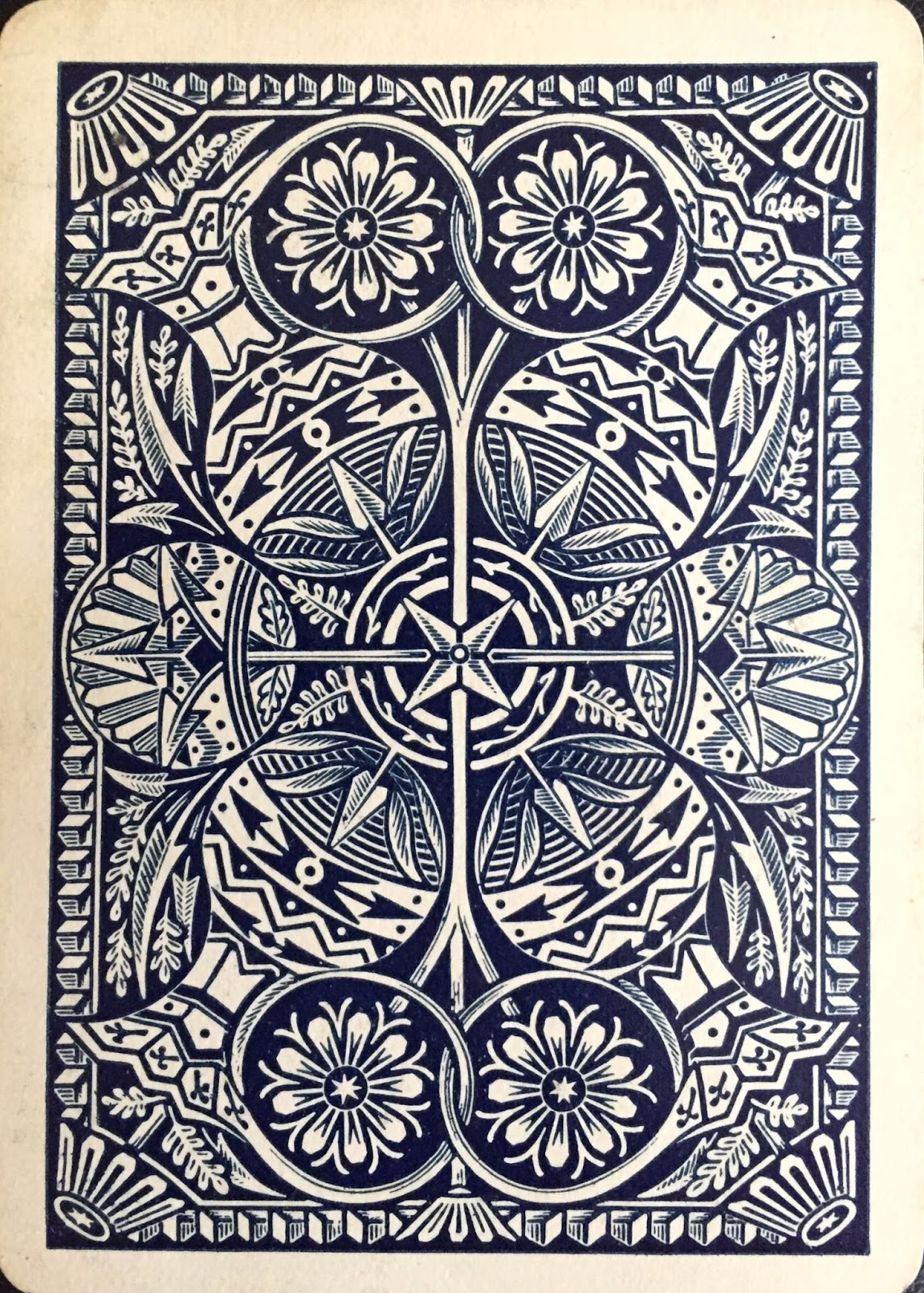
After preparing the post about Harry Haywood, automotive pioneer, I took a fancy to the beautiful and intricate back design of the card (which I'll call, for these purposes, "The Haywood Back.")   Searching through my collection for another exemplar of this back and finding none, and able to locate no other clues about its manufacture or origin, I opted to contact our friend, Lee Asher, head of the 52 Plus Joker American Playing Card Collectors Club for some scholarly guidance.

Answering the question, Lee advised, required him to crack open a "cold case file" in the 52 Plus archives.  It seems that the good folks at U.S. Playing Card Company asked him about the Haywood Back just a few years ago.  Apparently, after deciding to publish a "historic" deck, USPCC offered card aficionados the opportunity to select the back from several designs, including the Haywood Back.    The votes were tallied and the Haywood Back won.   

Here comes the mystery: after the voting, the people at USPCC
"got to work tracking down the story of this deck back. And we came up short. No one knew where it came from; the printing plate may have fallen from the sky and into the glass protective case, for all we know."
Displaying Herman TO card.jpgAlthough they had the printing plate for the deck back, the people at USPCC could not locate a single example of its use. So, they did what I did: they consulted with Lee Asher.  Despite Lee's considerable knowledge and access to a national network of card collectors, he, too, could not locate a complete deck of these cards. Thus, when I sent Lee the Haywood Back, he was delighted, particularly after years of unsuccessful sleuthing.  The Haywood card was among the first exemplars of this back design to surface.

But we at Propelled Pasteboards did not quit there.  I asked my co-contributors Gary Frank and Tom Ewing, and our friend Jay Hunter, to search their collections for this rare back design. Gary Frank found a different piece that also used the Haywood Back -- this one for a performer named Namreh (backwards for Herman), whose story we'll feature in a separate installment.  Jay, too, located additional examples of the Haywood card and the Namreh piece.

Tom managed to turn up something entirely different: a card for a performer named Issac Twamley who billed himself as Valentine (and also happened to be born on St. Valentine's Day). It's scrapbook damaged-back clearly features the Haywood Back, but this time in red.

So, even though a diligent search by USPCC and the members of 52 Plus Joker failed to fully expose the mysteries of the Haywood Back, we here at Propelled Pasteboard turned up five examples in three different varieties and two colors, all in the space of a day.  "Clearly," my wife quipped when I advised her of this accomplishment, "you guys have the power."

Back of Valentine card
Our work rekindled interest in this particular project, so the members of 52 Plus Joker snapped back into action.  Lee sent out a request for further help, and his folks delivered.  Barb Lunaberg, the head of the Chicago Playing Card Collectors Club, advised that she located a blank card with a Haywood Back. This makes a great deal of sense: as we've learned from on other posts, including those about Roterberg Stock Cards and the Bamberg Cards: Blank faced playing cards were often sold or given to magicians expressly for the purpose of printing giveaway cards.  Following this, Lee made the final scholarly link: he found the Haywood Back in a vintage playing card catalog given to him by long time 52 Plus Joker member, Toby Edwards.

So what is the Haywood Back?  Lee advises that the design appears in the No. 9 Tally Ho Collection made by Andrew Dougherty, a leading card manufacturer with strong distribution in the New York area.  The design is called
the "Vase Back, No. 930" (note the vases drawn into the pattern).  I guess we can't call it the Haywood Back any further...

Mystery solved!


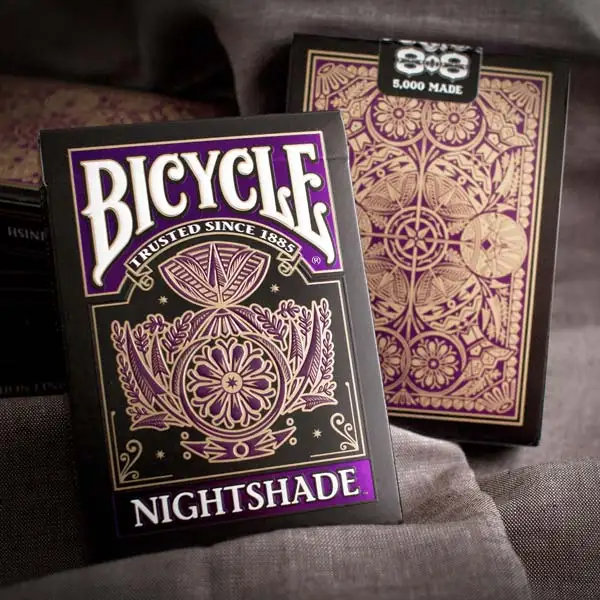
The Bicycle Team at USPCC advised that this particular card design back was reproduced in 2014 as promised in a limited run, Club 808 Edition called Bicycle® NIGHTSHADE, which featured a rich gold and purple version of the original design.

Image result for bicycle 808 nightshade

You can read USPCC's full account of its adventure here, which includes some interesting insights about the artistic style of this formerly-mysterious card design.

Thursday, April 6, 2017

Lee Asher & 52 Plus Joker


In an effort to bring Propelled Pasteboards to interested viewers and increase our knowledge base, I contacted the 52 Plus Joker American Playing Card Collectors Club.  The organization runs a fabulous website loaded with information about collecting cards, and issues a wonderful digital journal called Card Culture and a print journal called Clear the Decks.

Imagine my surprise when the return email came from the group's president, our own Lee Asher.  I use the possessive with respect to Lee because, as any magic aficionado can attest, Lee is an internationally renowned card magic exponent.  For those unfamiliar with his work, The Linking Ring for August 2012 reported that:


"noted card star Lee Asher presented his lecture to members of Ring 22.  Raised by a semi-professional sleight-of-hand artist. Lee states that he was born into the art of magic. Lee has been interested in the art of magic for over twenty years and has been performing professionally for half that time.When younger. Lee worked in every magic shop he could get into. This allowed him to interact with different types of people and form a solid foundation. Over the years. Lee has taken that knowledge and performed in every situation possible.Lee states that all this hard work finally paid off in 1991 and 1992 when he won first place at the IBM. Close-up Championships two years in a row. Lee loves to share his magic with the community and has published in all of the industry's leading magazines."

I hasten to add that the "semi-professional sleight-of-hand artist" referenced in that paragraph is Dr. Mark Horowitz, Lee's father, a magician and collector who proved of great service when I was writing The Coney Island Fakir.

Lee jumped right in to help with Propelled Pasteboards, trumpeting the blog, featuring several of our posts in Card Culture, and providing interesting historical detail about certain cards on the site.  By way of example, because of Lee's contributions, I have learned that Flosso's throwout card seen on the Backstory page is an Andrew Dougherty brand card using the Tally Ho Circle back design.   Additionally, he advises that the back of the E.J. Moore card featured on the site has a Bicycle Lotus back.

Of course, this is a blog about cards featuring magicians, and Lee does not disappoint in that regard, either.  Looking around his website, I was able to uncover the fact that Lee has designed his own playing card deck, manufactured by Spanish card maker Fournier, which features the outstanding signature Ace seen here and comes in the two colors pictured.  Called the Lee Asher 605s, the cards are specially designed for card magic.  Having designed a card effect using Fournier cards, I can attest to the remarkable quality of their products.

So when you've read enough about throwing cards here, take a gander at the 52 Plus Joker site.   You'll be amazed.