Showing posts with label Harry Kellar. Show all posts

Wednesday, December 18, 2019

J.W. Wilson

I've long had a particular fondness for this card featuring J.W. Wilson, perhaps drawn by the incredibly cheesy devil-costume clad assistant whispering in this performer's ear.  This particular piece of ephemera dates to an era when artists like Thurston and Kellar distributed promotional pieces adorned with gorgeous lithography sporting imps, devils, owls and other familiars imparting secrets to the performer. Wilson went decidedly low-tech and low-rent on this piece, offering a friend in a devil get-up in this black-and-white photo. The Deland back suggests that Wilson may have hand-printed these himself.  

A group of Deland backs.  Wilson's is on the left.

So who was J.W. Wilson?   That Wilson is a common surname, and he insisted (generally) on only using the initials J.W.. made him somewhat difficult to track down.   (Consider the fact that these pages also feature a contemporary named John Darrell Wilson).  Scattered references reveal that together with the famed A.M. Wilson (ed. of the Sphinx), he was admitted to the Society of Buffalo (New York) Magicians in 1921. Later that year, the Sphinx reported that J.W. performed something intriguingly entitled his "Black Box Mystery" but left tantalizingly undescribed. (Additional research suggests it was a put-together production box).    In 1922, the Sphinx reported that Wilson was performing magic and Punch and Judy shows for American Legion halls.  By 1928, he hosted a group of Buffalo magicians, now using the name "John W. Wilson" and performed a spirit seance, and by 1933, this group elected him "stage manager."

The other textual clue on the card was the reference to The New York Clipper.  This periodical, it turns out, was a theater newspaper published in New York City through 1924, when its coverage was assumed by Billboard.  This helps date the card, and suggests that Wilson was playing the theater circuit.

Fortuitously, I came across this image of a 1918 issue of The Magic World on an Internet antique dealer's site, and Tom Ewing was able to secure a copy of the article for me.   It adds a few details: Wilson was born September 29, 1876 in Buffalo.  He developed a magic program and eventually added some large stage illusions, leading to a contract with United Booking Offices.  The illusions included Black Art and The Haunted House.  The Magic World found him working in Delaware and developing a new, Asian-themed act.  


 Despite my derisive comments about the production values of Wilson's throwing card, it turns out the image he used was a magazine cover portrait, which makes it a pretty cool collectible.

Finally, there is a coin move called the "JW Wilson Grip."  For a time, I assumed it was attributable to this performer.   However, continued searching led me to a September 2010 article in M-U-M by inventive magician Nathan Kranzo.  Fascinated by the JW Wilson move, he dug into the question, and came to believe that it had been developed by a Jimmy (sometimes spelled "Jimmie") Wilson, Jr. whose father, J.W. Wilson Sr. was also an accomplished magician.  Yet Richard Kaufman credits "Jimmy Wilson, Sr." for developing a coin grip in 1946 (see Genii, June 2003).  And the Conjurer's Magazine for May 1946 does contain  an effect called the "Five Coin Vanish" by one Jimmy Wilson.

The J.W.'s -  father and son - have left us with a few mysteries.


Sunday, March 10, 2019

Jack Burch – A Bicycle Mystery

I really enjoy finding new throw-out cards that utilized the free promotion that was offered to magicians from Bicycle Playing Cards. In exchange for the ad on the front of the card that proclaimed how good Bicycle Cards were, the magicians could get the cards made up for free. This card for Jack Burch caught my eye as the wording was a little different than what I was used to seeing.
 
In place of the phrase “When you play with BICYCLE you hold GOOD PLAYING CARDS”, this card states, “Bicycle” “Playing cards possess peculiar points of merit not found in other makes at the same price. Their playing and wearing qualities are unequaled. Insist on having “Bicycles”. “They are the best”.
The back of this card remains a mystery however. It is gone. It is not that there is scrapbook residue covering the back. The back is just not there. Evidently this card was glued in a scrapbook, and when it was removed, the Bicycle back was left behind. It is a shame too, as I feel this card is a very early example from the Bicycle promotion. The era in which Jack Burch performed leads me to believe this.
From The Sphinx for July of 1902.
Below is a short bio on Burch which appeared in The Sphinx for November of 1902. His name was John G. Burch, but in reality his last name was Burcy. He went by “Jack”. Besides the bio, he was also featured on the cover of the magazine.
In the first ten years of the Twentieth Century, I found several references to Burch, and good reviews, in the magic magazines and newspapers of that era. An odd item I found in The Sphinx for June of 1904 was a notice that Burch had declared bankruptcy. I thought that this was an unusual thing to print in a magic magazine. This is where I found his real last name.
Occasionally Burch ran ads in The Sphinx for items that he had for sale. In September of 1906, he was offering Harry Kellar’s “Blue Room” Illusion for sale. If he really did have Kellar’s original apparatus as he said he did, you would think he would have avoided misspelling his name as Keller. Twice!
Kellar ad from the Boston Globe for May 18, 1897 and The Sphinx for September, 1906.
After 1910, references to Jack Burch seemed to stop. The only thing I did find was an item from The Sphinx in February of 1917, in which W. J. Hilliar was quoted as saying, “Do you remember – When Jack Burch was a magician?” Like the backside of his throw-out card, Jack Burch just vanished…
From the Louisville Courier-Journal for January 6, 1901.

Wednesday, October 31, 2018

Charles Howard Sheck, the Rise of the S.A.M. and the Broken Wand Tradition


This handsome pasteboard, obtained in early 2017 from Ray Goulet, showcases Charles Howard Sheck,  a seemingly obscure performer, whose obscurity seemed, at first, something of a mystery....

Turn-of-the-20th Century magical periodicals, which provide fairly comprehensive documentation of the lives of conjurers of that period, offer only a few scraps about Sheck.  He received a few brief mentions in Mahatma, an early magicians' magazine printed by New York's legendary Martinka magic shop.  Beginning in 1899, we find Sheck in New York City "playing lyceum dates," dubbed "a clever little professor [offering] the latest sleights with cards and coins" and "busy with local work in Brooklyn."  Curiously, in the grand tradition of magicians making hay out of fooling a leading performer, he is referred to as "the man who mystified Kellar," without further explanation, and commanding ten encores in Saratoga with his "flag trick."

Almost as interesting as the information I found about Sheck was what I didn't find.  Despite exhaustive searching, I discovered little about the nature of the effects he performed, any promotional material or even a single photo.   He published no books or articles.  Aside from the throwing card pictured here, I can find no graphic material relating to this magician.   The date and place of his birth remain a mystery.

While this kind of obscurity makes sense for one of our men of mystery (like Stincel), the trajectory of his career would seem to destined Sheck for substantial influence in the world of magic.   He was among the "prominent regulars" at Martinka's magic shop, where, according to John Mulholland, he found himself among renowned company, including Alexander Herrmann, Imro Fox, Carl Hertz, Harry Kellar, William Robinson, Adrian Plate, de Lion, Zancig, Nate Leipzig, Dr. Ellison,
Frank Werner, John W. Sargent, Dr. Mortimer, Elmer P. Ransom, Bob Ankle, Frank Ducrot and Henry Hatton.  Beginning in the late 1880s, this group (including Sheck) began assembling on Saturday nights, guests of the Martinka brothers in the shop's locked back room.

The so-called "Saturday Night Club" proved to be the precursor to the Society of American Magicians, which became formalized in 1902.  Sheck was among 24 magicians sworn in as the group's founding members, along with some of the most prominent magicians in history.  According to chapter reports, Sheck was an active member, frequently appearing a meetings "with his bag of tricks," and, at one meeting, playing the bagpipes.    At another 1902 meeting, he offered "an envelope test" and a "slate test."


Then, in July 1906, on an evening when Harry Houdini was elected Vice President of the fledgling SAM, "The death of Charles Howard Sheck, of Brooklyn, N.Y., was reported."   No other details are provided.  Hence, Sheck's relative obscurity arose as a result of his death early in the history of the S.A.M. (and presumably at a young age).

His passing was not officially commemorated by the organization until three years later, at an annual dinner in 1909 (at which Harry Kellar was the featured speaker) and a list of departed members was read. At the banquet, a half dozen names of departed magicians, including Sheck, was read aloud. As each name was read, a plate was turned over and a white carnation laid upon it.

The description of this improvised ceremony made me wonder: why didn't they simply perform the traditional "broken wand" ceremony?  The answer is simple: no one had yet devised the tradition.  There would be no mention of a broken wand ceremony in the magic literature -- or even use of the term broken wand in connection with a magician's passing, for several decades.  

The earliest mention I could locate of a broken wand consists of a 1919 article about Baltimore's Demon's Club, noting that a panel painting commemorating the deaths of two members included an image of a broken wand.  According to Ken Silverman's authoritative Houdini biography, a member of the SAM placed a broken wand on Houdini's coffin, an act specifically devised to commemorate Houdini's death in 1926, but the source of this information is unclear and I could not locate any contemporary accounts.  In 1933, a piece describing the funeral of Heller (another founding member of the SAM), noted that "across his breast was placed a floral design representing a broken wand, the tribute of A. W. Fronenthal, a warm personal friend."  And the first mention I could find of an actual broken wand ceremony is found in the Linking Ring in 1936, which described the commemoration of the passing of Howard Thurston, in the following article:


It would appear, then, that Thurston's was the first broken wand ceremony, which have since become standardized and commonplace in the magic community.  

By the 1940s, magazines began to run obituaries of magicians under the heading "Broken Wands," a practice that has continued ever since.  

Thursday, June 1, 2017

Harry Haywood, Automotive Pioneer


"Can I make it any plainer?  Be original." Harry Haywood, M-U-M, 1916.  

Meet Harry Haywood, sometimes known, as reflected on his fine throwout card, as the "American Magician," also known as Hiram Haywood, William H. Haywood, The Illustrious Jarrell, William H. Jarrell, Harry H. Jarrell and, possibly, an exposer called Jarrell the Strong Boy.

Haywood was probably born William Jarrell, and became a well-known magician and ventriloquist, beginning his career in the 1890s.  He began his career performing in circuses, wagon shows and vaudeville theaters.   Reports suggest he had "sufficient mechanical genius" to build all of his own magic apparatus.  Haywood's skill with Cups and Balls was legendary.   Louis "Pops" Krieger, an undisputed Cups and Balls master, admired Haywood's talent, while Dr. Wilson called him "peer of all Cup and Ball performers."   Curiously, in or around 1900, Haywood had a son whom he named "Harry Kellar Haywood."

After the turn ot the century, Haywood settled in New York City.  He became a member of the Society of American Magicians shortly after its founding, eventually serving on its committee on admissions for many years.   An amateur astronomer, Haywood always travelled with a 3-inch Bordeaux telescope.

Haywood's claim to fame began in early 1919, when he loaded his magic act, usually carried by wagon, into an automobile for a two-year, cross-country tour.  According to Oscar Teale, Haywood's was the first magic show to tour by automobile.  Haywood drove a Ford adorned with the emblem of the SAM on both doors.

Though nearly a decade after Houdini flew an airplane in Australia, the magic trade press treated Haywood's motor vehicle magic tour as an adventure equal to the Lewis and Clark expedition. His own account of these experiences were featured in a dramatic M-U-M cover story tantalizingly entitled "Hell Gate to Golden Gate."


In the piece, Haywood details his experiences, which included several automobile accidents (including a crash with a street car that cost him $87 in repairs) and getting stranded in the desert.  He described performances in low-rent venues before brawling crowds.   Haywood describes being surrounded by a group of "gypsies . . . on a lone mountain road in Wyoming."  Brandishing a Winchester rifle, the magician faced down the group, while his wife Adeline  "stayed in the car with a Colt .38 automatic in her hand, ready to get .the first one that came too close to me."  The intervention of two highway patrolmen averted the couple's decision "to meet our defeat Davy Crockett style."

In the end, despite the hardships, the magician raved about the wonders of a tour which extended  "from the battlefields of Gettysburg to the Pikes Peak region; Salt Lake, the Temple, the big cities of the East, and over the beautiful Allegheny Mountains, through the many towns of the Mississippi Valley; across the plains, with its long,straight roads that reach the sky; the prairie dog villages; the mighty Rockies, with its range after range of towering, snow-capped peaks, the wild deer; the lone sheep herder; the desert, with its deathlike stillness; the sand, sage brush, coyotes, and wild horses, and the high Sierra Mountains,, the land of the sky and the camper's paradise; the Sacramento Valley, with its fruits and flowers—into old 'Frisco, with my car in good shape and still ahead of the game."  

The end of Haywood's story is a bit of a mystery, though it may involve yet another name change.  
In 1923, John Mulholland published a list of compeers he was trying to locate: Haywood was prominently featured on a list of SAM members, some of whom were presumed dead.   It is his last appearance in the trade press in the U.S.  However, that same year, the Magic Circular makes mention of an "H.W.F. Haywood, M.M.C." changing his name to "Hazel-Le-Roy," and references to that performer continue through 1928.    And there the trail goes cold....

From M-U-M, December 1918


Friday, February 3, 2017

Grdina


John J. Grdina came to America at age of five with his family and settled in Cleveland, Ohio. Checking through the internet, in 1940, census indicates he stated he was born in Yugoslavia in 1886 and not in Austria in 1885 as it has been indicated online and in past articles. Grdina became a naturalized citizen in May 1898. Years later he was in a theater audience in Cleveland and saw Harry Kellar perform. That show changed his life.

Friday, January 6, 2017

McDonald Birch


Having just released my new book, “Birch the Master Magician: The story of McDonald and Mabel Birch,” it seems fitting that I do a little post on his scaling card. It is of the “good luck” variety and features the back designed by the legendary trick card genius Theodore Deland.


Saturday, December 24, 2016

William Ellsworth Robinson a/k/a "Chung Ling Soo" and the Deadly Bullet Catch


William Ellsworth Robinson (1861-1918), will be remembered as not only a fine performer and inventor, but someone who kept his audiences and friends mystified. He worked for master magicians Alexander Herrmann and Harry Kellar. Under the guise of Chung Ling Soo, he performed in Europe and even ventured below the equator, receiving rave reviews. He cheated death during the first years he included his version of the bullet catching effect. During one of the first of numerous stage performances in England, he was set to “catch” the bullet, when he saw one of the assistant’s forgot to remove the ramrod after loading the power into the gun. He ran toward the assistant and pushed the musket so it would fire toward the ceiling of the theater. The startled assistant pulled the trigger and the ramrod left the barrel and was impaled in the ceiling.


On March 23, 1918, he wasn’t as fortunate. During the performance at the Wood Green Theatre, what was supposed to be the finale of the show, became the last time theater goers would see Chung Ling Soo perform his magical feats of illusion. When the muskets fired that evening, one of them discharged a live bullet and struck the performer. He collapsed onto the stage floor. He was rushed to the hospital, where he passed away the next day.


Here's a unique piece of Robinson's publicity as Chung Ling Soo:                                                                  


If you were lucky enough to be in the audience on a very special day, you might have fortunate enough to catch one of these 4 3/4" diameter (12.065 cm) cards. According to some accounts, Robinson would hurl these cards, modeled on the very china plate that Robinson would use to "catch" the bullet, into the audience like Frisbees. 


Robinson always had the perfect publicity.
                   Subscribe by Email - If you are enjoying these posts – and we certainly hope you are – – you can get free email updates.  Just enter an email address into the subscription gadget located at the top right corner and bottom of our page.   Note: if you're looking at the mobile version of our page, you'll need to go to the web version to find the gadget.

Sunday, December 18, 2016

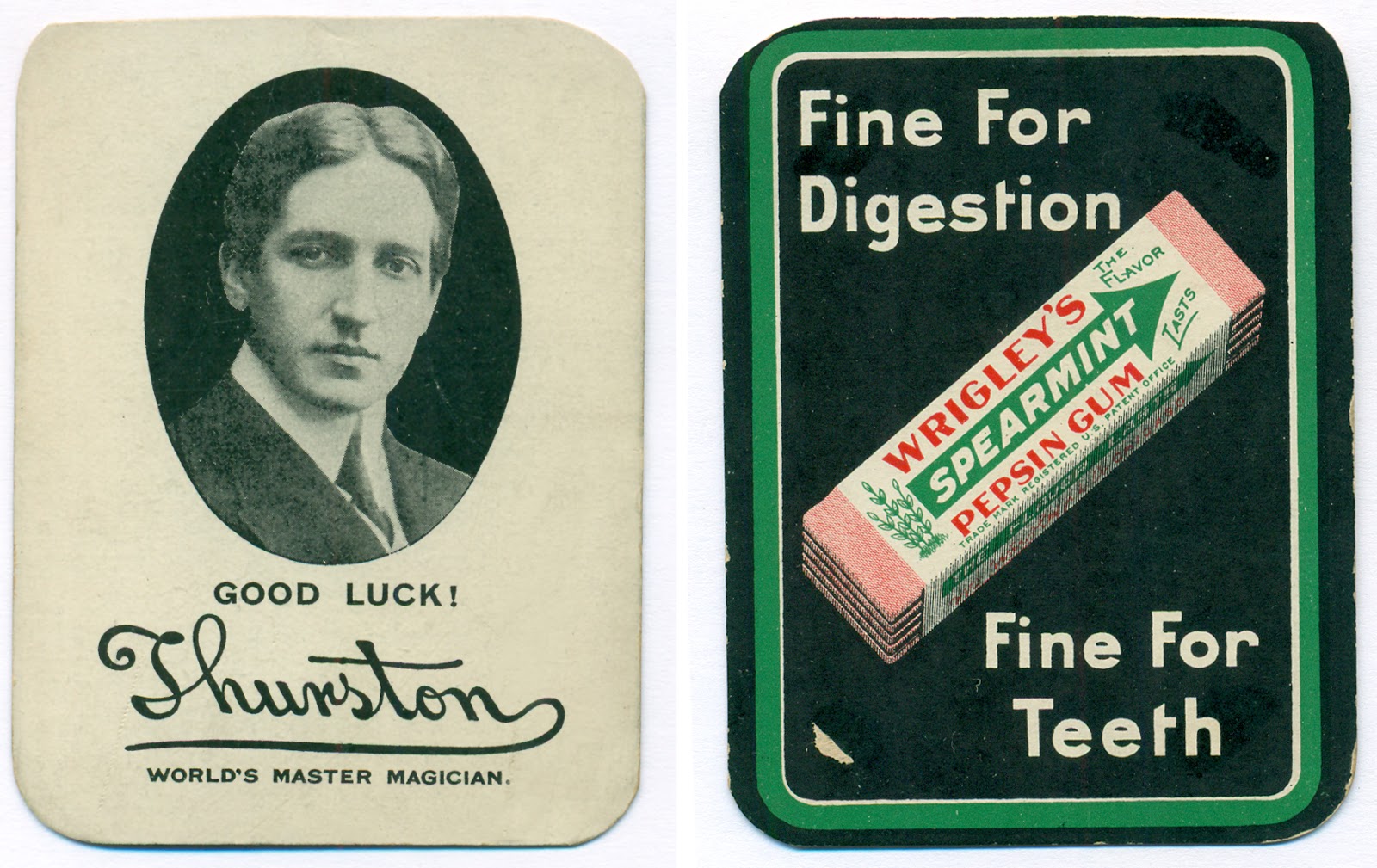
Howard Thurston


Howard Thurston (July 1869 – April 13, 1936) From his youth to his death, Thurston continued to achieve notoriety using his wit and innate ability to charm those around him. Over his lifetime, he crossed paths with some of the most noted performers in magic.
He joined forces with Harry Kellar, he nurtured a young performer named Harry August Jansen, and enlisted a worthy contender by the name of Raymond S. Sugden. He saw in both Jansen and Sugden a way to promote his name, but in doing it he lost, not only in fame, but it recognition. Both performers received praise and notoriety independently. At the end of his career, all Thurston achieved in his lifetime was lost by futile investments and owing taxes in both his own home state and the U.S. Government.
A rare photo of Howard as he performs a card trick for Jane