Showing posts with label McDonald Birch. Show all posts

Monday, October 22, 2018

Wayne Wissner – Theme Park Magician

Many throw-out cards have been posted here on Propelled Pasteboards of magicians from the distant past. I am now going to do a post of a more recent magician. He is still alive and kicking, and plays tennis in his spare time. He is also a longtime friend of mine, Wayne Wissner.
 
Alive and Kicking!
Wayne R. Wissner is a magician, magic collector, writer, historian, and photographer. He has also been a carpenter, restauranteur, truck driver, and is currently a producer of his grandkids’ annual magic show done for charity in his home state of Michigan.
Wayne had a very nice throw-out card made during his peak years as a professional magician. It has a Bicycle Blue Rider back as can be seen below.
Wayne got bitten by the magic bug at the age of seven, and like so many of us, it has never left. He started writing about magic as well as performing during his teen years. He even enrolled in the prestigious Chavez School of Magic and graduated at the age of seventeen. In his early days, Wayne was known as “Wizardo”.
Wayne "Wizardo" Wissner, Master Manipulator!
Being involved with magic during the sixties, gave Wayne the opportunity to have some memorable experiences and to see some great magicians of the past. At the age of fourteen, Wayne got to witness a performance of the legendary magician McDonald Birch when he appeared at an Abbott’s Magic Get-Together in Michigan.
 
A young "Wizardo" in front of Birch's trailer.
Also at an Abbott’s Get-Together, Wayne hung out with some other budding magicians around his same age. One of them he became pen pals with after the convention. The young man had come down to the convention from Canada. He later had some success as a magician. His name was Doug Henning.
Wayne Wissner and Doug Henning. Which one is which?
After Wayne got older, he “found his niche” as he has said in his writings on the subject. He worked for many years as a theme park magician, most notably at “Guntown Mountain” theme park in Cave City, Kentucky. While doing numerous shows a day, Wayne also had a magic shop at the amusement park, which he operated between shows. Because of his many years as a theme park magician, Wayne wrote the Handbook for the Theme Park Magician in 1990. It is full of tips and ideas and do’s and don’ts that Wayne learned through the years. He also included many personal anecdotes that make the book highly amusing and readable. I enjoyed it and recommend it.
Wayne in his Magic Shop.
Wayne is enjoying his retirement now with his lovely "first wife Sheila". (His words, not mine.)  The last couple of years he has helped his grandkids put on a summer magic show in his barn, with the proceeds going to charity.  He has built for them some very elaborate illusions.  The kids do a great job, and their grandfather should be very proud.  With any time left over, he is also in the process of learning from his wife... how to drive her bulldozer. 
The incomparable Wayne "Wizardo" Wissner!

Tuesday, July 10, 2018

Joseph McBee “Merry Mystifier and Komedy Kardist”

Columbus, Ohio originated a lot of magic history. It was the birthplace of Howard Thurston, the famous magician, and his brother Harry Thurston, the infamous magician. McDonald Birch was  born there, before moving to southern Ohio. It was also the home of two well-known magic dealers, U. F. Grant/MAK Magic, and Nelson Enterprises. An annual magicians’ convention, the Columbus Magi-Fest has been going strong for over eighty years.

Magicians' convention held in Columbus, Ohio in 1931.
The following throw-out card is for another Columbus magician a little less known, by the name of Joseph McBee. He called himself “The Merry Mystifier and Komedy Kardist in Vaudeville”. The front of the card has McBee’s image in an oval portrait, and the reverse of the card is a Bicycle Red Lotus back.
In the magic magazine The Sphinx for May of 1913, the Columbus magic club “The Mystic Ring” mentions that “Joseph McBee ‘Assisted by a Pack of Cards,’ mystified the audience with his clever manipulation and a number of his original card tricks.”
In October of 1913 McBee was elected president of “The Mystic Ring” in Columbus. The Sphinx for November, 1913 stated that “Mme. Herrmann appeared at the Broadway (a theatre in Columbus) week of September 29, presenting her beautiful act of illusions”. “The following week came our own Joseph (McBee). His act consisted of his splendid manipulation with cards and balls. When it comes to handling the cards, Mack is there”.
Broadway Theatre in Columbus, Ohio
When I began researching McBee, I assumed that maybe his claim to being in Vaudeville was a little inflated, as I had never heard of him. It seems I was wrong however, as I was able to find several references to him playing Vaudeville houses in several cities in the U. S. The Lumberg Theatre in Utica, New York ran this ad in the Herald Dispatch for February 8, 1916.
Newspaper ad with Joseph McBee billing.
Ladson Butler writing from Buffalo, New York in The Sphinx for March, 1916 said that “Joseph McBee, card manipulator played the Olympic Theatre the week of  March 7. His work was very smooth and absolutely clean, though a little fast. We had several pleasant meetings with him”.
Joseph McBee was a charter member when Columbus Ring No. 9, of the International Brotherhood of Magicians was formed in January of 1929. On February 5, of the same year the newly formed Ring held a banquet honoring Howard Thurston. At this banquet, according to The Linking Ring, Syl Reilly the vice-president announced “that the local organization had been named the Howard Thurston assembly (or Ring) No. 9 of the brotherhood”. Mention was made that McBee “did his clever card tricks” for the gathering. A pin back button was created for the banquet, and I have been fortunate in finding one of these with the name of a charter member of the Ring, Stanley W. Coulter.
From information I found, Joseph D. McBee was born on January 24, 1883, and died on May 29, 1967 at the age of 84. It appears that with the exception of when he was on the road performing, he lived most, if not all of his life in Columbus, Ohio.

Wednesday, November 15, 2017

Theodore DeLand's Got Your Back!

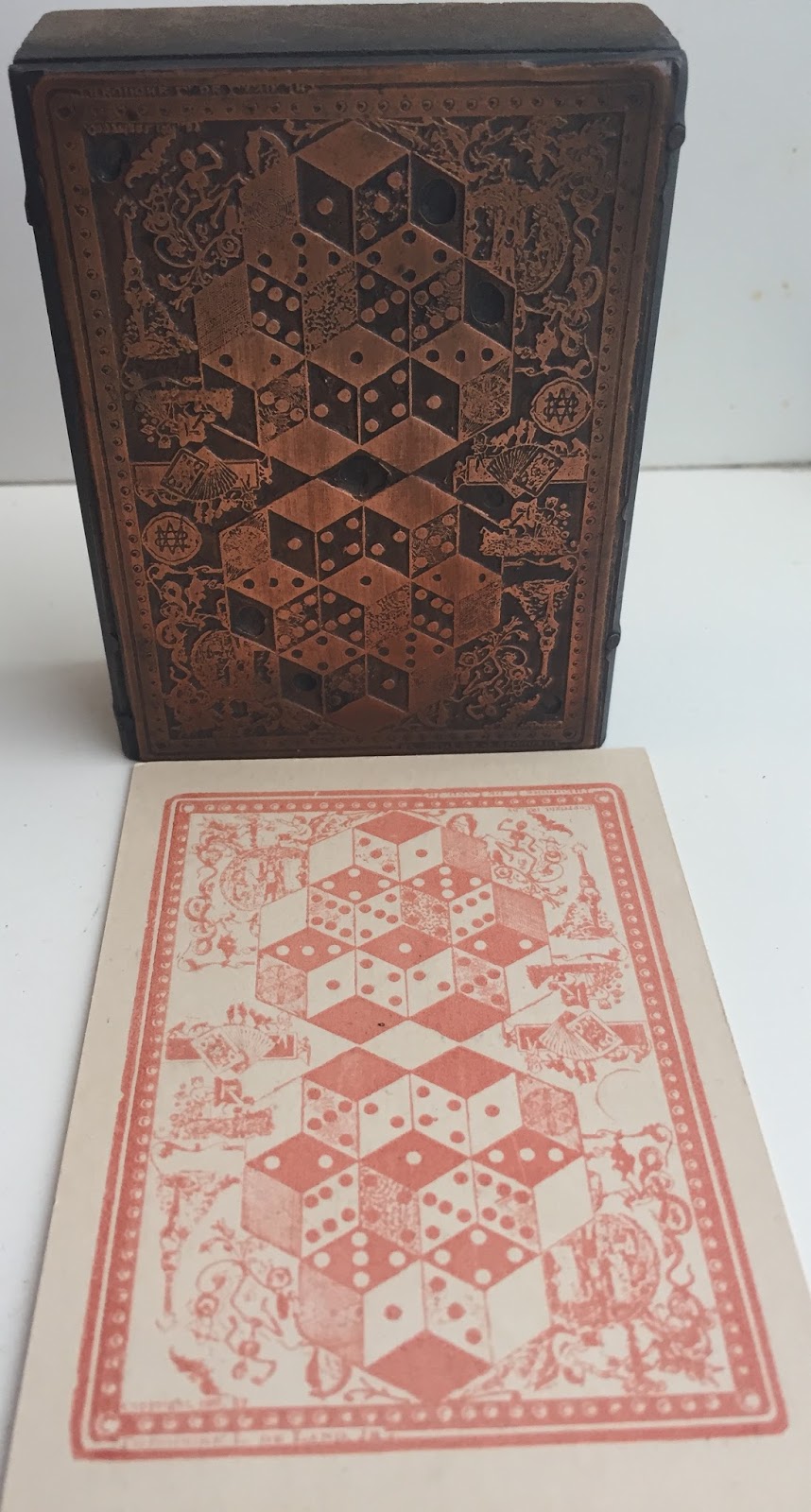
Deland's "Watch the Dice, 6 or 7," on the backs of throwout for J.W. Wilson, Puzzling Pierson and Lightner


As part of our continuing study of throwing cards, we have often stressed the importance of examining a card's back to provide added insight as to it provenance, manufacture, and approximate age. And if you look a enough magicians' cards, it will not be long before you notice one or more with this intriguing design, produced by Theodore DeLand, an eclectic, prolific magic card manufacturer in 1907. It's called "Watch the Dice, 6 or 7," and it's a terrific negative space illusion: Rotate the card 180 degrees and the number of dice in the stack appears to change.


Another unusual aspect of these cards is the manner in which they were created.  Unlike the various cards we've discussed which were sold as blanks, such as the Roterberg Stock Card and the Bamberg Magic Card, or cards that were professionally printed on both sides, to create these backs, DeLand sold printing blocks to allow magicians to create them on their own. I was fortunate enough to be able to add one of these rare printings blocks for the "6 or 7" back to my collection.   That block, seen here with a Puzzling Pierson card back, is in beautiful condition, and I suspect it was never really used.  It bears the emblem of the S.A.M. embedded in the design.


Gary Frank was able to provide me with one of the ad cards that DeLand used to sell these printing blocks.  The "Advertise Yourself" copy was printed on the face of playing cards with printed images of the three backs for which they were available.  Price: three printing blocks for $1!  (I paid much, much more for mine, even when adjusted for inflation.)  One of those three designs, obviously, was the "6 or 7" back.  In addition, I believe a second one was the "Dollar Deck" back, seen below as well as on the reverse of the promotional card used by McDonald Birch.  The third may have been the Daisy Deck back, though we have been unable to locate a throwing card with that particular design.


Jay Hunter was able to turn up something else: The M. Lewis Company, the work of which will be discussed in another post, advertised the DeLand "6 or 7" printing plate in the Sphinx in 1907.  Interestingly, as seen in the ad reproduced here, Lewis sold them for $1 each, offered with or without the S.A.M. emblem engraved in the circles in the design.  Lewis suggests having the corners rounded like a playing card, or square like a business card, and notes that it had a "large supply on hand."

Jay also kindly prepared an array of cards sporting the "6 or 7" back, printed in four different colors, both with and without the S.A.M. emblem as well as with rounded and square corners:


So who was Deland?  Well, according to Magicpedia, "Theodore DeLand (1873-1931) created the phenomenon of packet tricks between 1906 and 1915, during which time he marketed almost 100 tricks using gimmicked cards and decks, many of his own unique creation. DeLand was a clerk at the U.S. Mint in Philadelphia and died in an insane asylum in Norristown, Pennsylvania."   That snippet hardly captures DeLand's unusual story; for many years, Richard Kaufman has been working on a biography, DeLand: Mystery and Madness, which is expected to be released soon.

And while DeLand did not have a throwing card, many of his decks and effects included signature aces, which are quite interesting.   Several are seen below, which Mr. Kaufman helped me identify.


Ace of Spades from original Deland Dollar Deck
(later printed by S.S. Adams)


Ace of Spades from Deland's "Twister" trick

Ace/Three from a DeLand effect called "Pickitout"


Tuesday, October 24, 2017

Loring Campbell


Alexander Loring Campbell was born on March 19, 1905 in Sapulpa, Oklahoma where in just a few short years, the senior A.L. Campbell and his wife Byrd closed the drug store, packed up their belongings, and had their son comfortably set up in the back seat of the family car for the long trip to Southern California. Loring’s first exposure to magic was watching a group of Japanese performers known as the Ten’ichi Troupe of magicians. It wasn’t long after that Loring tapped by the “Goddess of Magic” and she didn’t let go.

    
  Whether it was entertaining classmates, or working a summer performance in full make-up in a polka dotted suit being billed as “Cambello the Clown”; Loring was fulfilling his destiny to become a full-fledged, professional magician.
After his schooling, Loring captured the attention of the managers of the Redpath-Horner Chautauqua circuit. He was contracted to work a twenty-five week tour. The only condition he had to agree to was being billed as magician Jack Gwynne. Gwynne wasn’t able to complete his contract and it was too late for the management company to alter the advertisements that were in the hands of every place Loring was to perform. So, taking everything in the old adage “the show must go on”, Loring Campbell was “Jack Gwynne”.


 A little known fact in magic history was when in 1929, Howard Thurston was searching for “one more traveling company” to take another one of his sponsored shows out along with his own show, and the Dante and Tampa show; Loring was also in the running. He readily declined, just as McDonald Birch, Werner "Dorny" F. Dornfeld, George Marquis and  Jack Gwynne. This time, Thurston has decided the name for the magician under the Thurston banner would be "Faust the Magician". All declined for the similar reasons; they wanted to keep their name and they their own performance style. When the International Brotherhood of Magicians was founded, Loring joined and was member number twenty-two. He did all that he could to find more members to join this newly established society of magicians wherever he traveled. Loring wasn’t alone in this life adventure, his wife Kathryn was at his side working in the show, on the show, and keeping the show going for many years. Kathryn kept the bookkeeping details kept the rabbits fed, and made sure Loring was on top of his game wherever they performed.

    
They toured throughout the United States dozens of times. Audiences and managers alike praised their magic shows. Loring included numerous effects from sleight of hand, to a presentation of the guillotine, and he would also include escapes. Their two-hour show would change every year and Loring would keep in touch with magic dealers and include whatever the latest effects were popular. He would also update his brochures and posters making sure he would keep the attention on the idea of fun for the entire family. 

          
How could you pass up
seeing this show?


       Whether Loring was performing his noted ventriloquist act with his sidekick, Johnny Applewood, or he stepped up to the artist’s easel and created wonderful rag pictures for all to enjoy; Loring had found his life’s dream and it did come true. He was a member of Los Magicos of Hollywood, Society of American Magicians, and he was a member of the Hollywood Comedy Club. 

           Loring wrote a column for the Tops Magazine titled “The Campbell Caravan” that was enjoyed by all its subscribers. He was elected into the Society of American Magicians Hall of Fame. Loring wrote two books This is Magic in 1945 and Magic That Is Magic in 1946. He retired from the stage in 1955. Kathryn passed away in 1958. Loring continued his interest in magic always there helping other performers and keeping in touch with magic friends he had met for the many years he was on the road. Loring passed away on January 11, 1979.

Friday, January 6, 2017

McDonald Birch


Having just released my new book, “Birch the Master Magician: The story of McDonald and Mabel Birch,” it seems fitting that I do a little post on his scaling card. It is of the “good luck” variety and features the back designed by the legendary trick card genius Theodore Deland.