Showing posts with label Bicycle Throwing Cards. Show all posts

Wednesday, February 28, 2018

Professor Struck - A Contemptible, Unscrupulous, So-Called Magician?


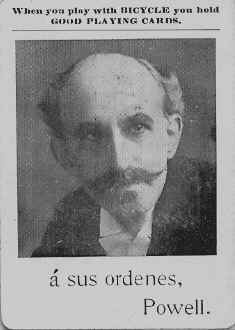
 This fine specimen of a throwout card relates to Professor Otto Struck, sometimes referred to as a "German magician" in the trade literature, but was almost certainly from Newark. N.J.   Otto Struck certainly has the feel of a stage moniker, yet if he had a different legal name, I've yet to uncover it.  He appears in magic trade publications beginning in or around 1895, which document a number of performances in the U.S. and Canada.   By 1905, The Sphinx still called Struck a "newcomer" whose performance  "promises well for the future."  Amusingly, for reasons that will become clear shortly, a correspondent for Mahatma complimented the young performer in 1904 on his magical ethics, noting that, unlike a magician named Hornmann who shared the bill, Struck "did not have to resort to any exposes to strengthen his act."


His throwing card, obtained in early 2017 from the collection of Ray Goulet, is a Bicycle "Hold Good Cards" piece using a Motorette #2 back, which was introduced in 1907.  Take a good look at his photo - looks unthreatening enough, no?   Well, it was right around the time of the issuance of this card that things started to go south for the promising newcomer.   It seems that, by around 1909 (about when this card was printed), Struck was reportedly imitating the great Alexander Herrmann and, according to some reports, falsely holding himself out as Herrmann's nephew.    The similarity between Struck and Herrmann had long been recognized; as early as 1895, a writer for Mahatma noted that "Otto Struck, whose work, setting and personal appearance remind one strongly of the late Alexander Herrmann."

His false representations, though, placed him in the middle of controversy, culminating in the following warning being published by Adelaide Herrmann, Alexander's widow, in the pages of The Sphinx in 1910:

Bicycle Motorette #2 Back (introduced 1907)

WARNING—To Prof. Struck and Felix Kretchman—A contemptible and unscrupulous team of "so-called Magicians" named Prof. Struck, assisted by a Felix Kretchman, are playing this week at the Third Avenue theatre, this city, and billing themselves as "Herrmann the Great & Co." Repeatedly their agent, Joe Shea, has been notified that said Prof. Struck and his assistant, Felix Kretchman, have stolen my husband's name and my trade-mark. But Shea pays no attention and would rather collect the few dollars commission he receives.
 
Is this a square deal? 
I hereby notify everybody, managers and agents in partic- ular, that from this date, Sunday, October 3, 1909, my attorneys. House, Grossman & Vorhaus, will vigorously prosecute each and every manager playing anybody billing themselves as "The Great Herrmann," "Herrmann the Great" or "Herrmann the Great & His Co.." and every agent who procures bookings for acts using said title will be held liable. 
ADELAIDE HERRMANN, Gilsey House. New York.
House, Grossman & Vorhaus, Attorneys at Law, 115 Broadway, N. Y. City. 


Was Professor Struck knocking off Herrmann's act?   Let's compare, side-by-side, that innocuous-looking portrait of Struck with the iconic throwing card of Alexander Herrmann:


I think you'll agree, dear reader, that Struck appeared to be styling himself like the performer who was, at that time, probably the best known magician in the history of magic.


Adelaide Herrmann lodged a complaint letter with The Sphinx concerning this cover.
And what was it about that fellow Felix Kretchman that incurred Madam Herrmann's wrath?  Well, he was more commonly known as Felix Hermann, though he wasn't supposed to be.  In fact, Kretchman was Adelaide's nephew, but she ultimately got a  court injunction forbidding him from holding himself out as being associated with Herrmann the Great.  Most interesting in Madam Herrmann's warning letter is the suggestion that Struck and Kretchman were performing together, though I've found no other references to this fact.  In any event, the battles between Madam Herrmann and Kretchman continued for many years.


I suspect that Struck eventually got out of the imitation business.  After Adelaide's warning, and a few more reports about Struck doing a Herrmann imitation in 1910, the trade press goes largely silent about him for several decades.  But by the 1920s, there are a few notices of his admittance to and participation in the S.A.M., which would have been unlikely to have granted him admission if the issue remained unchecked.  A magic historian writing about the Felix Herrmann saga for The Linking Ring in 1960 put Struck on the right side of that controversy:  "Otto Struck, Larry Crane, Imro Fox, George Holder, Bill Twickward, Edward Biedron or any of the old North Newark magicians, if living, could give you plenty of information regarding Felix 'Herman' Kretschman."

And there the trail goes cold -- at least in the trade press.   Decades later, however, Ted Bogusta of martinka.com, unearthed a trove of material about Struck, leading to this summary on his website:


Professor Otto Struck performed in the late 1800s and early 1900s. He was a Martinka customer, he performed with T. Nelson Downs and was a friend and assistant to The Great Herrmann. His proudest performing moment was a command performance he gave for President Theodore Roosevelt. He retired from magic due to health reasons and became a farmer. His magic then resided in a barn for nearly 100 years and was recently removed and cataloged by Martinka. 

And that biography was accompanied by a photo of Struck and one of his wands


It's not clear what materials underlie Ted's biographical sketch, but we can be sure of one thing: it wasn't a fan letter from Adelaide Herrmann.


Monday, October 16, 2017

Howard Thurston on a Bicycle!


We have, elsewhere on this site, sung the praises of Howard Thurston's beautiful throwout cards, some of the most fabulous ever made.  Indeed, one of the hallmarks of his cards are the interesting things advertised on the reverse side, either by attracting sponsors (such as Wrigley's Gum or Miller Tires) or, even more interestingly, his promotion of his own acts or odd speculative investments and inventions (like the "Perfect Sleep" anti-snoring device).

Bicycle Expert Back
In other posts, we have examined the intersection of magician's promotional cards with the massive advertising campaign aimed at drawing attention to gorgeous card backs manufactured by U.S. Playing Card Company, among others.   These cards, apparently subsidized by USPCC and others companies, dominate the field.  Leave it to master collector Jay Hunter to discover the intersection between these two apparently disparate threads.   And that intersection is found, here, on this single, fabulous pasteboard.  

The face of this card depicts a young, tuxedo-clad Thurston, famous enough that he need not say that he's a magician.  The card simply reads "good luck, Thurston."   And the back is a Bicycle "Expert" back, one of the company's original designs.  

Many thanks to Jay for another amazing contribution.


Thursday, July 20, 2017

Holding Even More Good Bicycle Cards

Elsewhere, we have written about the United States Playing Card Company's promotional campaign for Bicycle cards, often employing the catch phrase "When You Play with Bicycle, You Hold Good Cards."  The campaign proved a boon for vaudeville-era magicians seeking free or subsidized promotion for their acts, and more indirectly, to modern-day collectors of these pasteboards.  Well, our good friend Jay Hunter, inspired by this historical effort, assembled this stunning array of such cards, representing a broad assembly of Bicycle card backs.

And, another buddy, Lee Asher, offered his considerable knowledge to identify the backs designs. According to Lee, they are as follows:


ROW 1 (Left to Right) - Lotus Back, Racer Back, Cyclist No. 2 Back

ROW 2 (Left to Right) - All Wheel Back, Acorn Back, Cupid Back

ROW 3 (Left to Right) - Sprocket No. 2 Back, Wheel No. 2 Back, New Fan Back.

Additionally, Lee advises, several of the backs are uncommon specimens, in particular the Cyclist No. 2 and the Sprocket No. 2.

Of course, the fronts are equally engaging, if not as colorful, depicting advertisements from nine different magicians, none of which have yet been covered here at Propelled Pasteboards.  You can see the faces below.  While the individual performers may be worthy of further comment (by way of example, I have assembled several other pieces and some information about De Jeu, Max Terhune and Professor Lindhorst), several of these are little-known performers about whom no information may exist other than that depicted on these fine collectibles.

However, these images are worthy of further examination.   The assemblage tells us a little more about the Bicycle promotional campaign, not only by the backs depicted, but also the ad copy on the faces.  Most of them bear some variation of the "hold good cards" theme.  Yet take a look at the detailed description on the Harry Kane card, which is very different than that usually encountered on these pieces.  Moreover, the Bicycle promotional text runs vertically along the side of the Hiestand card, while the normal positioning of this text is usually horizontally along the top of the card.  Finally, the Max Terhune card features a more specific endorsement relating to his use of Steamboat and Bicycle cards, along with the standard text.  Each of these differences are likely clues to the date the cards were printed, and may provide further insights.


Many thanks to Jay for sharing this wonderful assortment with us.

And before leaving the world of Bicycle throwing cards, here's an image of the 1905 Annual Report of the Commissioner of Patents in which USPCC first registered the "hold good cards" slogan, along with some others:


Friday, April 21, 2017

Karl or Carl? A Guest Post by Jay Hunter

Introductory Note: We're very happy to bring you this guest post authored by Jay Hunter, whose scholarly contributions were recognized on the Roterberg Stock Card post.  Jay is a noted magic collector who has invested a great deal of time and energy into assembling and curating an amazing collection.  His thoughtful contribution follows. - Judge Brown


This post features two throw-out cards for magician Howard Karl. Both cards took advantage of what appears to be a way to get your card made and to have someone else pay for it!  One card is on an early Bicycle red Cupid back and is part of the U.S. Playing Card Company promotion discussed elsewhere on this site.  The other card is an ad for Pluto Water, and the Bamberg Magic and Novelty Co. which Judge Brown has written about in his Triple-Promotion post.


Thursday, March 30, 2017

Bamberg, the Elusive Mr. Heir and the Triple-Promotion Throwout Card


Some time ago, when Tom published this terrific post about Theo Bamberg a/k/a "Okito", I wondered about the odd layout and language on the card reproduced here.  Why the empty space between the Bicycle Playing Cards banner and the "Free Trick" text below that?  At first I thought perhaps it was part of a trick that the card would be used for, but that didn't feel right.   And when it says "I can recommend The Bamberg Magic & Novelty Company," who is this mysterious "I"?

We have, of course, written elsewhere about the Bicycle Playing Card promotion offering free throwout cards to magicians,  In years of research, though, I have never found a specific reference to the arrangement, other than a mention by John Mulholland.   And, certainly, we've covered a throwing card hawking the Tarbell Course, as yet another form of cross-promotion.   But the layout of this Bamberg card proved curious.


Then, fortuitously, I came across an eBay auction for another card, advertising what is presumably a magic show called "Wonderland" starring someone named George (using the quaint, largely obsolete abbreviation "Geo.")  Heir.  The card, which sports a US Playing Card Company 808 back, answers certain questions about Tom's Okito card.   Heir's card features largely similar text about Bamberg Magic and the Bicycle Playing Card marquee, but also has the photo and text for Mr. Heir overprinted within that mysterious space.  So Bamberg must have sold or given cards like the one seen above as "blanks" to performers seeking to pitch their shows, who would overprint the cards with an image or additional text in the empty space.   So this card, from an advertising perspective, is a triple-threat: it simultaneously promotes Heir's show, Bamberg's shop and Bicycle cards.

In fact, this card also provides some evidence of something I've suspected for a while: it may be that US Playing Card distributed the cards printed with their backs and the "Hold Good Cards" banner, and performers were required get the fronts printed elsewhere.  If this theory is correct, it would account for the vast differences in the quality of printing between the beautiful backs of these cards and the often abysmal imaging on their faces.

Even assuming that this card provides a clue to this production mystery, it raises a new question. Who in the world was George Heir?  So far, my research has turned up an absolute blank on him.  So like Stincel, he may remain a man of mystery. . . .


Oh, and before we bid farewell to Mr. Bamberg, Gary Frank brought this piece to my attention.  It's a sticker, playing card sized, that he could use to convert a blank (or presumably even a printed) card into an advertising piece.  And Gary raises a very interesting question: do you think Bamberg got a discount on these given that they misspelled his name?

Thursday, March 16, 2017

It's T. Nelson Downs's Birthday!


The Bicycle "Expert" Back (1895)
 While working as a railroad telegrapher in Marshalltown, Iowa, T. Nelson Downs (1869-1938) passed the long, lonely hours teaching himself sleight of hand using coins. The time was well spent -- Downs mastered the art, becoming one of the greatest manipulators of all time. He developed an act in which dozens of coins seemingly materialized at the performer's fingertips. Down's act, dubbed "The Miser's Dream," was the first major advance in coin magic in nearly a century, and is still used by many magicians.

Tuesday, January 3, 2017

Adolph Carll - Thurston's Chief Mechanic


You never know what treasure will be discovered when you search for an obscure magician on the Conjuring Arts Research Center’s “Ask Alexander” database. For this posting, it turns out that a scaling card given out by Adolph Carll, revealed an interesting story.

Carll was born in Baltimore July 28, 1882. According to census records, his father was Henry Carll, mother Louisa Ziegler and he had two brothers, Gusdolph and Otto. By the 1910 census, his father must have passed away as he is no longer in the household.

Sunday, December 18, 2016

Theo Bamberg aka Okito


Tobias "Theo" Leendert Bamberg (1875 – 1963) was born in Holland. His father had been a court magician to King William III of the Netherlands. Tobias was the sixth member of the Bamberg dynasty. He designed a Japanese-styled act before he was twenty. Using an anagram of Tokio (Tokyo), he became known as “Okito”. He altered the show to a Chinese-style act with more people and elaborate effects. Bamberg appeared before the Prince of Wales, and toured England, Ireland, and Scotland. His tour included thirteen countries in Europe as well as the Balkans. He and his family moved to the United States in 1908, where he toured under contract with the Orpheum Circuit. In 1909, he and his partner opened the Bamberg Magic & Novelty Company in New York City.
                                                                     

Friday, December 16, 2016

"When you play with Bicycle, You hold Good Cards"


The rise of color lithography during the golden age of magic proved a happy accident for collectors of fine, classic magic posters.   For throwing card enthusiasts, the rise of vaudeville stage magic during an explosion in playing card production around the turn of the 20th Century created a similar synergy. 

By the late 1800s, new printing technologies and methods brought about great improvements in the quality of playing cards.  The formation of the United States Playing Card Company in 1894, which soon acquired several other major manufacturers, created a worldwide industry leader. Beginning in approximately 1900, the Company embarked on a number of aggressive marketing campaigns, registered numerous trademarks for its new designs and slogans, offered free window displays to retailers, and invested heavily in national print advertising.

As part of US Playing Card Co.'s promotion of its products, the company hit upon an unusual idea: it offered free, custom-printed advertising cards to stage magicians.  Each card featured one of the Company's prized back designs, plus a slogan promoting Bicycle cards on the face.  The balance of the face was devoted for space featuring images and text about the magician.

"For a number of years, in the early part of this century, the United States Playing Card Company, and other manufacturers of playing cards would print a quantity of cards gratis for any magician requesting them." John Mulholland wrote in The Sphinx in June 1944.  "The playing card companies’ generosity to magicians to distribute cards bearing advertising of their products on one side of the cards."

It proved a brilliant means of cross-promotion.  Some magicians scaled the cards into the audience, ensuring that the Company's samples would be caught -- and often kept -- by eager audience members.   The results is that dozens of magicians, including some top names in the field, such as T. Nelson Downs and Frederick Powell, had Bicycle brand throwing cards printed.  (On another magic site, collector Jay Hunter put together a collage of nine different back designs that appear on Powell's cards.)  Bicycle cards also feature relative unknowns, such as ventriloquist/magician Ned Frailey.


US Playing Card Co. Ad from Life, February 1901

Each of the Bicycle cards are imprinted with the slogan "When you play with Bicycle, You Hold Good Cards," or some slight variant of this slogan.  The use of this slogan helps date these cards quite specifically.  Searching through various databases, it appears that U.S. Playing Card registered this slogan in various trademarks and used it in print advertising from 1900-1905, like the ad seen here.   This suggests that any throwouts bearing this slogan date from this around period.

It's worth noting that several other playing card companies employed a similar strategy, including Golf Playing Cards and the Canadian Playing Card Company.  In fact, one promotional card touting "National" and "U.S." playing cards as the best could well be considered the scarcest throwing card of all: its face features a young and not-yet-successful Harry Houdini as a magician offering instruction in sleight of hand.   (A very small image of this card can be seen in Ricky Jay's book Cards as Weapons, which is also a scarce collectible).

 "Throw-out cards should have great publicity possibilities," Mulholland concluded, "but in the past
most of the cards have either been poorly printed or carried designs which were inartistic and were printed from cheap cuts. Except for Thurston, and one or two others, the printing was never in colors. With the proper layout and pictures, good printing, and in colors, one good stock, throw-out cards might once again regain their usefulness as good advertising for magicians, and souvenirs the public would cherish."

Mulholland's critique has particular application to the playing card company promotional cards: designed primarily to sell decks, not magic, these pasteboards feature luscious back designs, but the fronts generally offer grainy photos and splotchy printing.   Nevertheless, they are highly collectible and interesting souvenirs of a bygone era.

To learn more about the importance of back designs in the study of throwing cards, check our Back Story page


 Readers interested in lithographic posters can find lots of great information and images at Ken Trombly's magicposters.com and Charles Greene's site, magicpostergallery.com.

The Barnum of Magic

Many are not aware, but in his very early days, P.T. Barnum was an assistant to the famous clown and conjurer Joe Pentland. Barnum’s role in the act was to hide under Pentland’s table and secretly take articles passed down to him and pass others up to the magician unnoticed. 
                                             
One of the items passed up was a squirrel which bit Barnum on the thumb. Barnum screamed, knocked over the table and ran off stage. It was an embarrassing spectacle but the audience enjoyed it tremendously. The subject of this posting is NOT that Barnum, but rather “Professor” John H. Barnum.


The Bicycle New Fan Back
Our subject was born Nov. 19, 1870, in Hooversville, Indiana, and was associated with show business and magic since the age of seven. He was an early member of the S.A.M. joining on Sept. 6, 1902, and receiving card number 62. He toured primarily in the Indiana and Illinois area and more generally around the Midwest. He also must have toured abroad doing ventriloquism and magic for a March 1903 Sphinx mentions that Barnum reported doing good business on his tour through Mexico.

He must have fit in very well with those early leaders of the society for he was a great opponent to exposing magic to the public.

There are a number of references to him in the early part of the last century. In a July 20, 1907 issue of The Magician, he is noted as being a correspondent for the S.A.M.  In the mid-teens he must have dropped off the map because an Oct. 1917 Sphinx was trying to locate a number of magicians including Barnum. The secretary was asking for any information on his whereabouts. And then, in an Oct. 1923, issue, S.A.M. Secretary Richard Van Dien reported that Barnum was ill and confined to his home in Knox, Indiana. Van Dien indicated that Barnum would appreciate other members sending him reading material.

A year later, The Sphinx reported his death on Feb. 1, 1924, age 53, at Holy Family Hospital in LaPorte, Indiana. His death certificate shows the cause of death was colon cancer which he had battled for over a year. Barnum’s father was Josiah Barnum and his mother, Lucinda Myers. He had two younger brothers Horace and George. He was buried in Crown Hill Cemetery in Knox, Indiana.  

Like Kellar and Thurston, Barnum’s Good-Luck throwing card showed a devilish character whispering secrets into this ear.  It was a bicycle brand card featuring the fan back in red. The card is certainly no humbug!  

Tuesday, December 13, 2016

Professor Agoston – The Swiss Enigma


This particular card is for Professor Ernst G.A. Agoston (Ernst G.A. Schifferdecker), a wonder worker born in Berne, Switzerland October 11, 1872, who immigrated to America and became a very popular card and platform magician in the late 19th and early 20th centuries.


According to a personal write-up in February 1920 issue of The Magic World, Agoston began performing magic at age 12 appearing before the Swiss public as a “Boy Wonder.” He was reportedly following in the footsteps of his uncle, the famous Chevalier Agoston, who toured the continent extensively from 1860 to 1885.


Agoston indicated he himself toured most of the principal cities in Europe and toured South America from 1888 to 1891 with the Rodriquez Brothers Circus. In 1891, he came to the U.S. on a four-masted schooner landing in Florida and later became a citizen. On September 11, 1893, he married Maybel C. Wilson in New Castle, Delaware and they had two daughters, Matilda (June 2, 1900) and Virginia (April 22, 1905). In August 1920, Maybel passed away.

With the outbreak of the Spanish American War, Agoston enlisted August 12, 1898, and joined as a Private in the Second Pennsylvania Infantry. He served only until October 25, 1898, when he was discharged for medical reasons. The injuries he suffered during his four-month enlistment plagued him for the rest of his life.

He operated his own Vaudeville agency and entertainment bureau in Philadelphia from 1904-05, and then returned to playing professional engagements exclusively in drawing rooms, private clubs and the homes of the wealthy. He relocated to Chicago and throughout the 1920s entertained the city’s top family like the Wrigleys, Armours, and others. On December 11, 1921, he married again, this time wedding Rose Dennison of Chicago.

He was best known for his original blindfolded Demonstration of Mental Telepathy. When he wasn’t performing he worked at the Chicago magic firm of B.L. Gilbert, 11135 South Irving Avenue doing general office work, demonstrating magic and illustrations. He was apparently a talented pen and brush artist and reportedly helped Gilbert publish a book “Card Effects Without Apparatus” which featured some of his original card effects. He also performed Kellar’s Growth of Flowers as shown in the accompanying photo which is inscribed to Dr. A.M. Wilson, editor of The Sphinx.


Agoston was an early member of the I.B.M. being #21. At the time he joined he lived at 1814 Howe Street, Chicago. He was also a member of the National Conjurors Association as reported in the February 1923 Sphinx.  

Beginning in the late 1920s and early 1930s, Agoston’s war injuries ended him up in various military hospitals for years at a time including the U.S. Veteran’s Hospital in Dwight, Illinois. He apparently suffered from lung-related issues. The Billboard for October 4, 1930, reported that he was hospitalized with an abscess on his left lung which had placed him in the hospital since 1927. By December 1930, he was back working clubs in Chicago doing card tricks while blindfolded.

Eventually, his ill health or age caught up with him and he died October 15, 1932, at age 60. He is buried at the Sunset Cemetery in Quincy, Illinois. His two daughters lived to old age, Matilda passing away in 1985, and Virginia in 1983.


Bicycle Automobile No.2 back (c. 1913)


The scaling card (above) that Agoston left behind promoted him as “The Wizard With The Cards” and offered his Mental Telepathy act. For ten cents in silver interested parties could obtain his Magic Book and “Phantom Trick Cards.” The card also promoted Bicycle cards with the slogan, “When you play with BICYCLE, you hold GOOD PLAYING CARDS.”  

Saturday, December 10, 2016

E.J. Moore Welcomes You to Propelled Pasteboards!

Early Moore poster
E.J. Moore (1881-1957) (born Ernest Joseph Limberger), was a noted vaudeville performer and magic inventor, best known for his creation of the Link-King Ropes. According to this dramatic throwing card, "Moore, The Man with the Mysterious Hands," performed in the 1902-03 seasons of the Chicago Stock Company. Note the fantastic photographic special effect. Most likely, Moore had read Hopkins book on stage illusions, which detailed many similar photographic illusions. The reverse of this card, which appears to contain additional information, was badly damage from being removed from a scrapbook.

Remarkably, the second card from this performer's career shown here was produced 40 years later. This throwing card advertises Water-Go!, an effect invented by Moore. Read the fine print on the card -- the effect sold for one dollar, and each package was signed by the inventor as a safeguard against reportedly rampant piracy. The illustration on the card bears a credit -- it was drawn by Sir Felix Korim (a/k/a Brewerton Clarke) -- and depicts a performance of Water-Go! at the 1941 S.A.M. convention in Providence, RI. The card has a vintage Bicycle Lotus back design.
A red Bicycle Lotus Back
In May, 1941, Linking Ring carried the following review of Water-Go:


"A trick by E. J. Moore, and a clever one. Liquid from a glass is actually poured into your closed fist,and the hand instantly opened and shown empty. The misdirection is perfect, and the apparatus is never suspected. Fine close-up trick."

That review was penned by John Braun, who knew a thing or two about fine tricks.  According to one report, Moore pioneered the use of magnetic gimmicks in rope magic, both in the Link-King Ropes and the Instanto Rope tricks. These two effects sold more than 25,000 units.