Showing posts with label J.W. Wilson. Show all posts

Wednesday, December 18, 2019

J.W. Wilson

I've long had a particular fondness for this card featuring J.W. Wilson, perhaps drawn by the incredibly cheesy devil-costume clad assistant whispering in this performer's ear.  This particular piece of ephemera dates to an era when artists like Thurston and Kellar distributed promotional pieces adorned with gorgeous lithography sporting imps, devils, owls and other familiars imparting secrets to the performer. Wilson went decidedly low-tech and low-rent on this piece, offering a friend in a devil get-up in this black-and-white photo. The Deland back suggests that Wilson may have hand-printed these himself.  

A group of Deland backs.  Wilson's is on the left.

So who was J.W. Wilson?   That Wilson is a common surname, and he insisted (generally) on only using the initials J.W.. made him somewhat difficult to track down.   (Consider the fact that these pages also feature a contemporary named John Darrell Wilson).  Scattered references reveal that together with the famed A.M. Wilson (ed. of the Sphinx), he was admitted to the Society of Buffalo (New York) Magicians in 1921. Later that year, the Sphinx reported that J.W. performed something intriguingly entitled his "Black Box Mystery" but left tantalizingly undescribed. (Additional research suggests it was a put-together production box).    In 1922, the Sphinx reported that Wilson was performing magic and Punch and Judy shows for American Legion halls.  By 1928, he hosted a group of Buffalo magicians, now using the name "John W. Wilson" and performed a spirit seance, and by 1933, this group elected him "stage manager."

The other textual clue on the card was the reference to The New York Clipper.  This periodical, it turns out, was a theater newspaper published in New York City through 1924, when its coverage was assumed by Billboard.  This helps date the card, and suggests that Wilson was playing the theater circuit.

Fortuitously, I came across this image of a 1918 issue of The Magic World on an Internet antique dealer's site, and Tom Ewing was able to secure a copy of the article for me.   It adds a few details: Wilson was born September 29, 1876 in Buffalo.  He developed a magic program and eventually added some large stage illusions, leading to a contract with United Booking Offices.  The illusions included Black Art and The Haunted House.  The Magic World found him working in Delaware and developing a new, Asian-themed act.  


 Despite my derisive comments about the production values of Wilson's throwing card, it turns out the image he used was a magazine cover portrait, which makes it a pretty cool collectible.

Finally, there is a coin move called the "JW Wilson Grip."  For a time, I assumed it was attributable to this performer.   However, continued searching led me to a September 2010 article in M-U-M by inventive magician Nathan Kranzo.  Fascinated by the JW Wilson move, he dug into the question, and came to believe that it had been developed by a Jimmy (sometimes spelled "Jimmie") Wilson, Jr. whose father, J.W. Wilson Sr. was also an accomplished magician.  Yet Richard Kaufman credits "Jimmy Wilson, Sr." for developing a coin grip in 1946 (see Genii, June 2003).  And the Conjurer's Magazine for May 1946 does contain  an effect called the "Five Coin Vanish" by one Jimmy Wilson.

The J.W.'s -  father and son - have left us with a few mysteries.


Wednesday, November 15, 2017

Theodore DeLand's Got Your Back!

Deland's "Watch the Dice, 6 or 7," on the backs of throwout for J.W. Wilson, Puzzling Pierson and Lightner


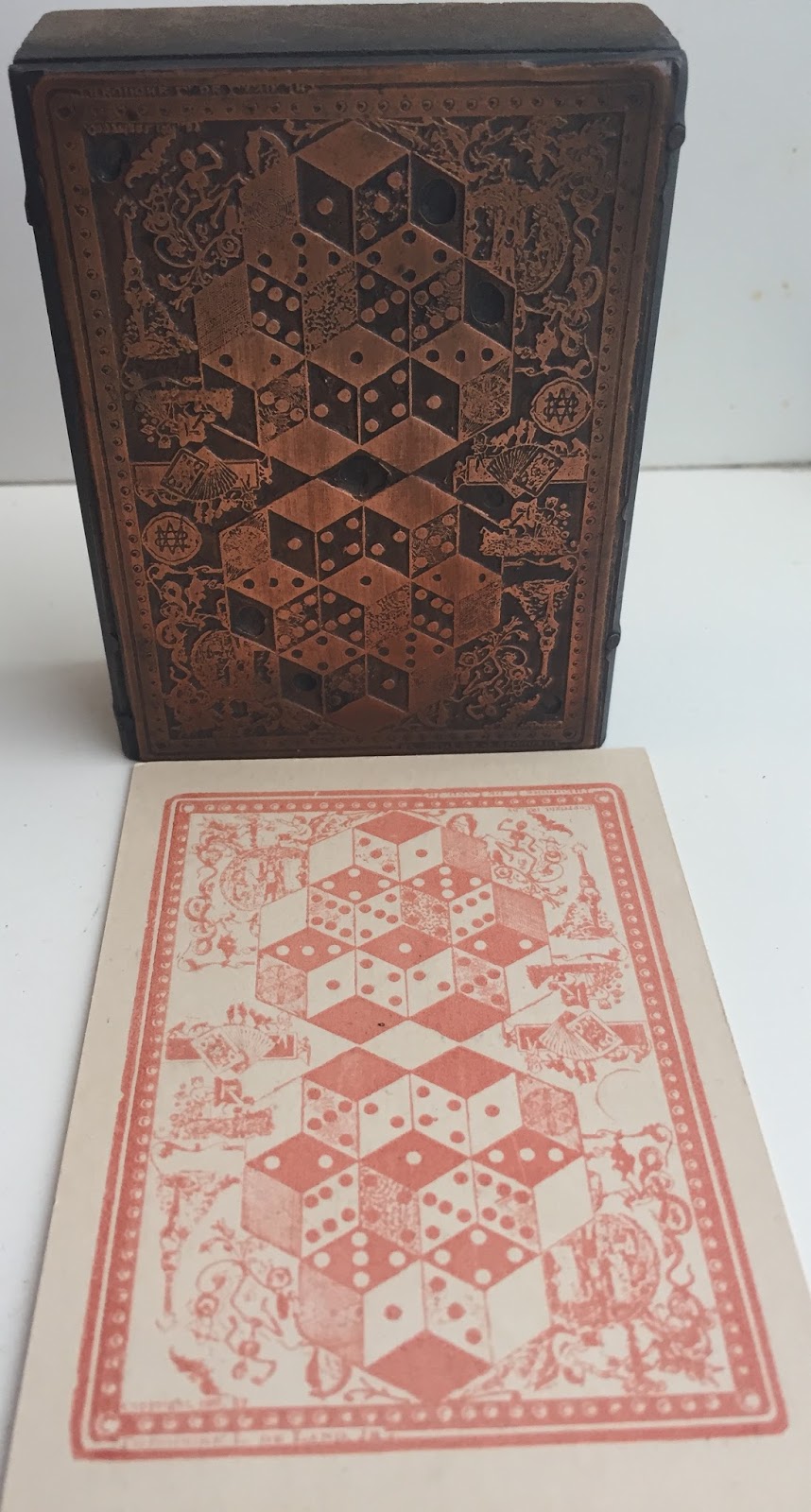
As part of our continuing study of throwing cards, we have often stressed the importance of examining a card's back to provide added insight as to it provenance, manufacture, and approximate age. And if you look a enough magicians' cards, it will not be long before you notice one or more with this intriguing design, produced by Theodore DeLand, an eclectic, prolific magic card manufacturer in 1907. It's called "Watch the Dice, 6 or 7," and it's a terrific negative space illusion: Rotate the card 180 degrees and the number of dice in the stack appears to change.


Another unusual aspect of these cards is the manner in which they were created.  Unlike the various cards we've discussed which were sold as blanks, such as the Roterberg Stock Card and the Bamberg Magic Card, or cards that were professionally printed on both sides, to create these backs, DeLand sold printing blocks to allow magicians to create them on their own. I was fortunate enough to be able to add one of these rare printings blocks for the "6 or 7" back to my collection.   That block, seen here with a Puzzling Pierson card back, is in beautiful condition, and I suspect it was never really used.  It bears the emblem of the S.A.M. embedded in the design.


Gary Frank was able to provide me with one of the ad cards that DeLand used to sell these printing blocks.  The "Advertise Yourself" copy was printed on the face of playing cards with printed images of the three backs for which they were available.  Price: three printing blocks for $1!  (I paid much, much more for mine, even when adjusted for inflation.)  One of those three designs, obviously, was the "6 or 7" back.  In addition, I believe a second one was the "Dollar Deck" back, seen below as well as on the reverse of the promotional card used by McDonald Birch.  The third may have been the Daisy Deck back, though we have been unable to locate a throwing card with that particular design.


Jay Hunter was able to turn up something else: The M. Lewis Company, the work of which will be discussed in another post, advertised the DeLand "6 or 7" printing plate in the Sphinx in 1907.  Interestingly, as seen in the ad reproduced here, Lewis sold them for $1 each, offered with or without the S.A.M. emblem engraved in the circles in the design.  Lewis suggests having the corners rounded like a playing card, or square like a business card, and notes that it had a "large supply on hand."

Jay also kindly prepared an array of cards sporting the "6 or 7" back, printed in four different colors, both with and without the S.A.M. emblem as well as with rounded and square corners:


So who was Deland?  Well, according to Magicpedia, "Theodore DeLand (1873-1931) created the phenomenon of packet tricks between 1906 and 1915, during which time he marketed almost 100 tricks using gimmicked cards and decks, many of his own unique creation. DeLand was a clerk at the U.S. Mint in Philadelphia and died in an insane asylum in Norristown, Pennsylvania."   That snippet hardly captures DeLand's unusual story; for many years, Richard Kaufman has been working on a biography, DeLand: Mystery and Madness, which is expected to be released soon.

And while DeLand did not have a throwing card, many of his decks and effects included signature aces, which are quite interesting.   Several are seen below, which Mr. Kaufman helped me identify.


Ace of Spades from original Deland Dollar Deck
(later printed by S.S. Adams)


Ace of Spades from Deland's "Twister" trick

Ace/Three from a DeLand effect called "Pickitout"