Showing posts with label Deland Back. Show all posts

Wednesday, December 18, 2019

J.W. Wilson

I've long had a particular fondness for this card featuring J.W. Wilson, perhaps drawn by the incredibly cheesy devil-costume clad assistant whispering in this performer's ear.  This particular piece of ephemera dates to an era when artists like Thurston and Kellar distributed promotional pieces adorned with gorgeous lithography sporting imps, devils, owls and other familiars imparting secrets to the performer. Wilson went decidedly low-tech and low-rent on this piece, offering a friend in a devil get-up in this black-and-white photo. The Deland back suggests that Wilson may have hand-printed these himself.  

A group of Deland backs.  Wilson's is on the left.

So who was J.W. Wilson?   That Wilson is a common surname, and he insisted (generally) on only using the initials J.W.. made him somewhat difficult to track down.   (Consider the fact that these pages also feature a contemporary named John Darrell Wilson).  Scattered references reveal that together with the famed A.M. Wilson (ed. of the Sphinx), he was admitted to the Society of Buffalo (New York) Magicians in 1921. Later that year, the Sphinx reported that J.W. performed something intriguingly entitled his "Black Box Mystery" but left tantalizingly undescribed. (Additional research suggests it was a put-together production box).    In 1922, the Sphinx reported that Wilson was performing magic and Punch and Judy shows for American Legion halls.  By 1928, he hosted a group of Buffalo magicians, now using the name "John W. Wilson" and performed a spirit seance, and by 1933, this group elected him "stage manager."

The other textual clue on the card was the reference to The New York Clipper.  This periodical, it turns out, was a theater newspaper published in New York City through 1924, when its coverage was assumed by Billboard.  This helps date the card, and suggests that Wilson was playing the theater circuit.

Fortuitously, I came across this image of a 1918 issue of The Magic World on an Internet antique dealer's site, and Tom Ewing was able to secure a copy of the article for me.   It adds a few details: Wilson was born September 29, 1876 in Buffalo.  He developed a magic program and eventually added some large stage illusions, leading to a contract with United Booking Offices.  The illusions included Black Art and The Haunted House.  The Magic World found him working in Delaware and developing a new, Asian-themed act.  


 Despite my derisive comments about the production values of Wilson's throwing card, it turns out the image he used was a magazine cover portrait, which makes it a pretty cool collectible.

Finally, there is a coin move called the "JW Wilson Grip."  For a time, I assumed it was attributable to this performer.   However, continued searching led me to a September 2010 article in M-U-M by inventive magician Nathan Kranzo.  Fascinated by the JW Wilson move, he dug into the question, and came to believe that it had been developed by a Jimmy (sometimes spelled "Jimmie") Wilson, Jr. whose father, J.W. Wilson Sr. was also an accomplished magician.  Yet Richard Kaufman credits "Jimmy Wilson, Sr." for developing a coin grip in 1946 (see Genii, June 2003).  And the Conjurer's Magazine for May 1946 does contain  an effect called the "Five Coin Vanish" by one Jimmy Wilson.

The J.W.'s -  father and son - have left us with a few mysteries.


Tuesday, October 15, 2019

Senator Lightner, the Wizard


This throwout card for Senator Joe Lightner (1884-1946) has everything a person could want in a throwing card. First, behold the intriguing stage moniker -- Lightner, reminiscent of lightning, conjuring up powerful supernatural images. Then, look to the bold, unsupportable claim to the title "America's leading magician," an excellent piece of showmanship. Next, consider the dramatic portrait -- the conjurer's profile, with a top hat perched at a jaunty angle, simply exudes mystery. Finally, the card contains some real magic -- the face of the card entreats the holder to count the dice on its back. (A standard Deland back design makes this a puzzling endeavor.)
Several Deland backs.  Lightner's is on the right.

Lightner first performed as "Lightner the Wizard" in 1906. performing in Chautauqua.  He was close friends with Dr. A.M. Wilson, and after the good doctor's death, he joined a group of investors who bought The Sphinx magazine, becoming a shareholder and member of the Board of Directors.

While I was running the throwingcard.com web site, Tom Ewing kindly supplied the following report about Lightner from the October 1943 issue of The Sphinx:

___________________________________________________________________________


The Hon. Jos. G. Lightner, a member of the Missouri Senate, and leading citizen of his home town of Odessa, Missouri, is as proud of once having been a magician as he is of any of the various high elective public offices he has held.

Joe Lightner had his own show of magic for a number of years and as he was a good magician, it was a good show. It was during this period of his life that he first became a close friend of the late Dr. Wilson. During the latter years of the Doctor's editorship of The Sphinx, Joe aided him in innumerable ways. His devotion to Dr. Wilson and The Sphinx prompted him to become one of the first stockholders of the present corporation. At one period, Joe was also associated   with the Seven Circles magazine.

An early member of the S.A.M., Lightner regularly came to New York for the annual banquets. He has also attended many conventions of magicians. Joe likes magic to be fast, colorful and it must be entertaining. Although he has little time for his own magic today, he always seems to be able1 to make time to go to see the performance of some other magician. His love of watching magic is so great that he will travel great distances to see a performance.

 Joe Lightner in his quiet way is awfully good company and knows magic and magicians of today and yesterday. 

  __________________________________________________________________________


He had a storied career in and out of magic, becoming president of a group called the International Magic Circle and regularly reporting on the Seven Circles Conclave.  His wife- named Marvel - also performed in vaudeville with comedian Gallagher Shean.   Collectors might be interested to learn that he inherited many artifacts from Doc Wilson, including the very first pack of Deland's Dollar Deck, autographed by Deland for Wilson.


Lightner died of a heart attack in 1946 at age 62.  Upon his death, The Sphinx described him as "a brilliant man of noble tendencies."


Friday, January 19, 2018

Devo – “The Magician from Dixieland”

While going through my throw-out cards looking for something interesting, I ran across a card for DEVO “The Magician from Dixieland”.  This card has always caught my eye as it reminds me of Devo, an alternative rock band from the seventies and eighties.  I thought I would try to find out what this earlier Devo was about.

 What I discovered was that Devo was in reality a much better known magician by the name of Benjamin R. Badley.  Badley was born on December 26, in either 1895, 1897, or 1898 (depending on various sources) in Baton Rouge, Louisiana.

As a young boy, his aunt took him to a performance of Leon Herrmann.  Other magicians followed, such as Karl Germain, and Eugene Laurant.  A local magician, Felix Guidry gave him a copy of Hoffmann’s “Modern Magic” and his future was set.  Bart Whaley’s “Who’s Who in Magic”, states that he moved to Saint Louis in 1916 and performed as Devo “The Magician from Dixieland” in roadshows of the southern states until around 1918.  He served in the Army during World War I. During this time he added hypnotism to his act.

 
Badley was a charter member and the first president of S.A.M Assembly No. 8, and also was one of the founders of Ring No. 1 of the I.B.M, both in St. Louis. His day job was working for the St. Louis Engraving Company as an estimator.
Badley had a long involvement with magic and wrote for various magic magazines and liked to collect books and photographs. Ben Badley passed away on October 2, 1950 in Saint Louis.

I found four throw-out cards of Badley in my collection. The Devo card has a blue Bicycle Tangent No. 2 back which was first used in 1907.  The card depicting Badley pulling a rabbit out of a hat has a Jack of Diamonds on the other side and is signed by Badley.
 
The two remaining cards offer up red and black variants of the “6 or 7” cubes illusion which were used in a different form on the backs of other throw-out cards. Judge Brown wrote about this illusion in another post concerning a Deland “Watch the Dice, 6 or 7” card back. These two cards for Badley have blank backs.

I should also mention that there was another Devo in magic. Carl Devo was a British Music Hall magician who got his start in the late 1800’s. While he did not last long as Carl Devo, under his real name of Will Goldston, he went on to fame as a magician, magic dealer, author and publisher of many magic books.
The rock band Devo released an album in 2010 entitled “Something for Everybody”. When looking at the total variety of throw-out cards that have been produced over the years by all of these magicians, including Devo, “The Magician from Dixieland”, the same can be said…something for everybody!

Monday, January 15, 2018

Puzzling Pierson, the Wisdom of Petronius and the Yale Divinity School

Having long ago acquired one of Puzzling Pierson's throwout cards, pictured here, I featured it on ThrowingCard.com, without much information of value.  However, access to increasingly more powerful research tools, as well as some old-fashioned shoe leather, permits me to tell you a great deal more about this charming piece, an unglazed card with square corners and an optical illusion Deland back.  The back bears a copyright date of 1907, making this a century old piece of magicana.  The face bears a Latin phrase, attributed to Petronius, "Mundus Vult Decipi Decipiatur," meaning "The world wants to be deceived, so let it be deceived" and also graces Martinka magic tokens of this era.   The face design really packs it in: the unique imp-devil character, hand with wand, linking rings, appearing bird cage and fabulous font make for an exquisite example of throwing card art.  (Another variant of this card -- which I've seen but do not own -- features a steamboat back.)

Well before his first appearance in magical literature,  George Pierson, a/k/a Guy H. "Puzzling" Pierson (b. circa 1879) is mentioned in the quarterly journal of the Yale University Divinity School, which describes him as a prestidigitator who entertained students on St. Patrick's Day, 1911.  It is in the same publication that we learn of his day job -- for the previous ten years, he had served as assistant superintendent of the Divinity School's buildings.  Less than a week later, the Yale Divinity News reports, a Professor Macintosh offered a sleight of hand demonstration “in imitation of Pierson” as part of a “Faculty Stunt Night.”  By 1917, Pierson began reporting New Haven's magical happenings in the Sphinx with an occasional feature called "Pierson's Paragraph."  In 1923, he helped organize this effort by forming a magic society headquartered at the famed Petrie Lewis company.

In 1947, The Sphinx ran a wonderful autobiographical piece about this performer.   In it, Pierson describes his early influences in magic, including a seminal trip to Martinka's, a friendship with its proprietor, and his acquisition of a copy of Professor Hoffmann's Modern Magic. "In my day we could not buy or hear anything about magic, especially in small towns," he reflected.   "We started with a chair round with a brass tack stuck in the end for a wand and a deck of cards,a few tin cups made by the local plumber and a home-made table with music rack legs. But suddenly the Great Mysto Company sprang up in New Haven and we began to get some good magic."  In 1949, he wrote a reminiscence about traveling medicine shows and the opportunities they offered magicians for The Sphinx, which elicited published comments by Augustus Rapp a few months later, and in 1950, he did a similar reflection on early travelling magic shows.   The last reference I can find about him was a performance mentioned in M*U*M in 1958.


Not satisfied that I had unearthed everything I could about Puzzling Pierson, I packed one of his cards with me on an early 2017 trip to Ray Goulet's Magic Art Studio, figuring that, on a well-attended Saturday, one of the assembled experts on New England's magic history could tell me something more about him. Well, I didn't find a subject matter expert, but among the many treasures there, I found something equally interesting,  Perched near a Spirit Clock, I spotted a cabinet-style card with a photo of Pierson.   In the photo, he's posing next to a small tripod magic table covered with vintage magic equipment, including a large ghostly chronometer. The Clock in the picture appears to be a different one than the one in the shop, unless, as one of the wags present noted, Pierson made the numbers change to Roman numerals from beyond the grave!


A second Pierson variant from Gary Frank's collection.
For anyone who might be interested, I have a duplicate Puzzling Pierson card in my collection which I'd be happy to trade for something of similar vintage.

Wednesday, November 15, 2017

Theodore DeLand's Got Your Back!

Deland's "Watch the Dice, 6 or 7," on the backs of throwout for J.W. Wilson, Puzzling Pierson and Lightner


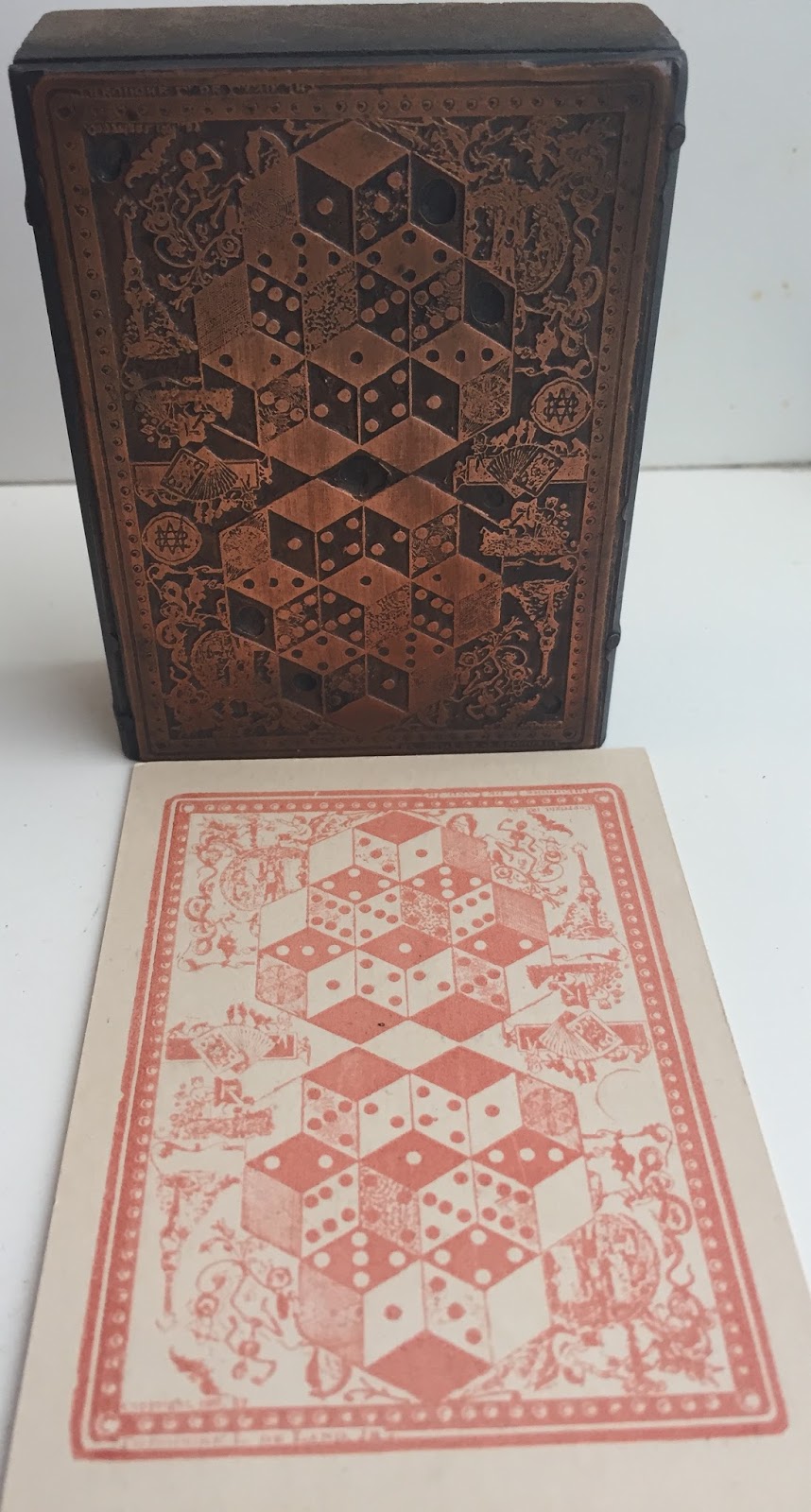
As part of our continuing study of throwing cards, we have often stressed the importance of examining a card's back to provide added insight as to it provenance, manufacture, and approximate age. And if you look a enough magicians' cards, it will not be long before you notice one or more with this intriguing design, produced by Theodore DeLand, an eclectic, prolific magic card manufacturer in 1907. It's called "Watch the Dice, 6 or 7," and it's a terrific negative space illusion: Rotate the card 180 degrees and the number of dice in the stack appears to change.


Another unusual aspect of these cards is the manner in which they were created.  Unlike the various cards we've discussed which were sold as blanks, such as the Roterberg Stock Card and the Bamberg Magic Card, or cards that were professionally printed on both sides, to create these backs, DeLand sold printing blocks to allow magicians to create them on their own. I was fortunate enough to be able to add one of these rare printings blocks for the "6 or 7" back to my collection.   That block, seen here with a Puzzling Pierson card back, is in beautiful condition, and I suspect it was never really used.  It bears the emblem of the S.A.M. embedded in the design.


Gary Frank was able to provide me with one of the ad cards that DeLand used to sell these printing blocks.  The "Advertise Yourself" copy was printed on the face of playing cards with printed images of the three backs for which they were available.  Price: three printing blocks for $1!  (I paid much, much more for mine, even when adjusted for inflation.)  One of those three designs, obviously, was the "6 or 7" back.  In addition, I believe a second one was the "Dollar Deck" back, seen below as well as on the reverse of the promotional card used by McDonald Birch.  The third may have been the Daisy Deck back, though we have been unable to locate a throwing card with that particular design.


Jay Hunter was able to turn up something else: The M. Lewis Company, the work of which will be discussed in another post, advertised the DeLand "6 or 7" printing plate in the Sphinx in 1907.  Interestingly, as seen in the ad reproduced here, Lewis sold them for $1 each, offered with or without the S.A.M. emblem engraved in the circles in the design.  Lewis suggests having the corners rounded like a playing card, or square like a business card, and notes that it had a "large supply on hand."

Jay also kindly prepared an array of cards sporting the "6 or 7" back, printed in four different colors, both with and without the S.A.M. emblem as well as with rounded and square corners:


So who was Deland?  Well, according to Magicpedia, "Theodore DeLand (1873-1931) created the phenomenon of packet tricks between 1906 and 1915, during which time he marketed almost 100 tricks using gimmicked cards and decks, many of his own unique creation. DeLand was a clerk at the U.S. Mint in Philadelphia and died in an insane asylum in Norristown, Pennsylvania."   That snippet hardly captures DeLand's unusual story; for many years, Richard Kaufman has been working on a biography, DeLand: Mystery and Madness, which is expected to be released soon.

And while DeLand did not have a throwing card, many of his decks and effects included signature aces, which are quite interesting.   Several are seen below, which Mr. Kaufman helped me identify.


Ace of Spades from original Deland Dollar Deck
(later printed by S.S. Adams)


Ace of Spades from Deland's "Twister" trick

Ace/Three from a DeLand effect called "Pickitout"


Thursday, February 23, 2017

John Sardo and The Celebrity Trick

This post involves John Sardo of Elmira, NY, who was born in 1896. He was a longtime supporter of magic clubs, published a number of effects in The Sphinx, and was instrumental in initiating one of the great minds of conjuring into the magic business. He also created “The Celebrity Trick” and had a nice scaling card.

Friday, February 3, 2017

Grdina


John J. Grdina came to America at age of five with his family and settled in Cleveland, Ohio. Checking through the internet, in 1940, census indicates he stated he was born in Yugoslavia in 1886 and not in Austria in 1885 as it has been indicated online and in past articles. Grdina became a naturalized citizen in May 1898. Years later he was in a theater audience in Cleveland and saw Harry Kellar perform. That show changed his life.