Showing posts with label Stuart Cramer. Show all posts

Wednesday, April 14, 2021

Jean De Jeu, the Wizard a/k/a Jean De Jen


Regular readers have already seen a card featuring De Jeu the Wizard, as part of Jay Hunter's assembly of Bicycle Promotional cards.  The custom card here features some additional details about this performer, who was clearly influenced by the unparalled success of Alexander the Man Who Knows.  In fact, when I picked this card up from Ray Goulet's collection in early 2017, I initially thought that De Jeu could be yet another stage name for Claude Alexander Colin, who performed under a number of names (including Astro the Seer) because of, among other things, many scrapes with the law.


But that initial impression was quickly dispelled through a bit of research.  Turns out Jean De Jeu (b. 1896) was a noted Lyceum performer and a formidible businessman.   Based on the styling and approach used on this card, he was clearly influenced by Alexander the Man Who Knows, who was, after all, quite the magic superstar.   According to Grdina, De Jeu changed his name to De Jen in or around 1921, due to concerns about anti-semetism.   And, indeed, the historical record bears this out -- by the 1920s, all references to this performer use the name Jean (and sometimes John) De Jen.

He worked as a stage magician throughout the 1920s, taking on the sideline of booking other acts. Several ads in periodicals reflect the fact the he bought and then sold entire magic acts and pieces, including Karl Germain's black art act.

While we often focus on the charming details of the performers featured here, not everyone adored De Jeu.  Here's what Stuart Cramer had to say about De Jeu, according to a piece reprinted in Magic magazine in 2003:


"I admired him as a magician, but intensely disliked him as a person. It probably harks back to the time I assisted him as a high school kid, at the 1930 IBM Convention in Fort Wayne, Indiana. I was surprised when I went to his apartment in Cleveland Heights to learn there would be no rehearsal, just a typewritten sheet of instructions. The act didn't come off well, and it earned me a blistering and embarrassing bawling out after the show. I hadn't even known how the Asrah worked until I was pushing the table offstage with Mrs. De Jen inside. I later overheard De Jen blaming some of his own flubs on "that fool of a new assistant." I was so incensed that I took the bus home." 

By 1930, in the height of the Great Depression, De Jen accepted a sales position with General Electric, ending his stage magic career.  After retiring from GE, he founded his own visual presentation company, Oravision, which marketed easels, podia and similar devices for public speakers.  In The Perennial  Mystics No. 2, James Hagy presents a detailed biography of De Jen's life and career.

Tuesday, July 31, 2018

The Mystic Isely and “Anti-Gravico”

When I start to do research on a given throw-out card, sometimes I find next to nothing on the given performer. Other times, the search leads me down different paths that I did not expect, but makes for a more interesting story. I think this is one of those stories.

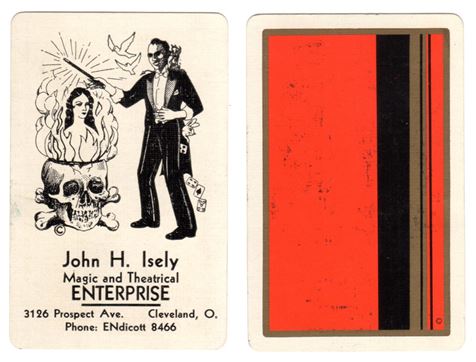
The throw-out card for John H. Isely is a Bridge sized playing card with an interesting illustration on the face, and an orange, black, and bronze design on the back. Isely has the wording “Magic and Theatrical ENTERPRISE” below the illustration. To say that Isely was enterprising, might be a bit of an understatement.

John H. Isely was born in the last years of the 1800’s in Baden Switzerland. Like countless others before him, he developed an interest in magic at a young age. He came to America sometime in the late 1920’s. (Some references have conflicting dates on this.) He and his wife settled in Cleveland, Ohio and Isely started doing magic around the local area. It was said that his full-time job in the thirties and early forties was working in a local novelty store as a demonstrator of magic tricks. It was called “Jean’s Funny House”. I actually have a token in my collection for this business.

Isely, who called himself “The Mystic Isely”, also marketed magic effects and ran ads in the magic magazines of the day. The one effect he struck gold with and that he became known for was a little trick called “Anti-Gravico”. He started advertising the trick in 1944. Here is the description of the trick in a magic catalog from 1945.

This trick became so popular, that it was named the years’ “Best Pocket Trick” of 1945. It can still be purchased to this day and can be found in some magic sets for youngsters. Because of its popularity, knockoffs of the trick began to appear, produced by others wanting to cash in on the effect. Because of this, Isely ran this ad in The Sphinx for December 10, 1944.

It can be assumed that Isely made a fair amount of money from “Anti-Gravico”. When he passed away on June 1, 1974, one obituary in a magic magazine stated; “John was a magical inventor as well as a performer, and will be best known for his invention of the ‘Anti-Gravico’ gimmick”.
Hold on a minute! There is more. As the late radio broadcaster Paul Harvey used to say, “And Now, The Rest of the Story!’”
John Isely never invented “Anti-Gravico”. In an article that the late Stuart Cramer wrote for The Linking Ring in April, 1985, Stuart set the record straight. The trick was actually invented by a local Cleveland magician named Bob Andre. He invented the trick in the early forties, and everybody wanted it. Isely tried to get Andre to sell the effect to him. In 1943, Andre went into the U.S. Navy during World War II. Before he left Cleveland, he had lunch with Isely and Isely tried so hard to get Andre to sell that “he had tears in his eyes”. Andre caved in and sold the rights to the trick to Isely for the money Isely had on him at the time, twenty-four dollars. The only condition Andre made was that it be called “Andre’s Anti-Gravico”. Isely kept his word, sort of. For the first month, the ad he ran for it looked like this.

In a very short period of time however, Isely dropped any mention of Andre as being the inventor. Not everyone in magic at the time was as misleading about giving the proper credit. A Sterling Magic catalog in my collection from 1945 appeared this way.

Over the years, there has been an effort in the magic community to make sure proper credit is given for the originator of a particular magic effect. I am happy to report that with articles to set the record straight by writers such as Stuart Cramer and magic historian Robert Lund, Bob Andre is now remembered for giving us this popular magic trick.
Don’t get me wrong. John H. Isely, the subject of this post was well liked by his peers in magic, according to what I found on him in the pages of the magic magazines. It did seem though, that maybe he was a little too enterprising when it came to giving credit in the marketing of “Anti-Gravico”.

Thursday, January 25, 2018

Stuart Cramer – The Man of Many Names

Kamain, Remarc, Chan Wing, Professor Nemo, Mr. Meriweather, J. Jefferson Palmer, Leo Starrman, and Germer C. Wrist. Who are these people? These are all pseudonyms for Cleveland magician Stuart Cramer.

This is one throw-out card front and back.                                                   This is one throw-out card front and back.

I have been able to acquire 4 different throw-out cards of Cramer over the years, all of them from fairly early in his life. In researching Stuart’s life it became quickly apparent that I could probably write about his experiences for days as there is so much written about him in the magic journals of his time. But as this is a blog about his throw-out cards, I will just cover the basics.

This is one throw-out card front and back.                                                      This is one throw-out card front and back.
Stuart P. Cramer was born in Cleveland, Ohio on July 16, 1911. He became interested in magic in 1918 when an uncle showed him a few pocket tricks. He falsified his age as a young man so that he could join the International Brotherhood of Magicians.
A great influence on Cramer was fellow Clevelander and one of magic’s greatest magicians, Karl Germain. Germain’s career was cut short when he began to lose his eyesight. Over the years Cramer visited Germain often. Cramer learned so much about Germain and his magic, that Stuart authored two books about his friend and his magical effects in later years.
Cramer was one to take advantage of performance opportunities. Besides doing regular magic shows, he appeared on early television as different characters on various TV shows in the Cleveland area. “Professor Nemo” was created for a Saturday morning show that featured westerns. As “Mr. Meriweather”, he was on television station KYW for around three years doing the weather reports accompanied by chalk talks and later with magic. When he was done with the weather gig, he was somewhat relieved, as coming up with a different trick every day during the weather report became stressful.

Stuart Cramer as Professor Nemo and Chan Wing

All of Cramer’s many characterizations gave him a different magic act to perform and I am sure made it easier for him to find continuing work as a magician. While he primarily spent his life as a professional magician, like his mentor Karl Germain, he too graduated from college with a degree in law and was admitted to the Ohio Bar. Stuart once said that he was the only attorney/magician who never lost a case. This is due to the fact that after winning his first ever case, he switched to magic full time and stopped the practice of law.

Stuart Cramer had a long and productive life as a magician and author. He was well known in the magic community and was very well respected by his peers. He passed away on April 15, 2003 in Ithaca, New York at the age of 91.

Saturday, February 18, 2017

Ralph E. Powell – One Bad Apple


“In the big barrel of fine people I have met in magic, here was one bad apple.” So reads the opening comment from Stuart Cramer, longtime magician, author and biographer of Karl Germaine, speaking of magician, Ralph Emerson Powell, of Cleveland. His comments were printed in James Hagy’s entertaining historical journal Perennial Mystics in 1989.

Cramer was recalling his experiences with Powell (1905 – c 1952), the son of the prominent Cleveland surgeon and nephew of a federal judge. Powell was a professional magician and if you go by Cramer’s account and those of others, not a very good one. He did have a scaling card with a Roterberg back.