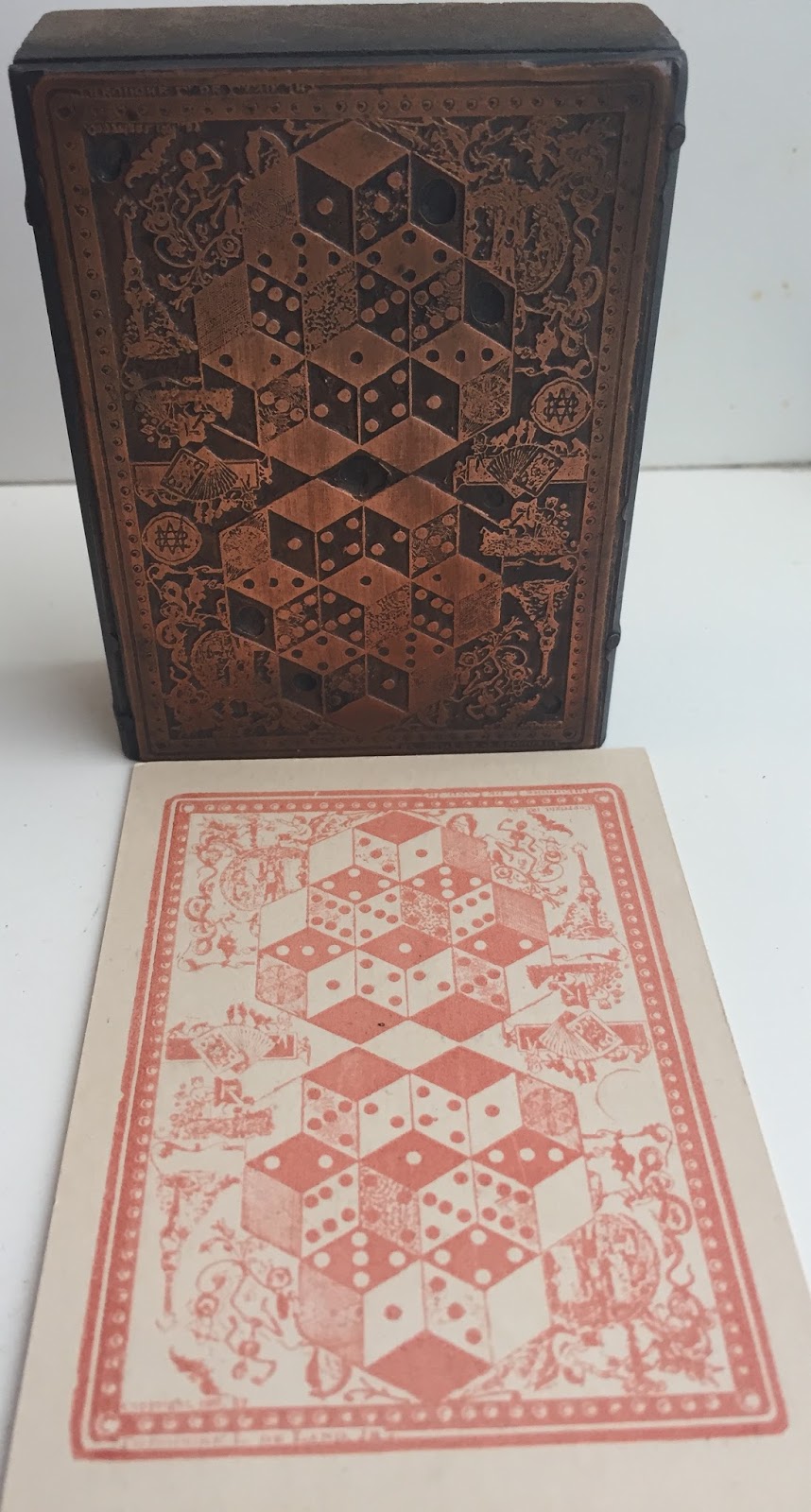
Having long ago acquired one of Puzzling Pierson's throwout cards, pictured here, I featured it on ThrowingCard.com, without much information of value. However, access to increasingly more powerful research tools, as well as some old-fashioned shoe leather, permits me to tell you a great deal more about this charming piece, an unglazed card with square corners and an optical illusion
Deland back. The back bears a copyright date of 1907, making this a century old piece of magicana. The face bears a Latin phrase, attributed to Petronius, "Mundus Vult Decipi Decipiatur," meaning "The world wants to be deceived, so let it be deceived" and also graces Martinka magic tokens of this era. The face design really packs it in: the unique imp-devil character, hand with wand, linking rings, appearing bird cage and fabulous font make for an exquisite example of throwing card art. (Another variant of this card -- which I've seen but do not own -- features a steamboat back.)

Well before his first appearance in magical literature, George Pierson, a/k/a Guy H. "Puzzling" Pierson (b. circa 1879) is mentioned in the quarterly journal of the Yale University Divinity School, which describes him as a prestidigitator who entertained students on St. Patrick's Day, 1911. It is in the same publication that we learn of his day job -- for the previous ten years, he had served as assistant superintendent of the Divinity School's buildings. Less than a week later, the Yale Divinity News reports, a Professor Macintosh offered a sleight of hand demonstration “in imitation of Pierson” as part of a “Faculty Stunt Night.” By 1917, Pierson began reporting New Haven's magical happenings in the
Sphinx with an occasional feature called "Pierson's Paragraph." In 1923, he helped organize this effort by forming a magic society headquartered at the famed Petrie Lewis company.

In 1947,
The Sphinx ran a wonderful autobiographical piece about this performer. In it, Pierson describes his early influences in magic, including a seminal trip to Martinka's, a friendship with its proprietor, and his acquisition of a copy of Professor Hoffmann's
Modern Magic. "In my day we could not buy or hear anything about magic, especially in small towns," he reflected. "We started with a chair round with a brass tack stuck in the end for a wand and a deck of cards,a few tin cups made by the local plumber and a home-made table with music rack legs. But suddenly the Great Mysto Company sprang up in New Haven and we began to get some good magic." In 1949, he wrote a reminiscence about traveling medicine shows and the opportunities they offered magicians for
The Sphinx, which elicited published comments by Augustus Rapp a few months later, and in 1950, he did a similar reflection on early travelling magic shows. The last reference I can find about him was a performance mentioned in
M*U*M in 1958.


Not satisfied that I had unearthed everything I could about Puzzling Pierson, I packed one of his cards with me on an early 2017 trip to
Ray Goulet's Magic Art Studio, figuring that, on a well-attended Saturday, one of the assembled experts on New England's magic history could tell me something more about him. Well, I didn't find a subject matter expert, but among the many treasures there, I found something equally interesting, Perched near a Spirit Clock, I spotted a cabinet-style card with a photo of Pierson. In the photo, he's posing next to a small tripod magic table covered with vintage magic equipment, including a large ghostly chronometer. The Clock in the picture appears to be a different one than the one in the shop, unless, as one of the wags present noted, Pierson made the numbers change to Roman numerals from beyond the grave!
 |
| A second Pierson variant from Gary Frank's collection. |
For anyone who might be interested, I have a duplicate Puzzling Pierson card in my collection which I'd be happy to trade for something of similar vintage.
 Having long ago acquired one of Puzzling Pierson's throwout cards, pictured here, I featured it on ThrowingCard.com, without much information of value. However, access to increasingly more powerful research tools, as well as some old-fashioned shoe leather, permits me to tell you a great deal more about this charming piece, an unglazed card with square corners and an optical illusion Deland back. The back bears a copyright date of 1907, making this a century old piece of magicana. The face bears a Latin phrase, attributed to Petronius, "Mundus Vult Decipi Decipiatur," meaning "The world wants to be deceived, so let it be deceived" and also graces Martinka magic tokens of this era. The face design really packs it in: the unique imp-devil character, hand with wand, linking rings, appearing bird cage and fabulous font make for an exquisite example of throwing card art. (Another variant of this card -- which I've seen but do not own -- features a steamboat back.)
 Well before his first appearance in magical literature, George Pierson, a/k/a Guy H. "Puzzling" Pierson (b. circa 1879) is mentioned in the quarterly journal of the Yale University Divinity School, which describes him as a prestidigitator who entertained students on St. Patrick's Day, 1911. It is in the same publication that we learn of his day job -- for the previous ten years, he had served as assistant superintendent of the Divinity School's buildings. Less than a week later, the Yale Divinity News reports, a Professor Macintosh offered a sleight of hand demonstration “in imitation of Pierson” as part of a “Faculty Stunt Night.” By 1917, Pierson began reporting New Haven's magical happenings in the Sphinx with an occasional feature called "Pierson's Paragraph." In 1923, he helped organize this effort by forming a magic society headquartered at the famed Petrie Lewis company.
 In 1947, The Sphinx ran a wonderful autobiographical piece about this performer. In it, Pierson describes his early influences in magic, including a seminal trip to Martinka's, a friendship with its proprietor, and his acquisition of a copy of Professor Hoffmann's Modern Magic. "In my day we could not buy or hear anything about magic, especially in small towns," he reflected. "We started with a chair round with a brass tack stuck in the end for a wand and a deck of cards,a few tin cups made by the local plumber and a home-made table with music rack legs. But suddenly the Great Mysto Company sprang up in New Haven and we began to get some good magic." In 1949, he wrote a reminiscence about traveling medicine shows and the opportunities they offered magicians for The Sphinx, which elicited published comments by Augustus Rapp a few months later, and in 1950, he did a similar reflection on early travelling magic shows. The last reference I can find about him was a performance mentioned in M*U*M in 1958.
 Not satisfied that I had unearthed everything I could about Puzzling Pierson, I packed one of his cards with me on an early 2017 trip to Ray Goulet's Magic Art Studio, figuring that, on a well-attended Saturday, one of the assembled experts on New England's magic history could tell me something more about him. Well, I didn't find a subject matter expert, but among the many treasures there, I found something equally interesting, Perched near a Spirit Clock, I spotted a cabinet-style card with a photo of Pierson. In the photo, he's posing next to a small tripod magic table covered with vintage magic equipment, including a large ghostly chronometer. The Clock in the picture appears to be a different one than the one in the shop, unless, as one of the wags present noted, Pierson made the numbers change to Roman numerals from beyond the grave!