Showing posts with label Harry Houdini. Show all posts

Friday, March 1, 2019

Billy Russell, Magical Inventor and his Vanishing Manuscript

Elsewhere, I mentioned that many of my most prized pieces came from the collection of George Hawley, a long time resident of Batavia, New York.  It is unsurprising, then, that one of those pieces was this fine card promoting Billy Russell, perhaps the most famous magical figure to hail from Batavia.  During the time I operated throwingcard.com (meaning, before the advent of AskAlexander), information about Mr. Russell was quite hard to come by. Indeed, the sum total of the information uncovered at that time consisted of the following from George Hawley:

"William 'Billy' Russell, based in Batavia, New York, was a popular society magician at the turn of the century. The Thurston-Dante letter set reproduced by Phil Temple contains an interesting letter from Russell in which he protests what he perceived to be an exposure of magic secrets by Thurston in a mass market book."


But now we have access to so much more.   As it turns out, Mr. Russell was a formidable figure in the world of magic according to many sources, including a fine piece authored by Gene Gordon for the Linking Ring in May 1947.  Gordon credits Russell with construction of several iconic magic effects, including Houdini's Milk Can Escape and his Paper Bag Escape.  Apparently, Howard Thurston challenged Russell to design and build a table for production of a fish bowl, with a caveat (which Thurston believed rendered the challenge impossible) that the bowl had to be larger than the table top.  Not only did Russell succeed, but the resulting prop became a standard in the field.


Russell launched his own road show, which later became a vaudeville act and school show, and featured several signature effects, including a floating ball, spirit slates and a crystal clock.  One of his ongoing challenges by the diminutive Russell was an offer to pay $125 (one dollar per pound of his weight) to anyone who could lift him off the ground; he never had to pay the sum to anyone.   As reflected on his card, he became a member of the IBM and helped found the Western New York Association of Magicians (MAWNY).   George Hawley served as an apprentice for Russell, which further explains his possession of this wonderful card.

Tantalizingly, in his 1947 profile, Gordon noted that  a book that Russell had authored, “Tricks of the Magic Trade, on which he has been working for years, will be published soon, and all professionals who have looked over the manuscript pronounce it the 20th century bible of stage magic.”  But no such book followed.  In 1964, Dr. Grossman, writing for M*U*M , conducted an extensive search for Tricks of the Magic Trade and proclaimed that the book never saw print.  What could have happened to this fine work described by Gordon?

Well, here's the good news:  As part of my research, I learned that all of the material described by Gordon saw publication, just not as a book.  In two issues of The Linking Ring -- April and October 1958 -- the magazine offered readers a "Parade" of magic by Mr. Russell.  As the editor properly crowed, taken together, the two issues  "will give you a whole book of the best you will find in the whole realm of magic!"  Even a quick perusal reveals this to be the case -- the material, clearly the same magic described by Gordon in his profile of the planned book -- is excellent.   Any stage performer interested in developing something so old that it would be new again would be well served to get access to these issues.

Russell continued as an active magician and inventor until his death in 1967 at age 86.


 r


Tuesday, October 2, 2018

Thurston – Some Throw-Out Card Trivia

It is amazing how many magicians used a throw-out card, or playing card, or a “Good Luck” card to advertise themselves. Without a doubt, the king of throw-out cards was Howard Thurston. From the time early in his career when he started to throw them out to his audience, until he had to stop performing, he literally sent thousands upon thousands sailing out into the theatres in which he played.  
 
From Adventures in Magic by Henry Ridgely Evans, (1927).

As one can imagine, Howard Thurston has been covered on this blog many, many times. Co-contributor Gary Frank wrote a fine post on Thurston and included many examples of his cards. I thought I would offer up, on this post, some interesting items of trivia that I have found on Thurston related to his throw-out cards, and his card scaling.
One early reference I have found concerning Thurston’s card throwing was found in the Black and White Budget for January 12, 1901 shortly after he had arrived in England. Like Harry Houdini and T. Nelson Downs, Thurston’s career first took off when he went to London. The following is a small sampling from that article.
Thurston’s inclusion of card throwing appears to have been inspired by having seen Alexander Herrmann while a young man. Thurston scaled cards from the start of his career when he billed himself “The World’s Premier Card Manipulator”. On one of his earliest throw-out cards from the beginning of his days as a performer, he had a card produced with an image of him about to throw a card. While I don’t have this particular card in my collection, Harry Houdini had this one shown below in a scrapbook.  This scrapbook now resides, and is through the courtesy of the Harry Ransom Center, The University of Texas at Austin.
Courtesy of Harry Ransom Center, The University of Texas at Austin.
We can get a general idea of the time frame of Thurston’s cards by seeing how he aged on the card over the years. This is not a hard and fast rule, as he would use older cards for long periods to keep himself looking youthful. He was rather vain about his appearance, even to the point of having face lifts.
For me, extra special Thurston cards are those where the audience member who received the card would often write the date of getting the card and sometimes the theatre as well. By searching old newspapers, I was able to find the location and even an ad for Thurston’s  performance  for the throw-out card below.
Acquired at the Crown Theatre in Chicago on January 9, 1913.
Another bit of trivia that I had heard for years, was that Thurston could throw a playing card over an 8 story building. The late John Booth mentioned this in his monthly column in The Linking Ring back in 1999. I was able to nail down the source of this story some years back, when I acquired a vintage newspaper page with the Ripley’s Believe It Or Not cartoon that first stated this fact. It ran in newspapers all over the country on December 23, 1930.
In Hugard’s Magic Monthly, Fred Braue wrote; “What is entertainment? Thurston would throw good-luck cards into the audience for perhaps two minutes – and they loved it!” In the same magazine, but a different issue, the magazine’s namesake Jean Hugard wrote the following; “Thurston would throw these to those at the back of the theatre or in the galleries. These cards were much heavier than ordinary playing cards and were therefore easier to throw to a distance. On one occasion, however, Thurston had the misfortune to have one of these cards strike a spectator in the eye and had to face a suit for damages”. Further research indicates the  member of the audience was awarded $500.00 in damages. So scaling cards out into the audience was not without its perils. (I would like to thank co-contributor Judge Brown for reminding me about this incident.)
There is no doubt that the overwhelming quantities of “Good Luck” throw-out cards that Thurston scaled out to his appreciative audiences was a great marketing tool in terms of advertising. He wanted to make those audiences remember him, and to keep them coming back for repeat performances of “The Wonder Show of the Universe”.

Sunday, July 29, 2018

Brindamoor – The King of Wonder Workers


Possibly the sign of the times, Brindamoor saved money by gluing his photo to a playing card.

George W. Brindamoor was born on April 5, 1870 in Cannon Falls, Minnesota. Brindamoor’s interests included photography and magic. He owned his own studio when he was only twenty-two years old. On stage, he performed under the name Professor G.W. Brown in local venues and in a short time as he gained experience he left the photography business and took to the road. He dropped the stage name of Prof. Brown and began performing under his given last name. As the 1900’s approached, he toured the New England area, entertaining audiences with magic and escapes. He performed between the acts of plays, which brought him acclaim from the theatergoers of the day. Brindamoor expanded his show with more magic and illusions including the effect known as the levitation.


Brindamoor kept up with the changing times and magic performers. When Houdini’s fame became world news, Brindamoor jumped on the bandwagon. He stored his illusions and began performing an all escape act that eventually included jumping off bridges, lakes, or streams while in handcuffs or shackles. He filled the houses in every town he visited. He traveled from state to state and even performed at the Barbee's Loop Moving Picture House in Chicago, Illinois in the 1920’s. Although his performance was a close second to Houdini, the audiences still enjoyed what The Great Brindamoor could do from start to finish to enthuse them.


As time past, Brindamoor and his wife left the hustle and bustle of touring and moved to Southern California just as The Great Depression hit the United States. Brindamoor continued performing magic shows (when he could find work). As opportunity would have it, he became a part of a theater company and was able to perform a small portion of his show. Brindamoor, the man who was credited with originating the “Beer Barrel Act Escape” and many other ideas escape artists are still using today, passed away September 11, 1941.

Friday, April 27, 2018

Harry Kellar - The Real Wizard of Oz?


 Students of magic history are probably familiar with Harry Keller (b. Heinrich "Henry" Keller 1849-1922), one of the great American illusionists.  While his fame has since been eclipsed by that of Harry Houdini (with whom he was close), and his chosen successor, Howard Thurston, in his day, Kellar was the best known illusionist in the world.  His fame was such that his advertising media, like the poster seen below, bore only his name "Kellar" -- there was no need to note that he was a magician or illusionist, as everyone knew.   Kellar's lithographic posters, produced by Strobridge litho, are among the most beautiful and highly sought after magic collectibles.

Tuesday, January 30, 2018

Professor Stockley's Hundred Year Time Capsules

Albert A. Stockley, Jr. (1868-1946) was the son of a civil war veteran who operated a wholesale liquor store in Baltimore, Maryland.  Somewhere in the middle of life's journey, Stockley became interested in magic.  Magic magazines from around 1900 through 1907 contain a variety of notes about "Professor Stockley." None of these, however, were quite as historic as his inclusion on the very first published list of potential applicants for the Society of American Magicians in the February 1903 Mahatma.  That list included 14 hopefuls, mainly from the East Coast, but most notably Harry Houdini from New York City and Harry A. Jansen (later known as Dante) from Chicago.

Later that year, Francis J. Werner, founding Secretary of the S.A.M., travelled to Baltimore and had the opportunity to watch Stockley perform at Henshaw's Episcopal Church.  After witnessing Stockley entertain with a program that included "Flower production, hat load, cards, billiard ball and handkerchief manipulations, and rising cards, a la De Kolta," Werner reported to readers of Mahatma that Stockley was "a credit to The Society of American Magicians."

Given his historic early membership in the S.A.M.,  perhaps it is unsurprising that Stockley commissioned a throw-out card prominently featuring the Society's logo, and identifying him as a "Fellow" of that organization.  The card, seen here, has a blank back.  Stockley approached his hobby in a business like manner, packaging these cards together with a handsome brochure in a beautifully printed envelope to be sent to prospective clients.

Fast forward a century.  Around 2016, a "picker" working in the Baltimore area organized an estate sale for one of Stockley's descendants.  Amidst the accumulated treasures, he unearthed a handful of sealed envelopes containing Stockley's ephemera, each packet sealed a century earlier, ready to be addressed to a potential customer.  The discoverer turned them over to an eBay seller.   Our friend Bill Mullins, who has posted on this site elsewhere, bought one, and alerted your correspondent to their existence.  I contacted the seller and bought the few that remained.

When they arrived, I gingerly opened one of the envelopes, which yielded a card and a brochure.  It was like opening a century-old magic time capsule.  For anyone interested in magic history, this was an exciting moment.

While, of course, the throw-out card was the prize, Stockley's brochure also proved a treat.  The cover features the handsome portrait featured here, as well as a Shakespearean quote about magic.   Inside, the good professor attempts to attract business using Victorian language and testimonials that were the fashion of the time.  He boasts of "my large number of mystic revelations" featuring "some of the newest and most delusive that have been presented."   He promises to "continue to add the latest effects and discoveries in the mystic art, thereby keeping my repertoire replete with up-to-date attractions."   Buttressing his respectful announcement are a series of testimonials from lodges, social organizations and one military regiment, expressing gratitude for his "first-class entertainment," including one particular shout-out for his "mysterious cabinet."  People really could write in those days.


Wednesday, November 8, 2017

Harrison Greenbaum's Stuck on You!


There's just one problem with Harrison Greenbaum's magic performances: he's just so funny that you're likely to forget -- or miss -- the subtlety and sophistication of his conjuring.            

But more on that in a moment - first I need to cover today's unusual offering.  The item depicted here is not a throwing card.   It is is business card-sized, but it is not a business card.  As its purveyor would likely shout in a mock-enraged stage rant "It's a sticker!"  And so it is.  For collectors, such an item should be highly sought after, as it is so very ephemeral (fans tend to apply and discard stickers, making them rare).   Showcasing a sticker is unusual without being unprecedented here:  we featured a sticker on the Bamberg page.

A second aspect of this keepsake also renders it unusual for its inclusion here: it makes no mention of magic.  Accompanying the genial portrait, the front reads "This is Harrison," followed by two notations "He does comedy" and, on the reverse "He likes you too."    The reverse lists a variety of social media references which have become so very important for contemporary performers, (which we'll examine in a subsequent post about Jeff McBride) particularly one that, like Mr. Greenbaum, offers more than 600 performances per year.  

And just like this collectible, Harrison Greenbaum defies easy categorization.  As a visit to his site, harrisongreenbaum.com, confirms, Harrison defines himself primarily as a comedian, which is where, unquestionably, he developed his performing chops. According to his bio, he began performing stand-up comedy while studying psychology and English at Harvard (a fact he often cites self-deprecatingly as part of his performances). A summa cum laude graduate, Harrison was the co-founder of the Harvard College Stand-Up Comic Society.  And he is a superlative comedian, featured on NBC's Last Comic Standing and America's Got Talent.   

Make no mistake, though, his conjuring skills are equally impressive.  Clues to his magic pedigree can be discerned from his bio -- he won an award at Harvard for his magic book collection.  Indeed, he maintains a separate magic website which includes the following magic credits:
Harrison offers his vision of the Mental Epic by Hen Fetch.


"As a magician, Harrison was named one of "today's best" by Newsday and tours around the world as one of the stars of The Illusionists: Direct from Broadway, the biggest selling magic show in history. The most requested performer at Monday Night Magic, the longest-running- Off-Broadway magic show in New York, Harrison has also performed at the Magic Castle in Hollywood, the Mystery Lounge in Boston, and was one of only 30 magicians chosen to perform at the International Festival of Magic, Illusion, and the Unusual in Louisville, Kentucky. He is also the proud winner of the Senator Crandall Award for Excellence in Comedy, given out annually at Abbott’s Magic Get-Together in Colon, Michigan. Harrison is a counselor at Tannen’s Magic Camp and has been an advisor to the Society of Young Magicians in Boston and New York for almost a decade."

At a recent performance at which he was the headliner, Harrison offered sophisticated, complex and beautiful magic pieces, accompanied by his frenetic comedy.  His set included some classics, such as his unique twist on the Mental Epic, a flawless and funny newspaper tear, a bizarre and hilarious add-a-number routine and a celebrity prediction that still has me scratching my head.  His effects were thematically linked in a nuanced way that nearly escaped my notice amid his razor-sharp wit, performing energy and gales of laughter.

At one point,  Harrison unleashed a sticker upon a particularly quirky audience volunteer (a man who claimed to be from Australia, Los Angeles and New York, and who proved incapable of describing his very strange job).  The spectator was clad in a tee shirt featuring a portrait of a snarling tiger.   The performer produced a sticker, peeled it and pasted it over the tiger's face.  "There, see, now it's not so scary!  My sticker helped," he quipped, in a tone of faux-derision, but belying the performer's efforts to not break out laughing.  "It's a picture of me, not of that scary tiger!"

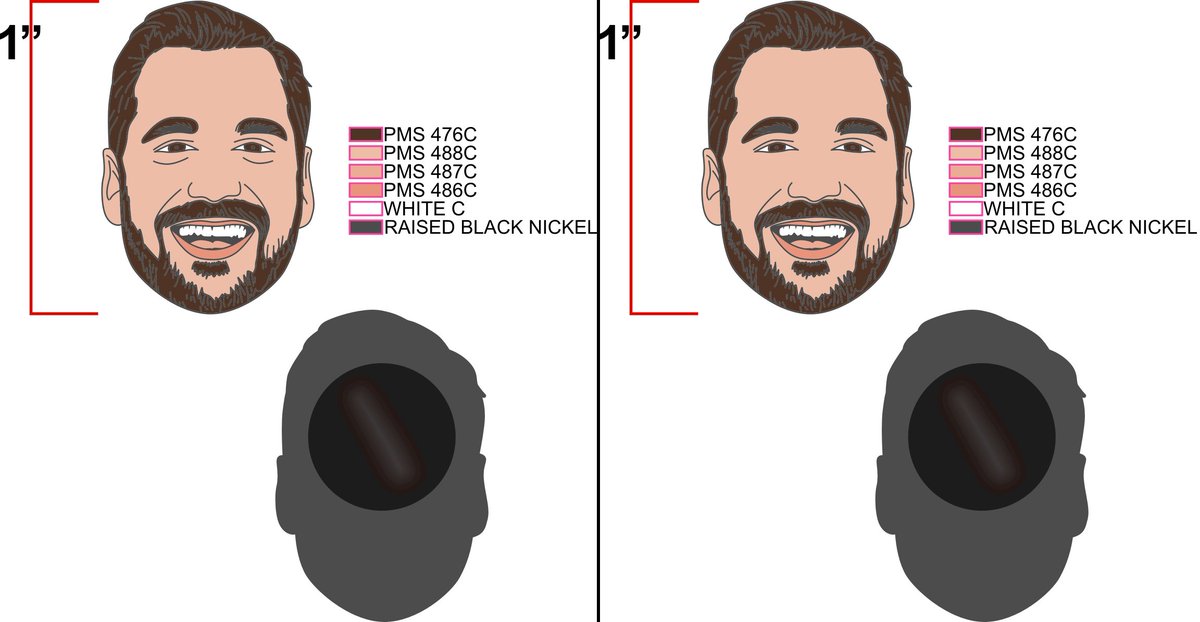
After the show, Harrison let me in on his plan -- which he has since shared with his fans via a posting -- to have his fine portrait made into a lapel pin, and was choosing between the following designs:


Harrison explained that these can be produced at a modest cost.  When they come out, I'll want one!

I first encountered Harrison at Monday Night Magic, a permanent magic venue founded by my friend Michael Chaut.  In creating Monday Night Magic, Chaut was able to accomplish what others -- including top performers from magic's heyday like Houdini and Carter the Great -- could not: he established a permanent venue for magic in New York City.  Monday Night Magic has been running for more than two decades, powered by the energy of performers like Greenbaum.  Just a note to those in or around New York City, and those planning a visit -- go see Monday Night Magic.  If you check the schedule, you might catch Harrison Greenbaum there!  You won't regret it!

_______________________________________
Postscript - December 2017

After sharing this post with Harrison, he kindly send me one of his new pins, hot off the press (and, in his words, that's assuming that lapel pins are made on presses!).  It's a terrific keepsake.  Take a look:


The card on the left is a business card on which the pin is mounted over his face!  Thanks again, Harrison!


Thursday, August 31, 2017

Earl Lockman – “Locks Don’t Lock Lockman”


Earl Albert Lockman was born on June 12, 1893 in Chicago, Illinois. He got a taste of the entertainment world at an early age. His father was employed to pull Buffalo Bill’s Circus

Thursday, June 1, 2017

Harry Haywood, Automotive Pioneer


"Can I make it any plainer?  Be original." Harry Haywood, M-U-M, 1916.  

Meet Harry Haywood, sometimes known, as reflected on his fine throwout card, as the "American Magician," also known as Hiram Haywood, William H. Haywood, The Illustrious Jarrell, William H. Jarrell, Harry H. Jarrell and, possibly, an exposer called Jarrell the Strong Boy.

Haywood was probably born William Jarrell, and became a well-known magician and ventriloquist, beginning his career in the 1890s.  He began his career performing in circuses, wagon shows and vaudeville theaters.   Reports suggest he had "sufficient mechanical genius" to build all of his own magic apparatus.  Haywood's skill with Cups and Balls was legendary.   Louis "Pops" Krieger, an undisputed Cups and Balls master, admired Haywood's talent, while Dr. Wilson called him "peer of all Cup and Ball performers."   Curiously, in or around 1900, Haywood had a son whom he named "Harry Kellar Haywood."

After the turn ot the century, Haywood settled in New York City.  He became a member of the Society of American Magicians shortly after its founding, eventually serving on its committee on admissions for many years.   An amateur astronomer, Haywood always travelled with a 3-inch Bordeaux telescope.

Haywood's claim to fame began in early 1919, when he loaded his magic act, usually carried by wagon, into an automobile for a two-year, cross-country tour.  According to Oscar Teale, Haywood's was the first magic show to tour by automobile.  Haywood drove a Ford adorned with the emblem of the SAM on both doors.

Though nearly a decade after Houdini flew an airplane in Australia, the magic trade press treated Haywood's motor vehicle magic tour as an adventure equal to the Lewis and Clark expedition. His own account of these experiences were featured in a dramatic M-U-M cover story tantalizingly entitled "Hell Gate to Golden Gate."


In the piece, Haywood details his experiences, which included several automobile accidents (including a crash with a street car that cost him $87 in repairs) and getting stranded in the desert.  He described performances in low-rent venues before brawling crowds.   Haywood describes being surrounded by a group of "gypsies . . . on a lone mountain road in Wyoming."  Brandishing a Winchester rifle, the magician faced down the group, while his wife Adeline  "stayed in the car with a Colt .38 automatic in her hand, ready to get .the first one that came too close to me."  The intervention of two highway patrolmen averted the couple's decision "to meet our defeat Davy Crockett style."

In the end, despite the hardships, the magician raved about the wonders of a tour which extended  "from the battlefields of Gettysburg to the Pikes Peak region; Salt Lake, the Temple, the big cities of the East, and over the beautiful Allegheny Mountains, through the many towns of the Mississippi Valley; across the plains, with its long,straight roads that reach the sky; the prairie dog villages; the mighty Rockies, with its range after range of towering, snow-capped peaks, the wild deer; the lone sheep herder; the desert, with its deathlike stillness; the sand, sage brush, coyotes, and wild horses, and the high Sierra Mountains,, the land of the sky and the camper's paradise; the Sacramento Valley, with its fruits and flowers—into old 'Frisco, with my car in good shape and still ahead of the game."  

The end of Haywood's story is a bit of a mystery, though it may involve yet another name change.  
In 1923, John Mulholland published a list of compeers he was trying to locate: Haywood was prominently featured on a list of SAM members, some of whom were presumed dead.   It is his last appearance in the trade press in the U.S.  However, that same year, the Magic Circular makes mention of an "H.W.F. Haywood, M.M.C." changing his name to "Hazel-Le-Roy," and references to that performer continue through 1928.    And there the trail goes cold....

From M-U-M, December 1918


Friday, May 5, 2017

Henry Gordien


Henry Gordien passed away at seventy-seven on February 9, 1967 in Maple Grove, Minneapolis. He was active in magic for well over fifty years. He specialized in presenting assorted effects including producing bowls of water filled with gold fish, a production of a live rabbit, a torn and restore newspaper effect, the ever popular borrowed bill in lemon effect, and a featured effect that seemed almost common place in his time and that was threading over a dozen needles after swallowing them which he called the “Hindu Needle-Eating and Threading Trick”. Another magician made this trick popular and his name was Harry Houdini. When the opportunity appropriate, Houdini would mention that he purchased the original needle trick from Gordien. 


Sunday, April 23, 2017

Elmer Eckam


Elmer G. Eckam was born in May of 1892 in Rochester, New York. Eckam’s first stage work was working as the assistant as a teenager with fellow Rochester magician Ray Hogan (1886 – 1945). Eckam performed for over forty years. He gained experience after leaving the auspices of Hogan by working the Chautauqua and Lyceum circuits as well as many of the theatres and clubs. By the Twenties, Eckam had his own unique act that included escapes. The full evening show was performed at national and state conventions in the East and Midwest. He was well liked by magicians and was a friend to fellow performers like Harry Houdini and Harry Blackstone. At the 1927 I.B.M. Convention in Kenton, Ohio, Eckam thrilled the over one thousand participants by escaping from a straight jacket while being suspended fifty feet in the air. Eckam published a magic newspaper titled, Eckam’s Echo from 1937 to 1940. He also had a mail order magic business from his home in Rochester that he called “Art in Magic”.

Thursday, March 2, 2017

Harry Houdini

Harry Houdini (Erik Weisz and later Ehrich Weis) born March 24, 1874 – October 31, 1926) was a Hungarian-American illusionist, stunt performer, and noted for his sensational escape acts. So much has been written about Houdini’s life from articles to books. The life he lived and the secrets he took with him over ninety years ago are still being researched and found today. There still seems to be an endless source of material around the world.

Over the past handful of years alone, anything from scrapbooks, posters, and letters seem to appear, and it doesn’t seem there will be any end in sight. The name Houdini will continue to live on as a goal setter. Whether it was his method of publicity, his public recognition, or just good timing; the name Harry Houdini has been the bar to reach for in magic.

Harry scaled playing cards with accuracy and he could cut a card in mid-air with a pair of scissors. Thanks to Jay Hunter for solving one part of the Houdini throw out card mystery. Jay found the following in "The Sphinx" for June, 1936. Included in John Mulholland's "Editor's Page", he included the following from Harry's brother, Theo Hardeen.  "...Hardeen wrote the following interesting letter to me: 'The very beautiful story about the card throwing of Herrmann and Thurston in the May issue interested me very much. However I think that it is a little incomplete in not mentioning the name of Houdini. In 1894, when Houdini and I were performing as the Houdini Brothers, Houdini threw out steamboat cards with his picture on the front. These were the regular cards, no thicker. Then when Houdini joined the Welsh Brothers tent show, after his marriage, and worked the act under the name of Harry and Bessie Houdini, Jim Bard of the famous Bard Brothers (Jim and Eddy) taught him how to do a back somersault. After that Houdini would scale out the cards and the last card, he would throw out, turn a back somersault and catch as it returned to the ring." 
        If it wasn't for one particular publication by someone who has surpassed Houdini in his prowess of handling cards, we wouldn't be able to enjoy the image below what appears to be the Houdini throw out card. Here is an image of the front of the card published in the 1977 book by Ricky Jay titled, Cards as Weapons. I want to make an open request, please. If you own this throw out card, it would really be nice to know what is on the back. What is the actual size and would you be so kind as to allow us to post a perfect image? One wonders, what happened to all of these cards? 

             To honor the man whose name continues to be brought up almost daily around the world, here is another image in the form of advertisement that nearly coincides with our site.

This 7.62cm x 11.43cm card was used to promote soap.

            It should be mentioned, the facts on the back of the card are not all correct (well, they got his name right). Possibly those were the facts they received at the time of the publication. This is one cards advertising Orocrema Almond Soap that was created in the early 1920’s. Each card measured three inches by four and a half inches (7.62cm x 11.43cm).

Loosely translated the card reads:
“A single film has been enough to make this fantastic artist universally known. Son of a wealthy merchant was born in Chicago, in 1887, where he studied the career of an engineer. Since childhood, he has always shown an engaging and decadent character that led him to the realization of his daring plans. He built an armored armor that was the main reason for his only film titled "Houdini and the human tank" that gave him popularity. He is of a nervous temperament, and his numerous prowess has made the stairway of the facade of a "skyscraper" with the sun helping his feet and hands. He is currently retired from cinematography.”
              Houdini's skills were somewhat legendary, as discussed on the sites Wild About Harry and The Great Harry Houdini. According to many sources, he would scale steamboat cards with his autograph on the face. Images of such cards can been seen on Pinterest and here on this site Propelled Pasteboards.

This three sheet poster is currently on display at the famed Winchester House in San Jose, California (Yes, that's me).

              As seen above, there was always one item that really would have made a perfect throw out card, but alas, it was only created as a poster.

Monday, February 20, 2017

Frank Ducrot


Ducrot's card sports National Playing Card Company's Rambler no. 23 Blue Hindoo Back
Frank Ducrot was born Theodore Francis Fritz on May 7, 1872 in Brooklyn, New York. His interest in magic started as a lad growing up just a ferry ride away from Manhattan where the famed Palace of Magic where Francis J. Martinka’s magic shop was just waiting to entice him. As a performer, he toured the Chautauqua and Vaudeville circuits. His billing as “The Boy Magician” lasted into his 50’s.

Tuesday, February 7, 2017

The Great Raymond


Maurice Raymond Sauders was born on May 30, 1877 in Akron, Ohio. At nine years old, he joined his uncle and traveled with the show. At the age of thirteen, he traveled the Chautauqua, the Kohl, and Castle circuits while still in his teens. During this part of his life, his grandfather took him to Europe. He met Alexander Herrmann. Seeing the master perform changed his life's work. He adopted a part of the consummate performer's title (“The Great”) and placed it with his own middle name.
Now, The Great Raymond would go on and modify his work as a performer keeping in mind all that his idol did. Before his career was complete, he toured parts of the world that had never seen magic before. His stage presence, his performance, the advertising, and the man were everything magic was supposed to be and more on stage.

Sunday, February 5, 2017

The Great Kolar


Joseph J. Kolar (1884 -1949) born in Chicago, Illinois. His father performed throughout Europe before young Kolar was born. In 1908, he was billed as Kolar, King of Locks and Chains. Kolar claimed to have the only iron bound bag escape of its kind in the world. He was a close friend of Harry Houdini. They both appeared at the Clark Street Museum. His wife joined her husband on the Western Vaudeville circuit and others. Hazel was billed as the world's greatest mind reader during her contract at the Oriental Theater in Chicago in 1914.

Can you remove this card from the string as easy as Kolar?

His act and show includes magic and escape work, as well as juggling and slack wire walking. In 1921, Kolar was strapped in, and escaped from an insane jacket by an attendant from the Dunning Insane Asylum. He was good friends with A.M. Wilson. Kolar had a monthly column for The Sphinx called "Chats by Kolar." 

         Among his magic effects he developed and marketed were the "Original Kolar Tag Trick"(advertised in National Magic Company's catalog as M182), and "Straw and String Trick," and "Kolar's Card Effect."

Friday, February 3, 2017

Grdina


John J. Grdina came to America at age of five with his family and settled in Cleveland, Ohio. Checking through the internet, in 1940, census indicates he stated he was born in Yugoslavia in 1886 and not in Austria in 1885 as it has been indicated online and in past articles. Grdina became a naturalized citizen in May 1898. Years later he was in a theater audience in Cleveland and saw Harry Kellar perform. That show changed his life.

Friday, January 27, 2017

Otto Maurer, Jr. - Like Father, Like Son

This post concerns the not-so-well-known, but still famous 19th century New York magician and magic shop owner Otto Maurer and his son. There is not a lot of biographic material on Maurer, but thanks to the tireless research of historian Tom Klem, we know quite a bit more about this father and son team. And, thanks to some unidentified magic collector who assembled many of the cards in my collection, we also know that Maurer’s son had a scaling card, it exists (below), and is offered here for your pleasure.
Otto Maurer Jr. 


Much of Maurer’s life is detailed in Klem’s article “Otto Maurer’s Magical Bazaar,” in The Yankee Magic Collector, Vol. 17, 2016, published by the New England Magic Collectors’ Association. Mr. Klem has graciously allowed me to draw from his article for the purposes of this post. Thanks. 

Maurer was born Oct. 28, 1846, in the village of Gemeisheim, Germany. When only 16 years old he immigrated to the United States and arrived in New York City where he quickly became part of a burgeoning German community located in the Bowery.  Census records have him employed as a tinsmith and in that capacity, he apparently also sometimes repaired the apparatus of local magicians. In 1872, he opened a magic shop in the basement of a five-story tenement building at 321 Bowery Street near Second Street.
A stylized portrayal of Maurer's Magical Bazaar.
It was actually in the basement of the building.

As Klem points out, in the nineteenth century, the Bowery had a thriving theatrical district with many first- and second-class theaters, dime museums and other sources of entertainment. There were also great restaurants and shops and it was a popular destination for those seeking entertainment. John Henry Anderson, The Wizard of the North, appeared at the Astor Place Opera House in 1851. Among Maurer’s regular customers were Imro Fox, Horace Goldin, Arnold De Biere, Frank Ducrot, Alexander Herrmann, Harry Houdini, Howard Thurston and many others.

Apparently, Maurer’s shop was also the first place that the back-hand palm was shown to magicians. According to the stories, Maurer was shown the move of effortlessly shifting a playing card from the tips of the fingers to the back of the hand by a traveling Mexican gambler. This would have been around 1887. Maurer taught the sleight to other performers including Houdini who was performing at the Globe Dime Museum in 1894, almost directly across the street from Maurer’s shop.


Within a short time, Houdini had added this sleight to his repertoire, proclaimed himself the “King of Cards” and had a lithograph printed to publicize the fact. 

T. Nelson Downs also learned the sleight as did Thurston, who utilized it in his very successful card manipulations.
Maurer married Emma Brichard in 1877, and they had three children, one of whom was Otto Jr., who played piano during his father’s performances (mostly in parlors) and who later went go on to operate the shop after his father’s death as well as performing musically and magically.

In the late 1890s, the magic magazine Mahatma started reporting on Maurer’s declining health due to cancer. After many hospital visits, Maurer passed away May 15, 1900. The New York Times ran an extensive obituary which read;

“King of Magic” Dead
A Master of Legerdemain on the Bowery Passes Away
The Bowery “King of Magic” is dead and the “Magical Bazaar” at 321, which for twenty-eight years has been a storehouse of implements for mystifying, has at last been visited by the mysterious hand of death. “Professor” Otto Maurer, one of the quaintest characters of the thoroughfare, succumbed to cancer last Tuesday in the Post-Graduate Hospital.
He came from Germany when a young man and established the shop, bringing with him many of his inventions for tricks. Incidentally he gave lessons in the art of mystifying the public.
As the years went on he accumulated a fortune and married. He could not mystify his better half, however, and they separated. Their son remained with his father, who instructed him in the tricks he know so much about.
The old “King of Magic” knew what good living was and his money finally disappeared. He died a comparatively poor man. The funeral will be held to-day, and many of the “professors” old friends on the Bowery will follow the body to the grave.
It is more likely that rather than living the high life, Maurer’s monetary resources were depleted unsuccessfully battling cancer. The New York Herald also covered the story with the headline, “Wizard of the Bowery is Dead.” Houdini was reportedly the last person to see Maurer alive. 

After Maurer’s death, his son, Otto Jr., continued to operate the business out of the address at 321, but eventually moved the shop to 105 E. 14th Street. It only operated there for a short time and then the shop and its contents were absorbed into the New York Magical Company on Broadway in Brooklyn.

The scaling card featured here bears the 105 East 14th Street address, probably written in Otto Jr.’s hand. It seems likely he continued to use the original cards after his father's death but then manually added the new address. According to Houdini, writing in his Conjurors Monthly, Maurer Jr. ended up working in the musical department of a store in Newark, NJ. As late as 1920, the Census showed him living with his mother. It is uncertain when he passed away. 

Tom