Showing posts with label Society of American Magicians. Show all posts

Wednesday, October 31, 2018

Charles Howard Sheck, the Rise of the S.A.M. and the Broken Wand Tradition


This handsome pasteboard, obtained in early 2017 from Ray Goulet, showcases Charles Howard Sheck,  a seemingly obscure performer, whose obscurity seemed, at first, something of a mystery....

Turn-of-the-20th Century magical periodicals, which provide fairly comprehensive documentation of the lives of conjurers of that period, offer only a few scraps about Sheck.  He received a few brief mentions in Mahatma, an early magicians' magazine printed by New York's legendary Martinka magic shop.  Beginning in 1899, we find Sheck in New York City "playing lyceum dates," dubbed "a clever little professor [offering] the latest sleights with cards and coins" and "busy with local work in Brooklyn."  Curiously, in the grand tradition of magicians making hay out of fooling a leading performer, he is referred to as "the man who mystified Kellar," without further explanation, and commanding ten encores in Saratoga with his "flag trick."

Almost as interesting as the information I found about Sheck was what I didn't find.  Despite exhaustive searching, I discovered little about the nature of the effects he performed, any promotional material or even a single photo.   He published no books or articles.  Aside from the throwing card pictured here, I can find no graphic material relating to this magician.   The date and place of his birth remain a mystery.

While this kind of obscurity makes sense for one of our men of mystery (like Stincel), the trajectory of his career would seem to destined Sheck for substantial influence in the world of magic.   He was among the "prominent regulars" at Martinka's magic shop, where, according to John Mulholland, he found himself among renowned company, including Alexander Herrmann, Imro Fox, Carl Hertz, Harry Kellar, William Robinson, Adrian Plate, de Lion, Zancig, Nate Leipzig, Dr. Ellison,
Frank Werner, John W. Sargent, Dr. Mortimer, Elmer P. Ransom, Bob Ankle, Frank Ducrot and Henry Hatton.  Beginning in the late 1880s, this group (including Sheck) began assembling on Saturday nights, guests of the Martinka brothers in the shop's locked back room.

The so-called "Saturday Night Club" proved to be the precursor to the Society of American Magicians, which became formalized in 1902.  Sheck was among 24 magicians sworn in as the group's founding members, along with some of the most prominent magicians in history.  According to chapter reports, Sheck was an active member, frequently appearing a meetings "with his bag of tricks," and, at one meeting, playing the bagpipes.    At another 1902 meeting, he offered "an envelope test" and a "slate test."


Then, in July 1906, on an evening when Harry Houdini was elected Vice President of the fledgling SAM, "The death of Charles Howard Sheck, of Brooklyn, N.Y., was reported."   No other details are provided.  Hence, Sheck's relative obscurity arose as a result of his death early in the history of the S.A.M. (and presumably at a young age).

His passing was not officially commemorated by the organization until three years later, at an annual dinner in 1909 (at which Harry Kellar was the featured speaker) and a list of departed members was read. At the banquet, a half dozen names of departed magicians, including Sheck, was read aloud. As each name was read, a plate was turned over and a white carnation laid upon it.

The description of this improvised ceremony made me wonder: why didn't they simply perform the traditional "broken wand" ceremony?  The answer is simple: no one had yet devised the tradition.  There would be no mention of a broken wand ceremony in the magic literature -- or even use of the term broken wand in connection with a magician's passing, for several decades.  

The earliest mention I could locate of a broken wand consists of a 1919 article about Baltimore's Demon's Club, noting that a panel painting commemorating the deaths of two members included an image of a broken wand.  According to Ken Silverman's authoritative Houdini biography, a member of the SAM placed a broken wand on Houdini's coffin, an act specifically devised to commemorate Houdini's death in 1926, but the source of this information is unclear and I could not locate any contemporary accounts.  In 1933, a piece describing the funeral of Heller (another founding member of the SAM), noted that "across his breast was placed a floral design representing a broken wand, the tribute of A. W. Fronenthal, a warm personal friend."  And the first mention I could find of an actual broken wand ceremony is found in the Linking Ring in 1936, which described the commemoration of the passing of Howard Thurston, in the following article:


It would appear, then, that Thurston's was the first broken wand ceremony, which have since become standardized and commonplace in the magic community.  

By the 1940s, magazines began to run obituaries of magicians under the heading "Broken Wands," a practice that has continued ever since.  

Tuesday, January 30, 2018

Professor Stockley's Hundred Year Time Capsules

Albert A. Stockley, Jr. (1868-1946) was the son of a civil war veteran who operated a wholesale liquor store in Baltimore, Maryland.  Somewhere in the middle of life's journey, Stockley became interested in magic.  Magic magazines from around 1900 through 1907 contain a variety of notes about "Professor Stockley." None of these, however, were quite as historic as his inclusion on the very first published list of potential applicants for the Society of American Magicians in the February 1903 Mahatma.  That list included 14 hopefuls, mainly from the East Coast, but most notably Harry Houdini from New York City and Harry A. Jansen (later known as Dante) from Chicago.

Later that year, Francis J. Werner, founding Secretary of the S.A.M., travelled to Baltimore and had the opportunity to watch Stockley perform at Henshaw's Episcopal Church.  After witnessing Stockley entertain with a program that included "Flower production, hat load, cards, billiard ball and handkerchief manipulations, and rising cards, a la De Kolta," Werner reported to readers of Mahatma that Stockley was "a credit to The Society of American Magicians."

Given his historic early membership in the S.A.M.,  perhaps it is unsurprising that Stockley commissioned a throw-out card prominently featuring the Society's logo, and identifying him as a "Fellow" of that organization.  The card, seen here, has a blank back.  Stockley approached his hobby in a business like manner, packaging these cards together with a handsome brochure in a beautifully printed envelope to be sent to prospective clients.

Fast forward a century.  Around 2016, a "picker" working in the Baltimore area organized an estate sale for one of Stockley's descendants.  Amidst the accumulated treasures, he unearthed a handful of sealed envelopes containing Stockley's ephemera, each packet sealed a century earlier, ready to be addressed to a potential customer.  The discoverer turned them over to an eBay seller.   Our friend Bill Mullins, who has posted on this site elsewhere, bought one, and alerted your correspondent to their existence.  I contacted the seller and bought the few that remained.

When they arrived, I gingerly opened one of the envelopes, which yielded a card and a brochure.  It was like opening a century-old magic time capsule.  For anyone interested in magic history, this was an exciting moment.

While, of course, the throw-out card was the prize, Stockley's brochure also proved a treat.  The cover features the handsome portrait featured here, as well as a Shakespearean quote about magic.   Inside, the good professor attempts to attract business using Victorian language and testimonials that were the fashion of the time.  He boasts of "my large number of mystic revelations" featuring "some of the newest and most delusive that have been presented."   He promises to "continue to add the latest effects and discoveries in the mystic art, thereby keeping my repertoire replete with up-to-date attractions."   Buttressing his respectful announcement are a series of testimonials from lodges, social organizations and one military regiment, expressing gratitude for his "first-class entertainment," including one particular shout-out for his "mysterious cabinet."  People really could write in those days.


Wednesday, November 15, 2017

Theodore DeLand's Got Your Back!

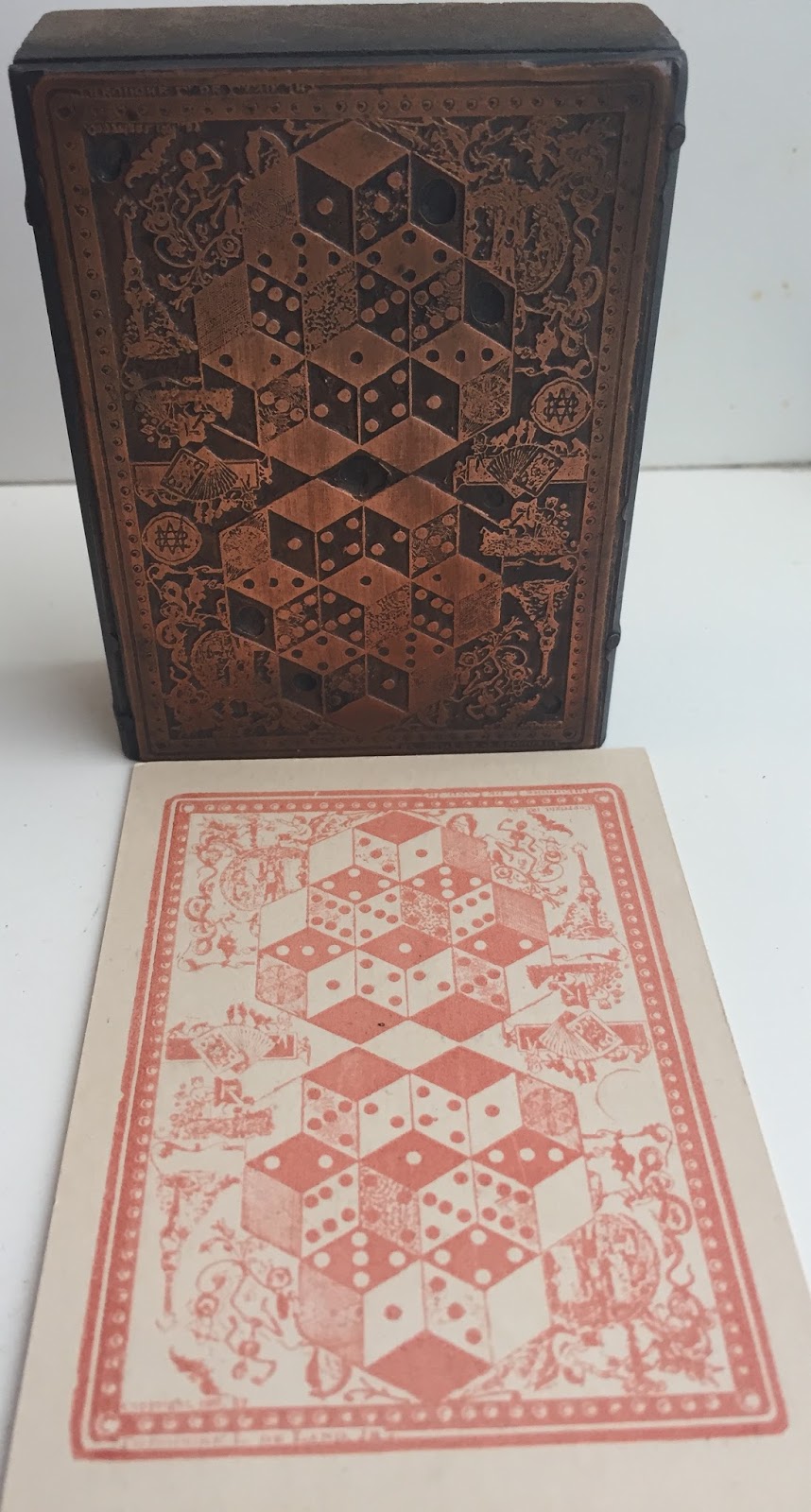
Deland's "Watch the Dice, 6 or 7," on the backs of throwout for J.W. Wilson, Puzzling Pierson and Lightner


As part of our continuing study of throwing cards, we have often stressed the importance of examining a card's back to provide added insight as to it provenance, manufacture, and approximate age. And if you look a enough magicians' cards, it will not be long before you notice one or more with this intriguing design, produced by Theodore DeLand, an eclectic, prolific magic card manufacturer in 1907. It's called "Watch the Dice, 6 or 7," and it's a terrific negative space illusion: Rotate the card 180 degrees and the number of dice in the stack appears to change.


Another unusual aspect of these cards is the manner in which they were created.  Unlike the various cards we've discussed which were sold as blanks, such as the Roterberg Stock Card and the Bamberg Magic Card, or cards that were professionally printed on both sides, to create these backs, DeLand sold printing blocks to allow magicians to create them on their own. I was fortunate enough to be able to add one of these rare printings blocks for the "6 or 7" back to my collection.   That block, seen here with a Puzzling Pierson card back, is in beautiful condition, and I suspect it was never really used.  It bears the emblem of the S.A.M. embedded in the design.


Gary Frank was able to provide me with one of the ad cards that DeLand used to sell these printing blocks.  The "Advertise Yourself" copy was printed on the face of playing cards with printed images of the three backs for which they were available.  Price: three printing blocks for $1!  (I paid much, much more for mine, even when adjusted for inflation.)  One of those three designs, obviously, was the "6 or 7" back.  In addition, I believe a second one was the "Dollar Deck" back, seen below as well as on the reverse of the promotional card used by McDonald Birch.  The third may have been the Daisy Deck back, though we have been unable to locate a throwing card with that particular design.


Jay Hunter was able to turn up something else: The M. Lewis Company, the work of which will be discussed in another post, advertised the DeLand "6 or 7" printing plate in the Sphinx in 1907.  Interestingly, as seen in the ad reproduced here, Lewis sold them for $1 each, offered with or without the S.A.M. emblem engraved in the circles in the design.  Lewis suggests having the corners rounded like a playing card, or square like a business card, and notes that it had a "large supply on hand."

Jay also kindly prepared an array of cards sporting the "6 or 7" back, printed in four different colors, both with and without the S.A.M. emblem as well as with rounded and square corners:


So who was Deland?  Well, according to Magicpedia, "Theodore DeLand (1873-1931) created the phenomenon of packet tricks between 1906 and 1915, during which time he marketed almost 100 tricks using gimmicked cards and decks, many of his own unique creation. DeLand was a clerk at the U.S. Mint in Philadelphia and died in an insane asylum in Norristown, Pennsylvania."   That snippet hardly captures DeLand's unusual story; for many years, Richard Kaufman has been working on a biography, DeLand: Mystery and Madness, which is expected to be released soon.

And while DeLand did not have a throwing card, many of his decks and effects included signature aces, which are quite interesting.   Several are seen below, which Mr. Kaufman helped me identify.


Ace of Spades from original Deland Dollar Deck
(later printed by S.S. Adams)


Ace of Spades from Deland's "Twister" trick

Ace/Three from a DeLand effect called "Pickitout"


Tuesday, October 24, 2017

Loring Campbell


Alexander Loring Campbell was born on March 19, 1905 in Sapulpa, Oklahoma where in just a few short years, the senior A.L. Campbell and his wife Byrd closed the drug store, packed up their belongings, and had their son comfortably set up in the back seat of the family car for the long trip to Southern California. Loring’s first exposure to magic was watching a group of Japanese performers known as the Ten’ichi Troupe of magicians. It wasn’t long after that Loring tapped by the “Goddess of Magic” and she didn’t let go.

    
  Whether it was entertaining classmates, or working a summer performance in full make-up in a polka dotted suit being billed as “Cambello the Clown”; Loring was fulfilling his destiny to become a full-fledged, professional magician.
After his schooling, Loring captured the attention of the managers of the Redpath-Horner Chautauqua circuit. He was contracted to work a twenty-five week tour. The only condition he had to agree to was being billed as magician Jack Gwynne. Gwynne wasn’t able to complete his contract and it was too late for the management company to alter the advertisements that were in the hands of every place Loring was to perform. So, taking everything in the old adage “the show must go on”, Loring Campbell was “Jack Gwynne”.


 A little known fact in magic history was when in 1929, Howard Thurston was searching for “one more traveling company” to take another one of his sponsored shows out along with his own show, and the Dante and Tampa show; Loring was also in the running. He readily declined, just as McDonald Birch, Werner "Dorny" F. Dornfeld, George Marquis and  Jack Gwynne. This time, Thurston has decided the name for the magician under the Thurston banner would be "Faust the Magician". All declined for the similar reasons; they wanted to keep their name and they their own performance style. When the International Brotherhood of Magicians was founded, Loring joined and was member number twenty-two. He did all that he could to find more members to join this newly established society of magicians wherever he traveled. Loring wasn’t alone in this life adventure, his wife Kathryn was at his side working in the show, on the show, and keeping the show going for many years. Kathryn kept the bookkeeping details kept the rabbits fed, and made sure Loring was on top of his game wherever they performed.

    
They toured throughout the United States dozens of times. Audiences and managers alike praised their magic shows. Loring included numerous effects from sleight of hand, to a presentation of the guillotine, and he would also include escapes. Their two-hour show would change every year and Loring would keep in touch with magic dealers and include whatever the latest effects were popular. He would also update his brochures and posters making sure he would keep the attention on the idea of fun for the entire family. 

          
How could you pass up
seeing this show?


       Whether Loring was performing his noted ventriloquist act with his sidekick, Johnny Applewood, or he stepped up to the artist’s easel and created wonderful rag pictures for all to enjoy; Loring had found his life’s dream and it did come true. He was a member of Los Magicos of Hollywood, Society of American Magicians, and he was a member of the Hollywood Comedy Club. 

           Loring wrote a column for the Tops Magazine titled “The Campbell Caravan” that was enjoyed by all its subscribers. He was elected into the Society of American Magicians Hall of Fame. Loring wrote two books This is Magic in 1945 and Magic That Is Magic in 1946. He retired from the stage in 1955. Kathryn passed away in 1958. Loring continued his interest in magic always there helping other performers and keeping in touch with magic friends he had met for the many years he was on the road. Loring passed away on January 11, 1979.

Thursday, August 31, 2017

Earl Lockman – “Locks Don’t Lock Lockman”


Earl Albert Lockman was born on June 12, 1893 in Chicago, Illinois. He got a taste of the entertainment world at an early age. His father was employed to pull Buffalo Bill’s Circus

Thursday, June 29, 2017

Senator Clarke Crandall


Clarke Crandall was born on April 23, 1907. In 1947, Clarke participated in the Society of American Magicians convention in Chicago. This was one of the first times audiences had the opportunity to enjoy his dead-pan expressions, droll patter, comic thoughts, and his whole act fit nicely in his banjo case (oh, there was no banjo). At one point of his life while he was living in Chicago, he was working as a stock hand possibly as a buyer of cattle. It was said magician Johnny Paul approached Clarke in the 1950’s and offered Clarke a job as a bartender/entertainer.

Monday, June 26, 2017

Leslie Guest


Leslie Pierce Guest was born on September 6, 1898 in Pelham, New York. He caught “the bug” of magic when he was eleven. Guest continued his interest in magic throughout his schooling, which included the University of Michigan and the College of the City of New York where he earned his Bachelor of Science Degree. 

After finishing college, Guest moved to Cincinnati,

Sunday, April 23, 2017

Elmer Eckam


Elmer G. Eckam was born in May of 1892 in Rochester, New York. Eckam’s first stage work was working as the assistant as a teenager with fellow Rochester magician Ray Hogan (1886 – 1945). Eckam performed for over forty years. He gained experience after leaving the auspices of Hogan by working the Chautauqua and Lyceum circuits as well as many of the theatres and clubs. By the Twenties, Eckam had his own unique act that included escapes. The full evening show was performed at national and state conventions in the East and Midwest. He was well liked by magicians and was a friend to fellow performers like Harry Houdini and Harry Blackstone. At the 1927 I.B.M. Convention in Kenton, Ohio, Eckam thrilled the over one thousand participants by escaping from a straight jacket while being suspended fifty feet in the air. Eckam published a magic newspaper titled, Eckam’s Echo from 1937 to 1940. He also had a mail order magic business from his home in Rochester that he called “Art in Magic”.

Monday, February 20, 2017

Frank Ducrot


Ducrot's card sports National Playing Card Company's Rambler no. 23 Blue Hindoo Back
Frank Ducrot was born Theodore Francis Fritz on May 7, 1872 in Brooklyn, New York. His interest in magic started as a lad growing up just a ferry ride away from Manhattan where the famed Palace of Magic where Francis J. Martinka’s magic shop was just waiting to entice him. As a performer, he toured the Chautauqua and Vaudeville circuits. His billing as “The Boy Magician” lasted into his 50’s.

Tuesday, February 7, 2017

The Great Raymond


Maurice Raymond Sauders was born on May 30, 1877 in Akron, Ohio. At nine years old, he joined his uncle and traveled with the show. At the age of thirteen, he traveled the Chautauqua, the Kohl, and Castle circuits while still in his teens. During this part of his life, his grandfather took him to Europe. He met Alexander Herrmann. Seeing the master perform changed his life's work. He adopted a part of the consummate performer's title (“The Great”) and placed it with his own middle name.
Now, The Great Raymond would go on and modify his work as a performer keeping in mind all that his idol did. Before his career was complete, he toured parts of the world that had never seen magic before. His stage presence, his performance, the advertising, and the man were everything magic was supposed to be and more on stage.

Saturday, December 17, 2016

Dante the Magician


Harry August Jansen (1883 - 1955) and his family came to the United States and settled in Chicago. Jansen made his stage debut at the age of sixteen. Years later, he toured the world as "The Great Jansen – America’s Greatest Transformist". From 1908 to 1911, Jansen and his partner I. F. Halton built magic props under the name Halton and Jansen Company. In 1922, Jansen began working for magician Howard Thurston in the capacity of shop foreman and master prop builder. Once the show was built, Jansen’s options were coming to a close.