Showing posts with label Harry Haywood. Show all posts

Thursday, June 8, 2017

Haywood's Back, An Exquisite Enigma

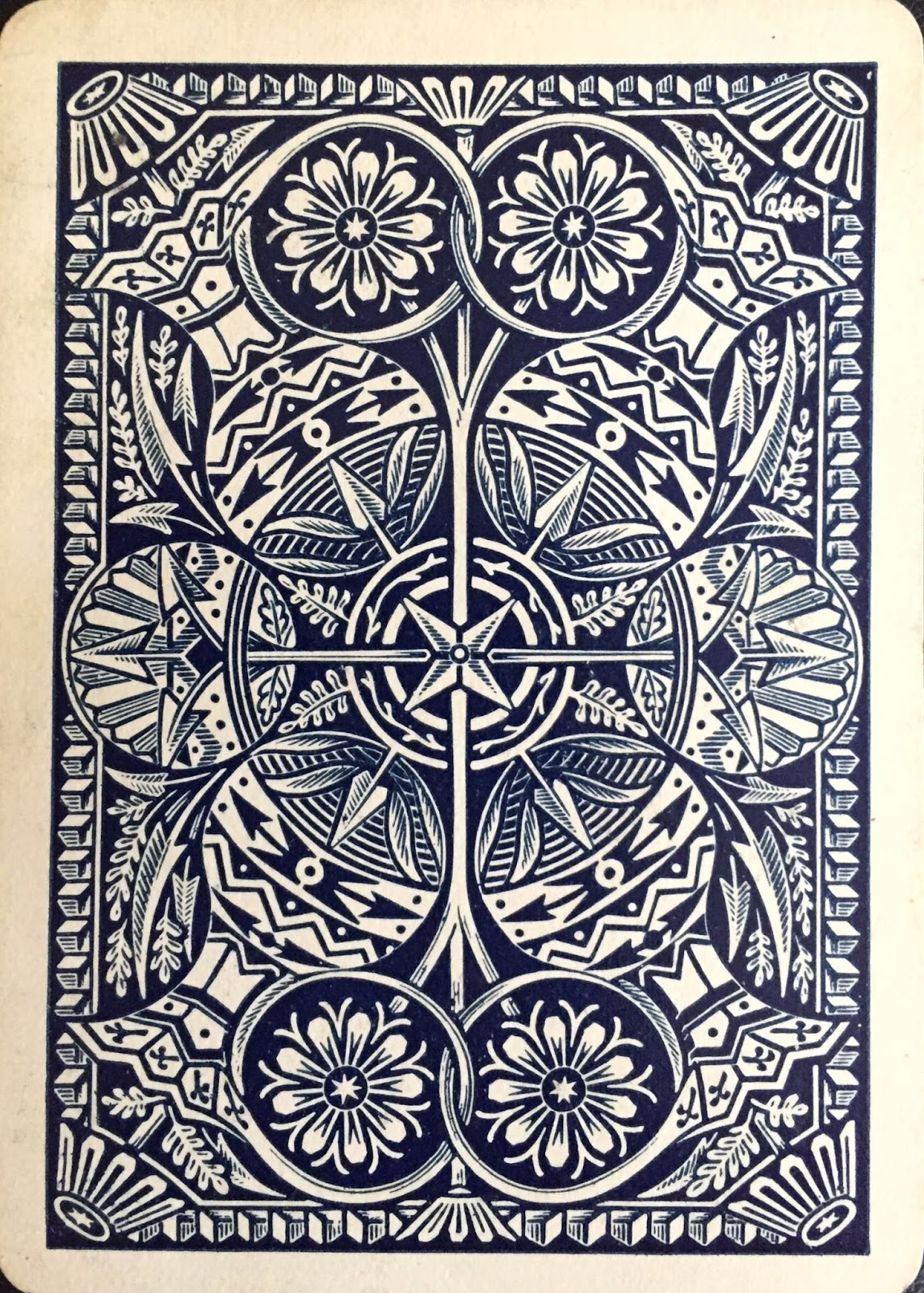
After preparing the post about Harry Haywood, automotive pioneer, I took a fancy to the beautiful and intricate back design of the card (which I'll call, for these purposes, "The Haywood Back.")   Searching through my collection for another exemplar of this back and finding none, and able to locate no other clues about its manufacture or origin, I opted to contact our friend, Lee Asher, head of the 52 Plus Joker American Playing Card Collectors Club for some scholarly guidance.

Answering the question, Lee advised, required him to crack open a "cold case file" in the 52 Plus archives.  It seems that the good folks at U.S. Playing Card Company asked him about the Haywood Back just a few years ago.  Apparently, after deciding to publish a "historic" deck, USPCC offered card aficionados the opportunity to select the back from several designs, including the Haywood Back.    The votes were tallied and the Haywood Back won.   

Here comes the mystery: after the voting, the people at USPCC
"got to work tracking down the story of this deck back. And we came up short. No one knew where it came from; the printing plate may have fallen from the sky and into the glass protective case, for all we know."
Displaying Herman TO card.jpgAlthough they had the printing plate for the deck back, the people at USPCC could not locate a single example of its use. So, they did what I did: they consulted with Lee Asher.  Despite Lee's considerable knowledge and access to a national network of card collectors, he, too, could not locate a complete deck of these cards. Thus, when I sent Lee the Haywood Back, he was delighted, particularly after years of unsuccessful sleuthing.  The Haywood card was among the first exemplars of this back design to surface.

But we at Propelled Pasteboards did not quit there.  I asked my co-contributors Gary Frank and Tom Ewing, and our friend Jay Hunter, to search their collections for this rare back design. Gary Frank found a different piece that also used the Haywood Back -- this one for a performer named Namreh (backwards for Herman), whose story we'll feature in a separate installment.  Jay, too, located additional examples of the Haywood card and the Namreh piece.

Tom managed to turn up something entirely different: a card for a performer named Issac Twamley who billed himself as Valentine (and also happened to be born on St. Valentine's Day). It's scrapbook damaged-back clearly features the Haywood Back, but this time in red.

So, even though a diligent search by USPCC and the members of 52 Plus Joker failed to fully expose the mysteries of the Haywood Back, we here at Propelled Pasteboard turned up five examples in three different varieties and two colors, all in the space of a day.  "Clearly," my wife quipped when I advised her of this accomplishment, "you guys have the power."

Back of Valentine card
Our work rekindled interest in this particular project, so the members of 52 Plus Joker snapped back into action.  Lee sent out a request for further help, and his folks delivered.  Barb Lunaberg, the head of the Chicago Playing Card Collectors Club, advised that she located a blank card with a Haywood Back. This makes a great deal of sense: as we've learned from on other posts, including those about Roterberg Stock Cards and the Bamberg Cards: Blank faced playing cards were often sold or given to magicians expressly for the purpose of printing giveaway cards.  Following this, Lee made the final scholarly link: he found the Haywood Back in a vintage playing card catalog given to him by long time 52 Plus Joker member, Toby Edwards.

So what is the Haywood Back?  Lee advises that the design appears in the No. 9 Tally Ho Collection made by Andrew Dougherty, a leading card manufacturer with strong distribution in the New York area.  The design is called
the "Vase Back, No. 930" (note the vases drawn into the pattern).  I guess we can't call it the Haywood Back any further...

Mystery solved!


The Bicycle Team at USPCC advised that this particular card design back was reproduced in 2014 as promised in a limited run, Club 808 Edition called Bicycle® NIGHTSHADE, which featured a rich gold and purple version of the original design.
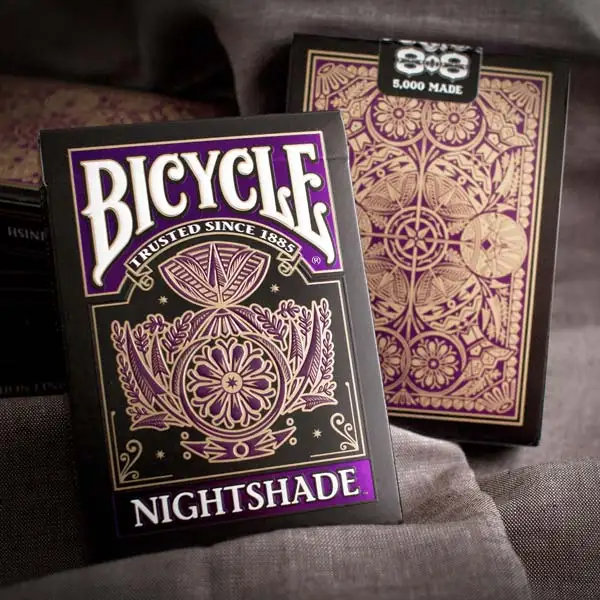
Image result for bicycle 808 nightshade

You can read USPCC's full account of its adventure here, which includes some interesting insights about the artistic style of this formerly-mysterious card design.

Thursday, June 1, 2017

Harry Haywood, Automotive Pioneer


"Can I make it any plainer?  Be original." Harry Haywood, M-U-M, 1916.  

Meet Harry Haywood, sometimes known, as reflected on his fine throwout card, as the "American Magician," also known as Hiram Haywood, William H. Haywood, The Illustrious Jarrell, William H. Jarrell, Harry H. Jarrell and, possibly, an exposer called Jarrell the Strong Boy.

Haywood was probably born William Jarrell, and became a well-known magician and ventriloquist, beginning his career in the 1890s.  He began his career performing in circuses, wagon shows and vaudeville theaters.   Reports suggest he had "sufficient mechanical genius" to build all of his own magic apparatus.  Haywood's skill with Cups and Balls was legendary.   Louis "Pops" Krieger, an undisputed Cups and Balls master, admired Haywood's talent, while Dr. Wilson called him "peer of all Cup and Ball performers."   Curiously, in or around 1900, Haywood had a son whom he named "Harry Kellar Haywood."

After the turn ot the century, Haywood settled in New York City.  He became a member of the Society of American Magicians shortly after its founding, eventually serving on its committee on admissions for many years.   An amateur astronomer, Haywood always travelled with a 3-inch Bordeaux telescope.

Haywood's claim to fame began in early 1919, when he loaded his magic act, usually carried by wagon, into an automobile for a two-year, cross-country tour.  According to Oscar Teale, Haywood's was the first magic show to tour by automobile.  Haywood drove a Ford adorned with the emblem of the SAM on both doors.

Though nearly a decade after Houdini flew an airplane in Australia, the magic trade press treated Haywood's motor vehicle magic tour as an adventure equal to the Lewis and Clark expedition. His own account of these experiences were featured in a dramatic M-U-M cover story tantalizingly entitled "Hell Gate to Golden Gate."


In the piece, Haywood details his experiences, which included several automobile accidents (including a crash with a street car that cost him $87 in repairs) and getting stranded in the desert.  He described performances in low-rent venues before brawling crowds.   Haywood describes being surrounded by a group of "gypsies . . . on a lone mountain road in Wyoming."  Brandishing a Winchester rifle, the magician faced down the group, while his wife Adeline  "stayed in the car with a Colt .38 automatic in her hand, ready to get .the first one that came too close to me."  The intervention of two highway patrolmen averted the couple's decision "to meet our defeat Davy Crockett style."

In the end, despite the hardships, the magician raved about the wonders of a tour which extended  "from the battlefields of Gettysburg to the Pikes Peak region; Salt Lake, the Temple, the big cities of the East, and over the beautiful Allegheny Mountains, through the many towns of the Mississippi Valley; across the plains, with its long,straight roads that reach the sky; the prairie dog villages; the mighty Rockies, with its range after range of towering, snow-capped peaks, the wild deer; the lone sheep herder; the desert, with its deathlike stillness; the sand, sage brush, coyotes, and wild horses, and the high Sierra Mountains,, the land of the sky and the camper's paradise; the Sacramento Valley, with its fruits and flowers—into old 'Frisco, with my car in good shape and still ahead of the game."  

The end of Haywood's story is a bit of a mystery, though it may involve yet another name change.  
In 1923, John Mulholland published a list of compeers he was trying to locate: Haywood was prominently featured on a list of SAM members, some of whom were presumed dead.   It is his last appearance in the trade press in the U.S.  However, that same year, the Magic Circular makes mention of an "H.W.F. Haywood, M.M.C." changing his name to "Hazel-Le-Roy," and references to that performer continue through 1928.    And there the trail goes cold....

From M-U-M, December 1918